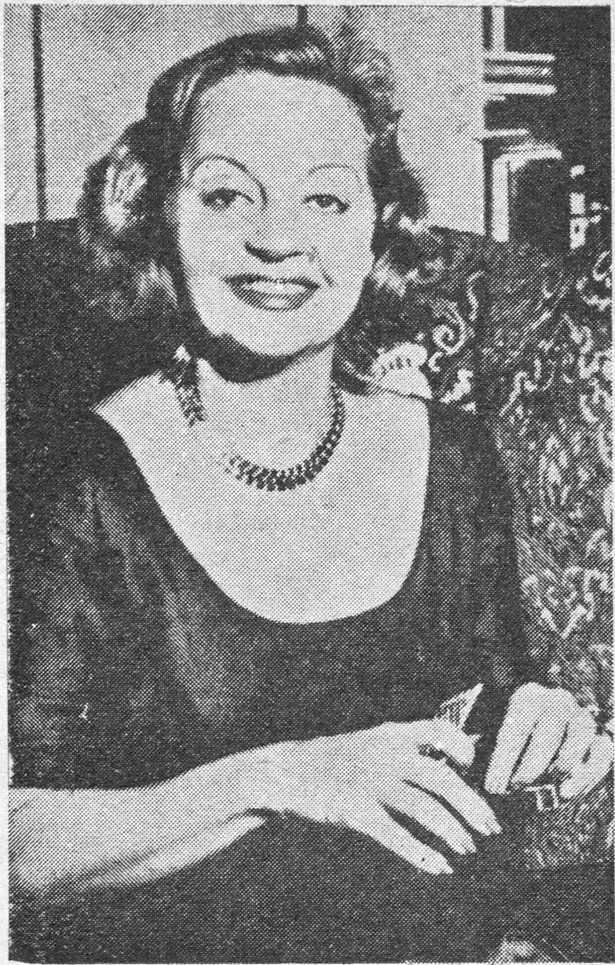
Tallulah Bankhead
recorded, took twenty aspirin tablets, and went to sleep contentedly awaiting the inevitable end! To her dismay she rose in the morning in the best of health, and this vexation was cut short by Noël Coward, who telephoned her, begging her to act in another play. Thus began the London period, which
lasted eight years and which Tallulah counts the best years of her life: in it she conquered the city and won the friendship of its great ones, above all the heir to the throne. The author recounts all this in detail, and speaks of the various plays she acted in; of the quips she let fall on this occasion and that, which have lived on and will live on after her; of what she loves in life and what she hates; of her opinions of this great man of the country and of that one; of her view of the Democratic Party, which she loves; and of the current rumor that she takes drugs (she declares the rumor a fabrication: all there is to it is that she took opium once, heroin another time, cocaine a third, and hashish a few times). And she recalls the tales of her loves, alluding to "the king of lovers," John Barrymore, who lost his round with her — a thing that rarely happened to him with anyone
else; and she confesses that she loved twice in her life: she loved Napier, that is, Lord Alington, and she loved another person whom she left unnamed because he is still living — thereby opening the field to conjecture, and there is no doubt that the coming months will see an abundant number of articles in which the writers try to lift the curtain from the unknown beloved.
So Tallulah discloses a great deal, but she does not disclose everything. And she herself feels that the reader expected her to hide nothing from him, and that he anticipated confessions beside which Rousseau's confessions would be nothing; and so she apologizes to him for having disappointed him, but says: "In deference to what good taste requires, I have not set down all my faults!" And she adds: "And what did you expect to read? Forever Amber?!" Yes — Tallulah has drawn the curtain over her bedroom, but she has stripped it from all her other rooms, without first troubling to tidy them.
Tallulah is a legend, and she is also a symbol — a symbol of the woman who defied environment and society, and did everything she wished to do, and succeeded in it, whether in the field of love or of art or of life. Not long ago a woman went to a psychoanalyst and began recounting to him her dreams and the symptoms of her nerves, and when she reached the words, "And yesterday I dreamed of Tallulah Bankhead," the analyst stopped her and said: "I understand. Yes, yes!"
•
The second book is entitled "Giant," by the novelist Edna Ferber. And if our first author has shone in the field of art and society, this author has shone, to a great degree also, in the field of the novel. In the past she published a number of novels that critics and readers alike received with much approval; then she fell silent for long years, from which she has emerged in these last days with the book I am leafing through in this hasty survey.
The new book has raised an uproar in the state of Texas: for the
giant to which the title points is meant to be Texas, in which the events of the novel take place, and some commentators hold that the characters of the novel are drawn from its well-known sons — despite what stands at the front of the book (as things customarily stand at the front of books): that all the characters are creations of the imagination, and any resemblance is mere coincidence! Among the signs of this uproar are seven successive essays published by a writer from Texas, in which he attacked the author and assailed her for having seen in the state nothing but a place where the inhabitants are base, the food is bad, civilization has been effaced, and money flourishes; and in his articles he laid on the bitter epithets in generous measure, describing the book as cheap, mendacious, spiteful, mean, wrong in its facts, tendentious, and so on through the like epithets. Another writer commented: Let the author rejoice and let the publisher rejoice, for the book will meet with great success in forty-seven of our states! And another said: Edna Ferber has declared that she does not love the Texas she writes about — let her be assured the feeling is mutual!
And in truth the book is entirely about Texas. It is a tourists' guide to that fabulous state — a guide the inhabitants of the state may themselves have need of, for it portrays their country as they have never known it. It is about Texas, where the dwarf stands six feet tall, and where the people are of two kinds: the rich millionaire and the poor millionaire. The author has deliberately set out to criticize what the state stands for, and to insist that wealth in itself is nothing; she makes one of the characters of the novel say: "Here in Texas we have the towering buildings raised on the vast prairies, but our thought is scanty and our civilization shallow." And she stresses that breadth of area does not mean greatness, adding: "Are sunflowers superior to violets because they are bigger?!"
In Texas there is an uproar, which