we inherited from the fifth and sixth and seventh centuries of the Hijra, transmitted by the books of the twentieth century and taught alongside the other books, which were composed to suit the mentality and the temperaments of pupils in every subject of instruction — except Arabic!!
It is a national and educational crisis, and we must hasten to find a solution for it. This solution will come only by way of a group of people who believe that there exists a problem far graver than most of the problems occupying the minds of the Arab world today: the problem of the remoteness of classical Arabic from our children. The first thing that must concern us is to make the language easy, by loosening its fetters and subjecting it to the scientific laws of evolution, which require it to draw its material and its terminology from the twentieth century and not from the first Jahiliyya; and that there be stripped from it this sanctity which the sheikhs of literature have imposed upon it ever since the coming of tolerant Islam, which drew its teachings from the reality of the people's life. And we shall never be able to spread the language in our schools unless we wipe out the reac
tionary mentality that distinguishes the teachers of Arabic and replace it with the mentality of the young — those who have studied the principles of education, believed that the problem exists, worked to preserve the precious literary heritage, and lived in the twentieth century..
Ladies and gentlemen, the Arabic language as it is taught in our schools kills the pupil's capacity to think and deforms his artistic taste, because the books imposed on pupils are pamphlets — misshapen offshoots of the old literary and linguistic tomes — containing every stray scrap of verse and prose passages, all chosen to display the splendor of badi' and bayan and the outlandish meaning. So the pupil, when he reads them and cannot relish their meaning — because he could not reach it through such a structure — the child is driven to take up the English reader, where he finds what delights and pleases him; and you see him reading about them, because if they are children, they think as he thinks, and if they are men, they realize his hopes and his dreams.
Would that those who hold the reins of the language understood that selection matters far more than the imposing of material which can
mean nothing to the child but a burden on his back, his duty being to memorize it because the teacher wants it so, and nothing more. It is our duty to reconsider the material that is taught, and to choose what is suitable in it — not according to the erroneous historical order, but according to a particular scientific law, the law of development: Jahili literature does not suit the mentality of the elementary pupil, nor does modern literature suit the mentality of the secondary pupil.
And then, for what purpose is Arabic taught in our schools? Has it ever occurred to our teachers to test how far their pupils savor the aesthetic value of a passage, or have they attended to nothing but the meaning of a strange word and its parsing — as if the Arabic lesson were demolition and not building, and as if the pupil read the passage for the purpose of explaining a difficult word!! or of knowing its place in the parsing? Explanation and parsing are a means to the savoring of the passage, not the aim of teaching.
Ladies and gentlemen: our children are far from our language — and it is the instrument of expression, the awakener of thought, and the refiner of taste.
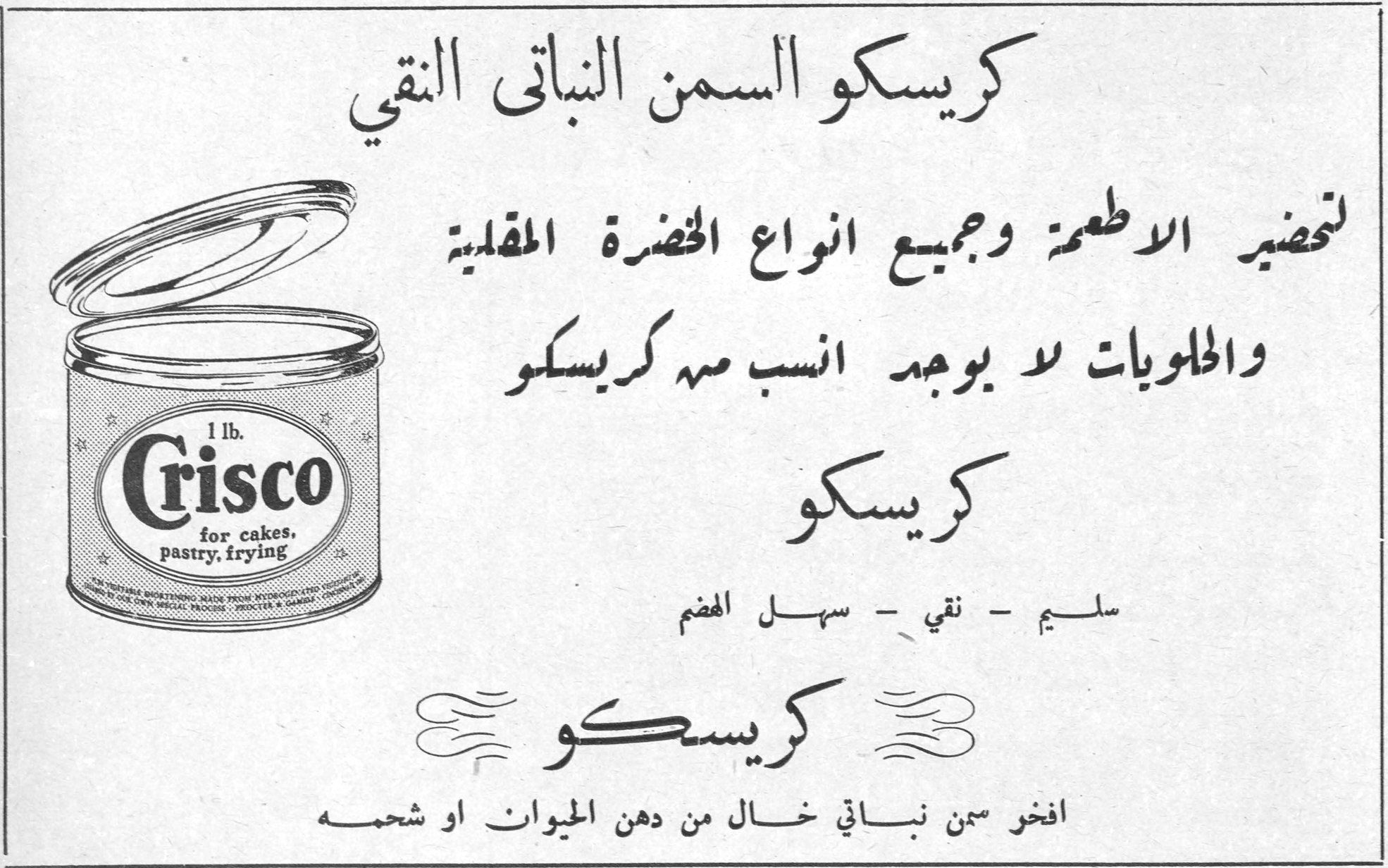
Crisco, the pure vegetable shortening
For preparing dishes and all kinds of fried vegetables and sweets, there is nothing more suitable than Crisco
Crisco
Wholesome — pure — easy to digest
Crisco
The finest vegetable shortening, free of animal fat or grease
1 lb. Crisco for cakes, pastry, frying