
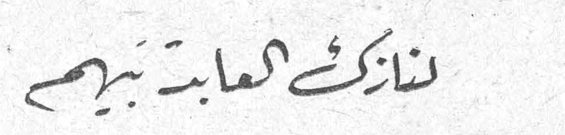
The Woman's Voice is pleased to seize the occasion of the Lebanese woman's winning the first fruits of her political rights, and it is glad, on the occasion of the anniversary of Lebanon's independence in this same month of the year 1943, to speak with a lady who was among the earliest to demand woman's political rights in our East. She is Mrs. Nazik al-Abid Beyhum; and to preface her interview with a piece published in the newspaper al-Nahar on October 5, 1949, by Mr. Salah Hasan Beyhum, on the occasion of the Syrian government's granting woman the right to vote. He said:
"Immediately after the end of the First Great War, the first Syrian government was formed. The number of Syrian girls left orphaned by the war's martyrs was not small, which spurred some of the worthy ladies of Damascus to work at founding a free school for girls. They chose for it the name 'Nur al-Fayha,' and elected a committee to manage its affairs, composed of: the Misses Nazik Abid, president; Fatima Mardam; Salwa Ghazzi; and others.
"Miss Nazik Abid saw the necessity of issuing a women's bulletin, so she brought out a monthly magazine which she likewise named 'Nur al-Fayha,' and she asked me to be its correspondent and agent in Beirut, and I complied with the request."
"At that time the Syrian Constituent Assembly was holding its sessions to enact the constitution of the state, so Miss Abid worked on gathering signatures for a petition from ladies and gentlemen, which she presented to the Constituent Assembly, asking that the educated Syrian woman have the right to vote for the state's general councils. She backed her petition in her widely circulated magazine 'Nur al-Fayha,' and wrote to me at the same time to work on getting a similar petition signed in Beirut to be presented to the Syrian Constituent Assembly. I recall here the names of some of those who signed it, namely: the champion of woman Jirji Baz, Nur al-Din Beyhum, Asaad Talhouq, Fouad Ibrahim Matar, Daoud Abu Izz al-Din, and others."
"Miss Abid presented the two petitions to the Syrian Constituent Assembly, but the majority did not approve it."
This is what appeared in Mr. Salah Beyhum's article. As for the interview which the aforementioned Mrs. Nazik al-Abid Beyhum granted us, it is as follows:
No sooner had the news spread, on the tenth day of November 1943, of the decision issued by Monsieur Jean Helleu, the delegate of France, dissolving the Chamber of Deputies and appointing Mr. Emile Eddé head of the government, together with the news of the arrest of the two Presidents and the ministers, and the arbitrary measures that followed, than Lebanon from one end to the other presented an appearance without parallel, distinguished not only by the intensity of its enthusiasm but by such unity of word that Mr. Emile Eddé could not find ministers for his cabinet.
As for woman, her stand in that crisis was an honorable one: she led the demonstrations, heedless of the tanks and of the violence resorted to by those who were slaves in face and heart.
The struggle ended with the victory of right over wrong and the independence of Lebanon. But that struggle left in the souls of men, as it left in women, a great deal of energy for work in the shade of independence, and several women's meetings were held with a view to building and to sharing in national and social services. I wished to make the most of this solidarity, and at one of those sessions I proposed the formation of a women's political party whose aim would be to continue
serving Lebanon on the political side, and to demand woman's political rights complete and undiminished. And while many of those assembled approved my proposal and supported it, the majority inclined to a view whose gist was that woman should confine herself to social works; and out of those meetings arose the Lebanese Women's League.
But the Lebanese woman did not in fact stop at this limit; she went on pursuing the struggle to obtain her political rights. Her Syrian sister's winning of the right to vote was a spur to her activity, until victory was hers at last; and she had many supporters in the machinery of government and in popular circles.
And how it pleases me that my husband has been one of her supporters for thirty-three years, since the day he backed my petition in the Syrian Congress, being then a delegate for Beirut, before I had ever had the good fortune to make his acquaintance. Indeed it pleases me still more that my husband has continued his endeavors along this path until now, and that his book "The Young Woman of the East in the Civilization of the West," which came out a month ago and which he distributed to most of Lebanon's statesmen by way of accustoming them to the idea of granting woman her political rights, went in it further than political rights, demanding also general equality in all social and legal rights. Yes, and he asked for her more than she asks for herself, when he called in this book for her to be partner in the man's earnings, in return for her devoting herself to the service of her house and his, her children and his, and in recompense for her application to the comfort of their common family. So my husband and I, as we congratulate ourselves on the victory woman has won in Lebanon, pin our hopes on her attaining also what she seeks of social rights, until no difference remains between the man and the woman, of whom together the complete human being is composed: for deeds are judged only by their completion.