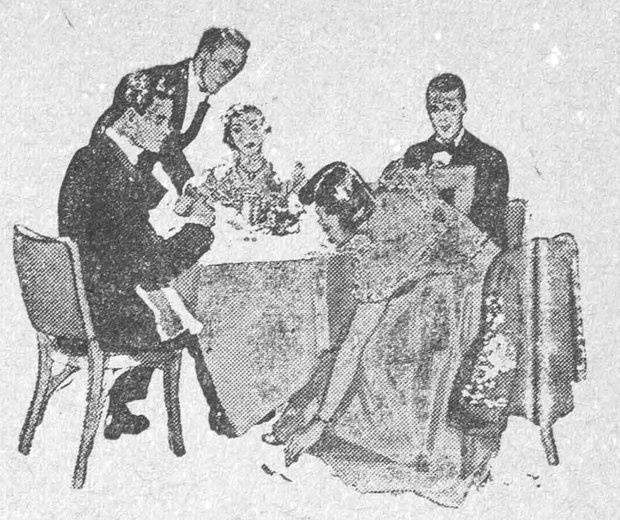
beware of showing any concern, or of lifting it from the floor. Calmly and composedly, ask the "garçon" to bring another; it is he who afterwards picks it up from the floor.
5 — If you suddenly feel, while you are eating, that there is a fishbone or a bone or a small stone in your mouth, do you cover your mouth with the napkin while you remove this thing from your mouth, or do you use your fingertips without casting a glance at it?
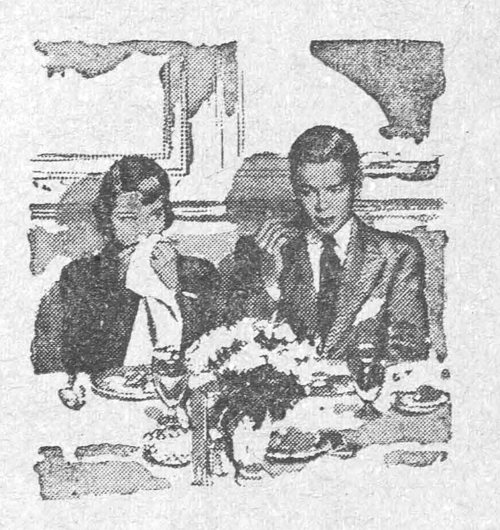
Answer — The best way to extract the bone or the fishbone from the mouth is by means of your fingertips, and without fuss; then you place it at the edge of your plate without any remark — and there is no need whatever to cover your mouth with the napkin.
These, my gracious reader, are some of the rules in the fundamentals of etiquette, or good manners, and we shall prepare a second set for you at another time.

There is no doubt that the modern theory in the art of raising children affirms that between the home and the nursery there is a close bond, for the nursery applies what the child learns at home. Therefore there must be complete understanding between the parents and the teachers, so that the direction given the child by the two sides may agree.
Is the nursery necessary for the child? What is necessary for one child may not be necessary for another. The only child in a family, for example, is in pressing need of the nursery to strengthen him socially, while the third child in a family, who has at home all the possibilities and means of expressing his feelings, is not in such need of it.
There is one observation the educators would like to make to parents, namely, that they should support them in urging the child to love the nursery, so that he comes to it of his own full will. In most nurseries of the better kind the mother is allowed to stay a little while with her child in the nursery, and then to withdraw with his consent, so that he may not feel the difference between home and nursery; the child is also allowed, at the beginning, to come to the nursery at other than the regular hours — and other indulgences besides, all of which aim at winning the child's affection, which strengthens his tie with the nursery and makes him eager to come to it.
Whoever considers the many benefits of nurseries will not wonder at their rapid growth in this age of ours. The chief of these are:
1 — Developing orderly habits in the child in eating, resting, and dressing.
2 — Accustoming him, thanks to play, to use his imagination and to express his opinions and his needs.
3 — Accustoming him to respect discussion as a means of solving problems and the like.
4 — Accustoming him to rely upon himself.
5 — Lessening his selfishness through sharing with his companions.
As for the general benefit of the nursery, it is to encourage the growth of each child's personality; and it and the home in which the child grew up aim at a single purpose, which is to direct the child toward the better — so each is a support for the other.