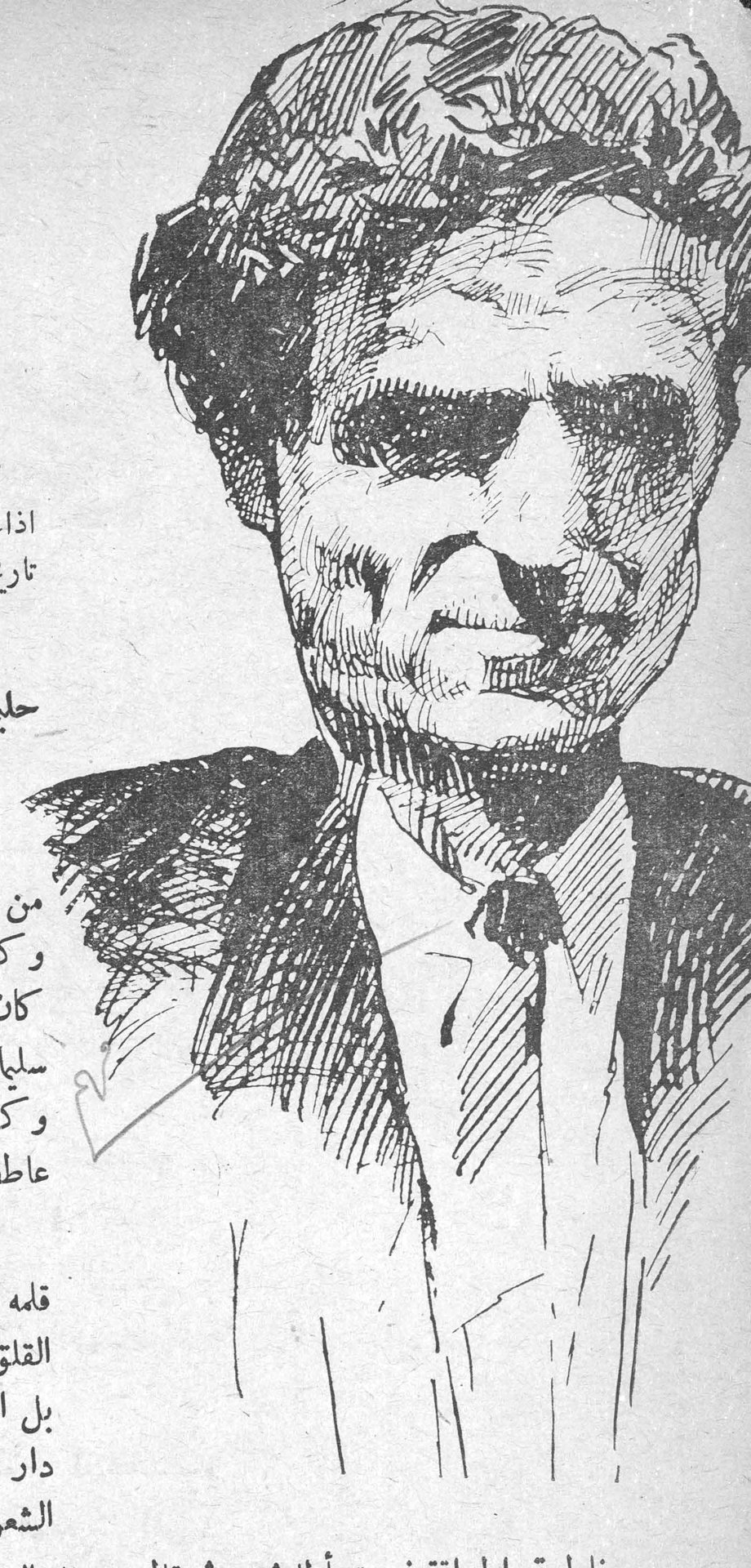
On the occasion of the passing of a full year since the death of the writer and poet Fouad Suleiman on December 14, the committee for the commemoration of the departed circulated to his friends and admirers a bulletin containing a summary of the committee's work during the year, a historical sketch of the departed's life, and press excerpts about him.
Mr. Marun Abboud delivered over Radio Lebanon the talk printed below, and Halim al-Roumi followed it with a concert of song in which he presented, from the departed's poetry, the two poems "Perfume" and "Straying."
Fouad Suleiman, in my view, is a poetic unity that cannot be divided: he is a poet in everything his pen set down, verse and prose alike. His verse may be like the verse of others, but his prose bears a stamp all its own, and his book The Moon's Path is a diwan of poetry with constituents and properties you will find in no one else. Perhaps this book, small as it is, is the best thing our young men produced in the period in which Fouad Suleiman lived. It is as if this writer-poet were an independent system in the universe of letters, with his own sun, his planets, and his stars, each swimming in its orbit. Wherever you come upon him, two traits declare themselves to you: a passion of devouring fire, and a word of heated iron.
He is the poet of pain and its writer. Everything we see on the tables of sorrows takes flesh in sentences written by his fiery pen. I never once saw him without picturing quivering quicksilver. He never settles into any state of rest; he is always poised to spring, as though inside him a coil turned horizontally. Half a smile — rather a smile like a sob — and a laugh that opens you no door of release. I have not forgotten the day I met him at Dar al-Makshouf and said to him: What is the whip of fire like, with which, as you
said, Abu Shabaka drives the poets?
He bowed his head like a tiger readying to pounce, then said: Like the whip you use on them in your criticism.
How quickly Fouad Suleiman became — alas! — words we repeat. The writer's greatest care is to become, on the morrow, words to which reciters and repeaters give body. Yes, this is the writer's kingdom, in hope of which geniuses die and with which they promise themselves. Fouad was among those who believed in the divinity of the letter. And he would speak the truth though the word burned his mouth, as the Lebanese proverb says. The word is the mainstay of life and the pillar of the edifice of humanity — indeed an unseen power which life teaches to those able to carry the message of truth.
That human mass whose name was Fouad Suleiman was a revolution in its own right. It was a storm hiding beneath its wings the smile of lightning and the guffaw of thunder. He and his fellow Abu Shabaka are twins, however far apart in lineage: form, temperament, and passion join them. Each of them sang his own heart first, and these turnings and summits second. Both were nurslings of the Lebanese village, which had a great share of their verse and prose. Fouad Suleiman's ears opened to the ringing of the bell swinging in the dome, and the playground of his boyhood was those flat threshing floors beside his house in Fiaa — that town crouching on the bald crown of the mountain. The poet played and frolicked in those sweet spots, and their images were stamped on his soul, later to be transmuted within it into splendid poetry, as the bee's kisses to the mouths of flowers are transmuted into honey.
And now: Fouad Suleiman left four works: a diwan of poetry; The Moon's Path; what he wrote over the signature "Tammuz"; and a book of literary criticism. These works, though they differ in subject, are one in spirit, in love, and in hatred. Fouad turned early to longing for the days of childhood and the haunts of boyhood, as if he sensed the approach of that unwelcome guest.
This writer was a fighter in The Moon's Path and