of painting pleased him.
He answered me: I believe that art must be human, universal, common to all, not the preserve of one class to the exclusion of another... This kind of abstract painting, which Picasso and his group have proclaimed, is understood only by a small class of people, or rather of artists, who have obtained a broad artistic culture and have then studied this particular kind thoroughly; hence it may be beyond the rest, the general run of people endowed with an ordinary artistic culture, to comprehend this kind and then to relish it... Art, in my view, must not be the preserve of one class to the exclusion of all others... Then, too, no painting is at bottom without this abstract element, though the artist afterwards adds to it what completes it; hence we may say, without being extremists or exaggerators, that this abstract kind is the alphabet of painting..."
My eye caught a magnificent canvas representing a group of women in Jabal al-Druze, bent over their jars, waiting their turn to fill them at the spring... In their glances was weariness; in their movements, meekness and resignation... Another canvas appeared in the opposite corner, representing these same women after they had filled the jars... They had gone off laughing in their delight; mirth spread over their faces and gladness overflowed from their eyes... The colors of the picture had lightened after being dark and somber, and its lines had opened out after being drawn together... And there was a third picture, and a fourth, and a fifth, all representing all manner of women in all manner of postures, dress, and places... Mr. Onsi had noticed a question mark peeping from my eyes, and forestalled me, saying: "Do you see now how I am woman's champion?"... And here a question leapt up which I saw no way of avoiding putting to Mr. Omar, so I said: "I have heard, sir, that Mrs. Saleeby has had a great influence in preparing this harmonious atmosphere, and that hers is the credit for inspiring most of your canvases — is that true?..."
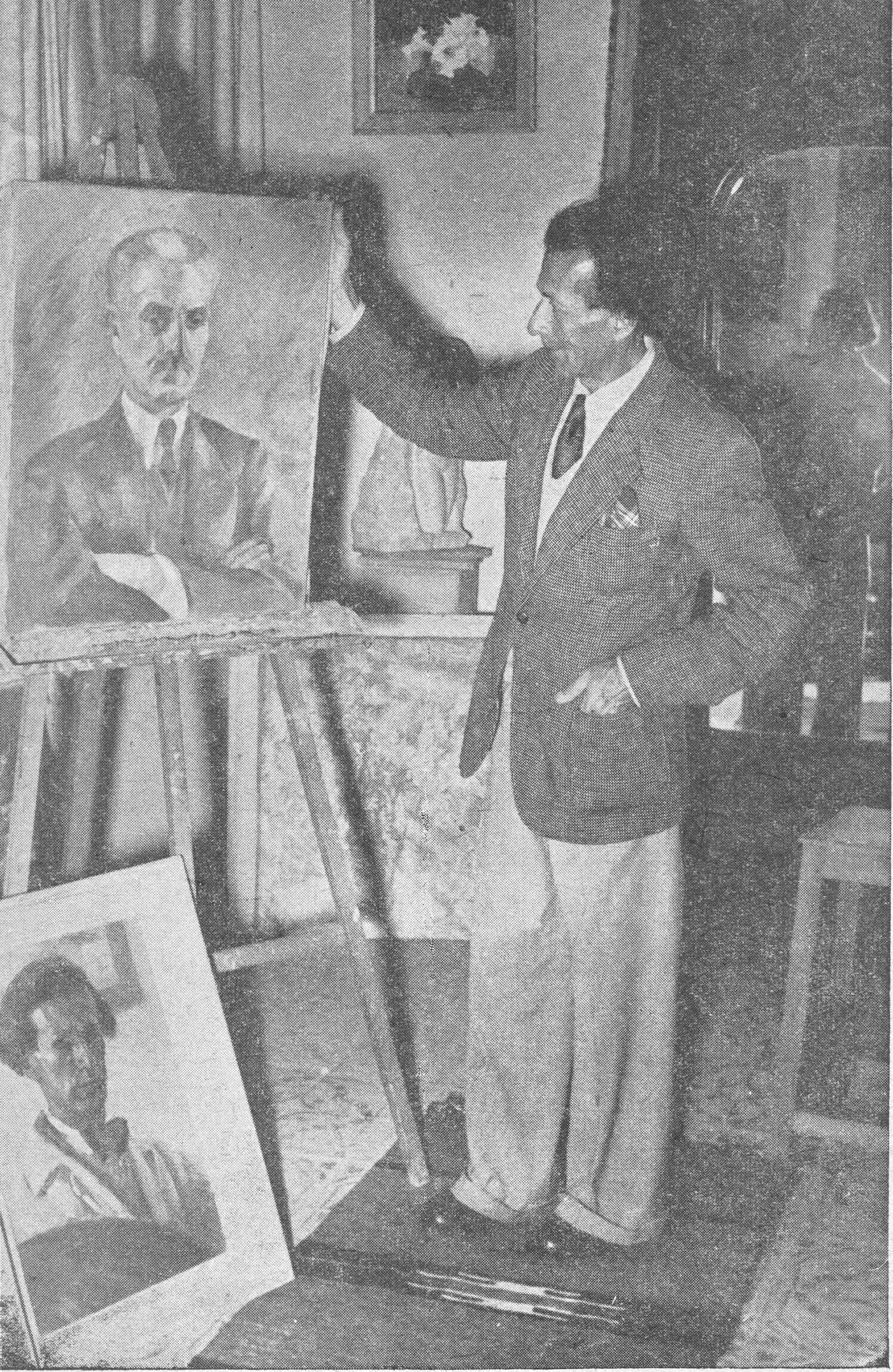
Lebanon's foremost sculptor, Youssef Howayek, believes Onsi to be the best of our artists; the two are the only artists on terms of complete understanding and unbroken accord, and Howayek has often spent days and nights at Onsi's. During these visits Howayek carved statues of Onsi and of some members of his family, and Onsi painted his sculptor friend. In the picture we see Onsi displaying his drawing of Howayek, with one of the sculptor's statues behind him.
I realized that I had uttered the name "Mrs. Saleeby" in error, when I had meant to say, of course, "Mrs. Onsi," and I went on apologizing in confusion; whereupon Mr. Onsi only burst into a laugh that quieted my alarm, and I was astonished when
he said: You were not mistaken at all... Mrs. Saleeby had a great share of credit in directing me, and her husband
a greater share still; it was those two who steadied my steps in this field, back when I was studying at the American University of Beirut