• The Zahra Literary Circle opened its new literary season on the evening of the sixteenth of December. At that session Dr. Omar Farroukh delivered a paper entitled "Historical Education and Its Effect on the Life of Peoples," in which he explained the role of traditions in the evolution of nations. There followed a heated discussion in which Messrs. Ahmad al-Futayyih, Wasif al-Baroudi, Dr. Sami al-Dahhan, Munir al-Rayyes, and Ahmad al-Hanafi took part, along with Miss Inaya Ramzi and Mrs. Thuraya al-Hafez.
• On the eighteenth of December the Syrian Arts Society invited guests to a literary and artistic session at which Dr. Jawdat al-Rikabi, professor of Andalusian literature at the Syrian University, presented a literary talk entitled "In the Embrace of Andalusia," in which he explained the spiritual refinement in lyrical literary production. Then the Andalusian muwashshahat troupe presented selections of that art, after which the great poet Abu Salma al-Karmi offered, from the overflow of his lyric and patriotic letters, delicate and beautiful poems that were received with the utmost approval and rapture. Miss Nahida Attar also presented on the piano pieces of the world's classical music.
• Mrs. Wadia Hourani Makdisi left us for the United States on the 27th of last month to deliver a series of lectures in American institutes and organizations, lasting seven weeks, in which she will treat the questions of the Middle East as a whole, and speak in particular of Palestine, the Eastern woman, and the renaissance the lecturer has witnessed over the course of twenty years.
This journey Mrs. Makdisi undertakes at the invitation of the society of the American Friends of the Middle East. The society had earlier sent, for the same purpose, an Egyptian delegate, Mrs. Hussein, and from time to time it sends certain American personalities to visit the Middle East
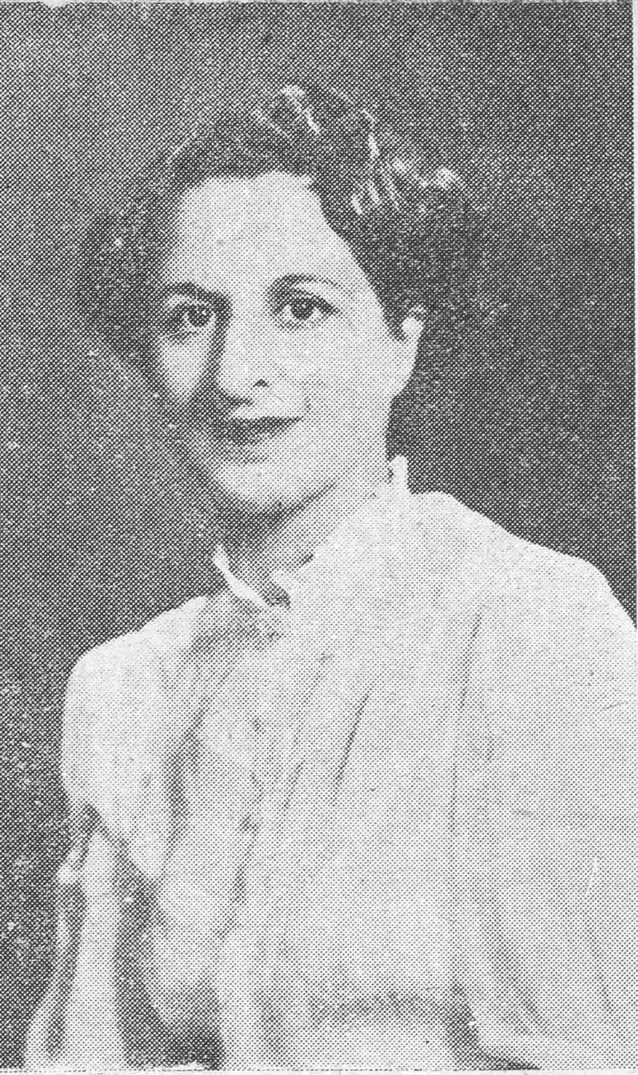
Mrs. Wadia Makdisi
and to acquaint American public opinion with its true condition.
Mrs. Wadia Makdisi will conclude her lectures on March 21 and pass through England to visit her father, and is then to return to rejoin her children in Beirut shortly before the glorious feast of Easter.
The magazine The Woman's Voice hopes that Mrs. Makdisi will succeed in her delicate national mission, so that her voice may rise high in uncovering truths most of which have until now remained buried and obscure.
• In the past two days the newspapers of the capital have carried a report to the effect that the Ministry of the Interior has submitted to His Excellency the President of the Republic a decree appointing the members of the Municipal Council of the city of Beirut.
The report confirms the rumor that the list submitted contains four ladies, representing most of the Lebanese communities. They are: Miss Ibtihaj Kaddoura, Mrs. Laure Tabet, and Mrs. Ellen Rihan; as for the fourth member, she is Mrs. Najla Saab, though certain obstacles still stand in her way...
Believing as we do that the Lebanese woman not only equals man but surpasses him in familiarity with municipal affairs, we hope that she will accordingly render to the Lebanese capital practical services which her predecessors have neglected; that this gracious gesture on the part of the Ministry of the Interior will be a good omen for an era in which reform and renewal prevail; and that woman will prove, to those who doubt her capacities, that she is worthy of every equality and every esteem.
• Among the news of the activity of the Cénacle Libanais is the lecture of Mrs. Emily Fares Ibrahim on the subject: "The Heart of Life through Memories." Her talk was a talk from heart to heart; it charmed hearts, awakened feelings, and opened before the imagination, the mind, and the spirit of the listeners beautiful vistas drawn from "the heart of life" — truly, vistas which none but those of quick wit and alertness of heart perceive.
In her talk, Mrs. Emily Fares Ibrahim knocked at the door of memories, the memories of life itself, and began to lay bare before her audience of listeners pages she had been keeping to herself between the two covers of a deaf, mute envelope.
She began her memoirs with the newborn — and the newborn is her son — how is she to guard him from the dangers of life encircling him?
And childhood is a second link in the chain of life, following birth...
After treating, in her fourth and fifth memoirs, the harms and evils of war upon the declaration of the Second World War, the lecturer passes to the most delicate aspect of the aspects of life, namely the problem of youth, the hardest stage of life's stages.
Thus the lecture of Mrs. Emily Fares Ibrahim at the Cénacle Libanais was new of its kind, treating the subtlest of deep