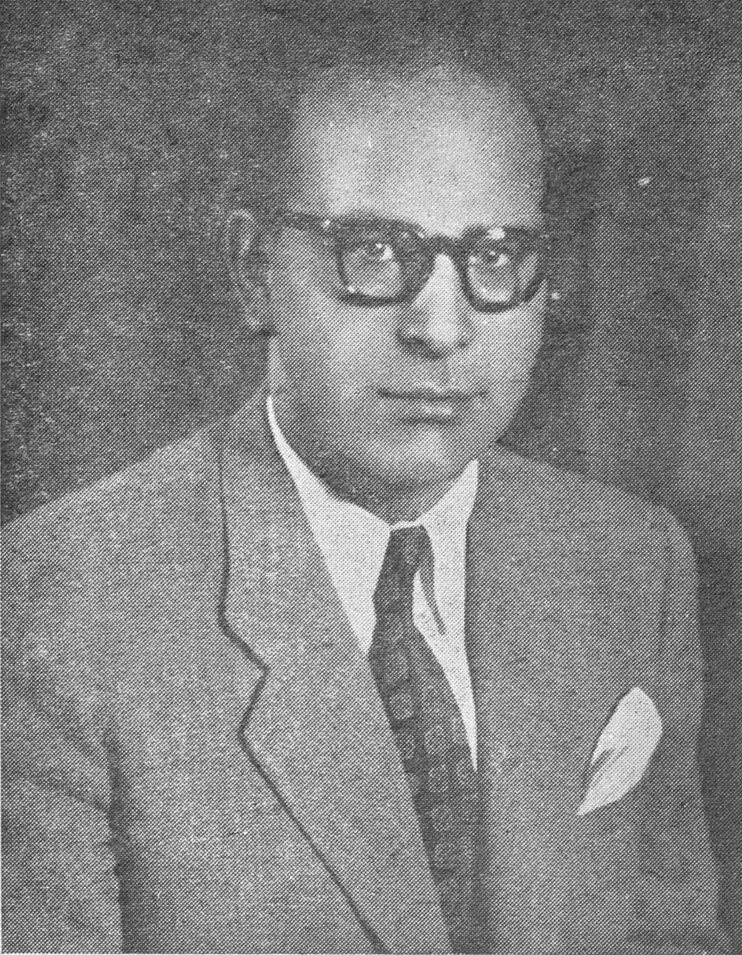

Minister of National Education, Public Health, and Social Affairs. An inspired poet, and a cultured, patriotic young man who handles the affairs of his three ministries with the wisdom of elders and the resolute awareness of youth. (*)
Q — Is Your Excellency one of the poets of the modern schools, or do you prefer classical poetry to them?
A — I object to the form of the question, for the school does not create the poet; rather, the true poet is the one who creates a school. And "the classical school" has become a general, vague term, which must be defined. I am a poet of renewal, but I keep faith with the spirit of the Arabic language and with its foundations. Renewal is a duty, in meaning and in form, on condition that we preserve the base — which is that we write Arabic, not a foreign language in Arabic letters.
Q — What is your view of the fate of the rising Lebanese generation, pulled this way and that by multiple intellectual currents? What practical means do you propose for drawing together the points of view that these currents create?
A — The multiple intellectual currents that pull at the rising Lebanese generation are a natural result of Lebanon's passage from the Mandate to independence, of its literature's passage from imitation to creation, and of the openness of Lebanese society to the ideas of the world. Drawing points of view together is not done by rebuke, nor by favoring one idea and championing it; it comes by way of studying these theories and putting them to the touchstone of the test. And I believe that the mission Lebanon has borne since the earliest ages — the mission of liberty and understanding — is sufficient to ensure that all tendencies will, in the end, be refined in its keeping into a sincere desire to serve thought and truth.
Q — A quick glance at our students' capacities in the Arabic language reveals a painful truth: these students find the foreign language — English or French — the easier, and throw themselves into studying it and going deep into it. As for our students who take up the learning of Arabic with longing and desire, they are a tiny few, whom special circumstances have surrounded. What, in your view, are some suggestions for endearing Arabic to its children and strengthening them in it?
A — The problem of the Arabic language, like all thorny social problems, is a problem of love. We must cultivate in our children love of the Arabic language, its literature, and its heritage, so that they take to it first from the motive of love, not from the motive of utility nor from the motive of ease. This does not prevent the scholars of the language from continuing their efforts to make the methods of teaching easier. And Arabic, contrary to appearances, is developing toward ease: all the archaisms and anomalous derivations are disappearing one after another, new terms are being created, however slowly, and the general rules are becoming consolidated. And general taste — the taste of the people, or of the ordinary reader — has a great influence.
"The Woman's Voice" Questions Our Leaders of Thought
As for suggestions to endear the Arabic language to its children, they consist in following all the means the Westerners have used to endear their own languages: selections from easy Arabic literature, rich as it is in maxims and anecdotes, with explanations brought close to the understanding; the printing of books at reasonable prices; a turn toward school series in Arabic literature; and the enlisting of all the means of publication in this — the press, the radio, the phonograph record, the theater, the cinema, and the rest.
Q — There are those who say it is necessary to delay the introduction of a foreign language into the school program until the fifth elementary grade, when the student has gained some command of his Arabic. Do you support this view or oppose it?
A — The matter is relative; it depends on the method of teaching Arabic. I find no objection to introducing the foreign language from the very start, on condition that Arabic be given the first importance, so that the varied readings are in it, and the foreign tongue is a language and nothing more.
Q — What are the reforms that must be brought about in the Ministry of Education so that its schools reach a standard worthy of all our children?
A — The reforms are many, and they are of two kinds. The first is easy: it concerns the organization of the affairs of education and of educators, and the related material interests of officials and of those concerned. Legislative Decree No. 25 has accomplished most of these things; what remains is application, and that is a continuous labor.
(*) These questions were put to His Excellency before woman obtained her absolute political right.