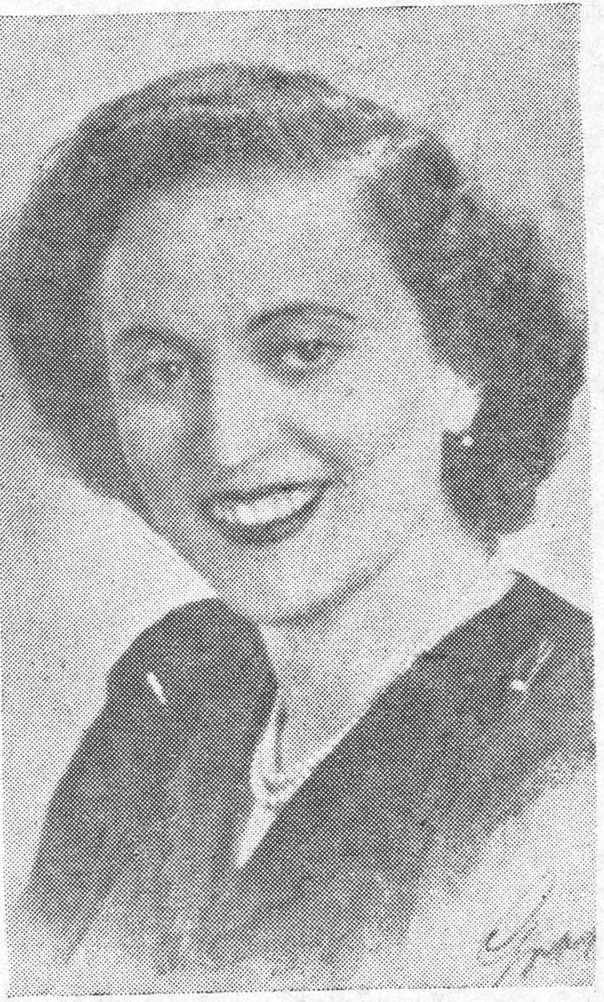
"I am a queen inside the house, and the man is a king outside it." "If our young men expended in their own country the energy, diligence, and work they expend abroad, they would not need to leave the homeland." So says Mrs. Alice Nahhas
In the days of the Arab woman's renaissance, people were apprehensive of this awakening and feared that the fabric of the family would be shaken or collapse. But the wakeful woman, who knew that eyes were watching her and that doubt enveloped her, has given the best possible proof that every role in life has its hour and every work its season; and she never once forgot that her first role is her home and her family, and that her loftiest work is the service of the homeland through raising the rising generation soundly. Here is a woman who has done her duty in life even as she has kept her rights from it.
On a clear morning I set out with a friend of mine for a house which, the moment one enters it, takes one with its fine order and elegance, and with the beauty of the refined artistic spirit that rules its atmosphere. This house is the home of the Honorable Adib al-Nahhas, and the gentle womanly taste that presides over the furniture and the pictures, over the flowers and the arrangement, is the taste of his wife, Mrs. Alice.
Her smile had gone before her to receive us, and her conversation ranged over all manner of subjects until we came to the countries she had left a few months before,
where her husband had been our Minister Plenipotentiary — I mean Argentina, Chile, Uruguay, and Paraguay. After ample discussion and talk, I was able to record something of Mrs. Alice's admiration for the life of the Argentine people in particular; she is very proud that many of their customs are no less fine than some of what we have here in this East.
As for woman and the family in Argentina, Mrs. Nahhas answered, saying: "Argentina has enjoyed her independence for nearly a hundred and fifty years, but only this year did she give woman her political rights — not because the people do not value
woman, but because woman herself feels that she has duties far more important than the exercise of these political rights. The greatest credit for giving woman these rights belongs to a woman who was not like all other women: Argentina's late lamented Mrs. Eva Perón, who raised the standing of woman in particular and of the citizen in general. In the national field, political and social, she played a great and weighty part, and she left behind her a name of gold and a flame of light that will not go out.
Then Mrs. Alice asks: "If we raised the new generation on love, equality, and understanding, would we not, I wonder, arrive at what these rights give? Is that not sounder and better than instilling in their souls partisanship and politics and the withering they drag behind them? I am not against these rights — let woman obtain them and stand equal with the other women of the world — but I want the woman citizen not to make this her sole aim in life, for there are many important matters, if I do not say matters far more important. For I feel that I am a queen inside the house and the man is a king outside; if the man fulfills his duties, and the woman likewise, and we then join these services together, we attain perfection."
"Woman belongs to her home and her children. My son, for example, asks me every day a question that never changes: Mama, will you be at home at lunchtime