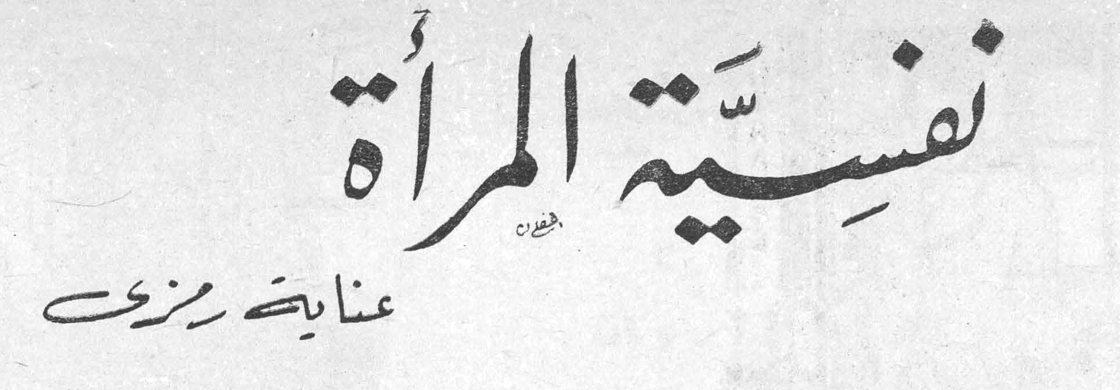
Last month Miss Inayat Ramzi delivered a valuable lecture at the Young Muslim Women's Club on the psychology of woman, and on the paths by which man may reach the hidden depths of that "human riddle" which has stirred his perplexity since the most ancient ages. In fulfillment of our promise, we here convey to our readers excerpts of the most important things said in this lecture.
A wise philosopher was asked about life, and he answered: a man and a woman — if they wish to live in paradise, they live in it; and if they wish to live in hellfire, they take the shortest paths to it. Knowledge of the nature of life, then, comes through knowledge of the nature of its two poles: woman and man. And knowledge of the nature of the human soul is the fundamental condition for the attainment of happiness, and the only means of avoiding the causes of misery and disappointment; for man is the great problem — not man insofar as he is an animal, but insofar as he is soul and mind.
If we leaf through the history of human thought from the age of Socrates to this day of ours, we find that thinkers have not given material nature the care they have given the problem of the human soul. And I devote my talk especially to woman — woman, of whom man has declared that he can know her as mother or sister or friend or wife, just as he knows a man as father or brother or friend or son. Yet he has gone on insisting that woman will remain a riddle so long as life lasts; indeed, some among them have claimed that he who tries to uncover her depths is like one who wanders the trackless wilds, and some have claimed that were the riddle of woman ever solved, her secret would stand revealed to man and he would lose all appetite for her.
And Nietzsche said: "Everything in woman is a riddle, and this riddle has but one key: motherhood." Yes — the psychology of woman is formed around an original center, which is motherhood, about which gather, in varying degrees, the secondary elements, which may be summed up in the trait of self-regard, and which are in my view as essential to the spirit of motherhood as the existence of the center itself. I shall devote my talk to these secondary phenomena, in which she resembles man to a great degree, because they express human nature. It is self-evident that physiological factors, and cultural and social factors, influence the psychology of woman; but I shall set these factors aside, precisely in order to form an opinion about the constancy of certain psychic occurrences in the nature of woman — that deep-rooted, native nature — through the succeeding civilizations, before the hand of culture takes them up with refinement and ordering.
The psychologists say that woman is more easily
stirred in her emotions than man, and they trace this back to her physiological nature. She passes swiftly from one state of feeling to another; and Victor Hugo likened woman to the weather, which on a given day appears clear and sunny — then the sky darkens, the storm rises, and the rain pours down. This is one of the pictures of woman in her contentment and her anger, in her hours of gaiety and in her times of sorrows and pains.
Mr. Fikri Abaza says that woman is a double personality by force of nature, not by acquisition, and that however hard you strive to uncover the secret, you fail. As for me, I say that the human personality in general — in woman as in man — is not, as the philosophers fancied, composed of a simple, essential, fixed core; rather, man is a composite creature of many personalities; the threads of personality are intertwined, and its manifold feelings are beyond counting. A human being is not content with a single color of life to live; personality multiplies within him with time and circumstance, and by it his life moves toward the growth and cohesion which are the goal of human life.
And there is a corner of childhood in her make-up, just as there is another portion of it in man: her leaning toward tears when she lacks a proof. And woman is of the breed that dreams even in the fullness of day; many of them soar on their wings in the heaven of imagination to dream of the happiness her heart paints — and what dream is lovelier than that she should have a heart aflame with wishes and hopes, and in that heart her world and her paradise!
The memories of the past may set her ablaze, as do the dreams of the future. And woman, like every living creature, is marked by self-interest — and selfishness shows plainly in both sexes alike. Though she prefers to love one man and to spend herself in faithfulness to him, it does her no harm that another should admire her; yet it grieves her — nay, it enrages her — that her man should sing the beauty of another woman, even were the one who voiced that opinion a person of no concern to her whatever.
It is this defect of character that has bred in her the feeling of jealousy; and it is this, too, that moves her to wrath against whoever attempts to wrest away what she regards as a right, whether natural or acquired. Perhaps the root of this selfishness is the instability of her personality: she finds that however high her station rises, she remains perplexed and anxious. Woman needs something to affirm her self to her. And in truth, praise finds favor in the eyes of men and women alike.
It is selfishness that drives woman to bargaining and to the settling of accounts in everything. Woman wants of man that he think of no one but her, even