Personality of the Month
"There is no intellectual or social emancipation for woman so long as she is not materially emancipated, supporting herself without depending on the wealth of her father or her husband."
"Every mother has ample time to carry out all her duties toward her children. All she needs is to know how to organize her time."
"I want woman to be a complete human being who thinks with her own mind and acts as it dictates to her; for true maturity and sound thinking come to us only by way of learning and knowledge."
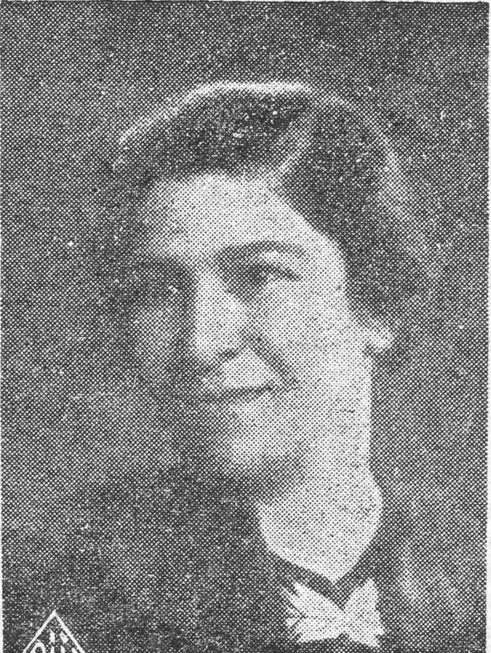
Dr. Saniya Habboub Nakkash stands in the front rank of Lebanon's women physicians, and she was among the first who called for the girl to go out into the field of work and to share with man the burden of the responsibility of married life. She took up the study of medicine at a time when her companions among the daughters of Lebanon still made their houses their shields and sheltered behind the veil from the glittering appearances of society. While still a young girl playing in the innocence of childhood, she felt that she had a duty she must perform; for she never ceased to see that the girl's material dependence on her husband or her father had made of her a cheap bondmaid in his hands: he gives her his material protection and asks of her in return that she submit to him, act by his opinion, and be to him a driven slave, not a free-choosing partner. She felt this yoke under which woman groaned, and she worked hard to draw her out of the depths of darkness, having come to believe in woman's ability to keep pace with the caravan of civilization if only the chance were given her. And the child Saniya Habboub always took the leader's part in all the games with which the girls of her sex and the companions of her age amused themselves; so she grew up seeing before her nothing but the president's chair, in the belief that a girl's ambition ought to be bounded by nothing in the world!!
I went to her torn by all manner of feelings. How would she receive me, and in what way would she answer my questions? Could I really manage to
talk with her? — she for whom I had drawn in my imagination a beautiful picture, whom I had wrapped in a halo of shining light and made a model of daring and boldness. But I found myself in the presence of a complete lady, who opened her heart to me and poured out upon me such gentleness that I felt ashamed of myself and disowned the creeping of those black thoughts into my mind. I sat with her in the office of her clinic, surrounded by her various diplomas, which she has hung on the wall to bear witness before her visitor to that unfettered spirit which went in pursuit of learning and knowledge before any other girl of her sex.
Q — Tell me, madam, about your first steps in life?
A — I grew up, miss, thinking of freedom. I saw the difference in the treatment of boy and girl, and I felt that there is no intellectual or social emancipation
for woman so long as she is not materially emancipated, supporting herself without depending on the wealth of her father or her husband. And so I went after a profession. A girl's dependence on man requires that she give him something in exchange for the material things he bestows on her, and the least that can be said of this something is that it is submission, or total effacement in his hands. The beginning of knowledge, my girl, starts with a person's serving himself, and the sensible individual is the one who does all his own work without leaning on anyone. Determination decides everything: if one of us sets his mind on a thing, he is bound to reach it, however many obstacles cross his life. And had I not become a doctor, I would have chosen for myself any other profession that would help me to material independence.
Q — Some say that the woman who practices any profession sometimes falls into what they call the "sense of guilt," feeling that every harm or every shortcoming that occurs in her house has its source in her absorption in her work and her turning away from the care of her home. Do you agree with this view, and has anything happened in your own life to support it?
A — Never — quite the contrary: there was a feeling of greatness, a sense of pride and of standing tall. And to prove this feeling I went forward into marriage, so as to show everyone that the woman with a profession can combine her profession with the demands of her home... I worked, and still work, night and day, in my house and in the care of my patients. I carried a child and gave birth without breaking off from work for a single moment. I buy all my household supplies myself, and to this very day I remain without a cook or a nurse for my daughters. And I have been able to find the fitting time for everything. I am proud to say that woman is a complete, working creature, who does not consent to be waited on by anyone. A feeling of divinity floods the human heart when a person sees himself standing independent in his