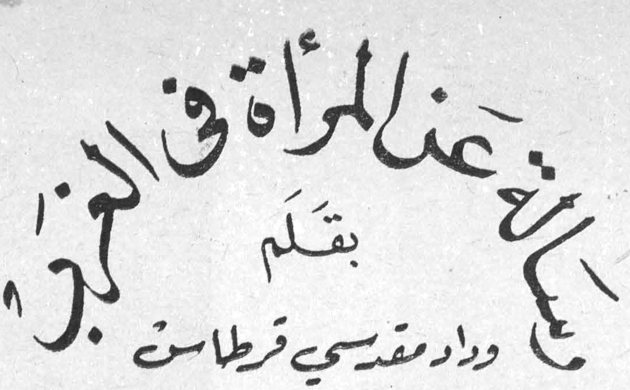
I have been, and still am, one of the admirers of the woman of the West, ever since the day I first knew her as a pupil on the school bench, earnest in her daily work, driven toward duty with a firm will and a sure resolve.
Last summer it was granted me to know her at close range, in her wider social setting, and to touch the rare effort that feeds this vitality and secures this flood of positive production which she accomplishes alone.
And I should like now to repeat what I have tried to say, over and over, to my pupils in the twenty years gone by: that there is no progress in any society whatsoever unless the wise woman employs her whole vitality for the good of all.
I saw with my own eyes how the woman in the West has a mission of defined aims and ends, built upon firm supports of strong human principles; and I grieved on the day I became certain that we — we women of Lebanon in particular and of the Arab countries in general — have no mission. No mission of ours embraces the vital activity we try to carry on. Each of us works in her own private circle, and each struggles for her own meager portion. But the greater, unified program is missing, and far from our sight.
The mission of the woman in the West is a comprehensive, general mission: it takes to heart the greater national order and works with all the strength given her to safeguard that order.
We can ask no greater sacrifice than the one made by the woman of England on the day she consented to free herself from her material demands in order to secure for her country a stable internal sovereignty.
And today, after no short time has passed since the events of the crushing war, she still submits to rationing and observes a stern economy in her wants. She wears only what is woven in her own country, eats only what the workman produces on her own soil, and will not reach for anything, however much she may need it, if
in doing so there is harm to the working hands of her homeland.
She has learned not to love silks, because they are not woven in the country's mills, and not to crave the articles of ornament and adornment, because they are imports from abroad. She has learned that her country's industry is the best of industries and its institutions the best of institutions; and so she has contented herself with the necessities of bodily existence, that the homeland may go on enjoying freedom, mastery, and independence.
The woman in the West saw the necessity of not living at a level that stirs envy and jealousy in the people of poverty and want and creates an atmosphere of rebellion and revolt in the greater society. Yes — this is what the stranger feels today even in the aristocratic circles of England. And the truth of the matter is that there exists an aristocracy of mind, of culture, and of art, not an aristocracy of lineage and birth; an aristocracy of noble, steadfast deeds, not the aristocracy of the vanished order.
All this came as the result of the Western woman's acceptance of present conditions and of her frank liberation from the bondage of matter. Were not these the factors — or the fundamental cause — in preserving the family from collapse?
The mission of the woman in the West is a mission of confidence in herself and in her capacities. She learned early to rely upon her own will, to perform her duties without the help of a troop of men about her. She learned that she has her own bounded world, and that she can be its mistress if she keeps within it order and arrangement; so she took to thinking for herself and to relying upon facts — and whoever relies upon facts need have no
fear of being shaken. She is not flustered when responsibilities pile upon her, not terrified when she faces events and calamities, not afraid when the strokes of fate fall on her. She is a mighty one, who meets life with calm nerves, poise, and reason — not with a wild, clamorous emotionalism and a violent inward confusion.
This is what I saw with my own eyes, when I touched the mark left by the hardships and events through which the woman of England passed during the last war.
And today, though no little time has gone by since those events, she still accepts harsh regulations, because the higher interest of the country demands it.
She learned the greatest examples of self-denial and the sternest kinds of economy in dress and food, and she created around herself an atmosphere of stable spiritual values, as she threw herself wholly into tangible, useful works.
How happy is a country whose women know that the most important things in existence are not measured by the naked eye!
Some thirty-five years ago, Europe was holding celebration after celebration to honor the greatest woman of science our age has known — I mean Madame Curie. It happened that in the course of these celebrations this scientist's attention was drawn to the gleaming jewels on the breasts of the aristocratic women of Paris. When she returned to her humble house, her husband said to her: I noticed that the sparkling diamonds on the women's breasts caught your attention more than usual, and I have always known you to be indifferent to such worldly things. Madame Curie answered him with the simplicity and quickness of wit for which she was known: I was counting every stone and every piece, and reckoning their enormous prices, and wishing that one day they might be gathered up and sold, and with their price laboratories and hospitals and houses of learning be built — and that we might buy an ample share of radium,
to ease with it the diseases