If you fall on your knee and cut it badly, do you wash the deep wound with soap and water, then swab it with a sponge tinted with tincture of iodine, then bandage it? Or do you cover the wound with sterile gauze and hurry to the doctor?
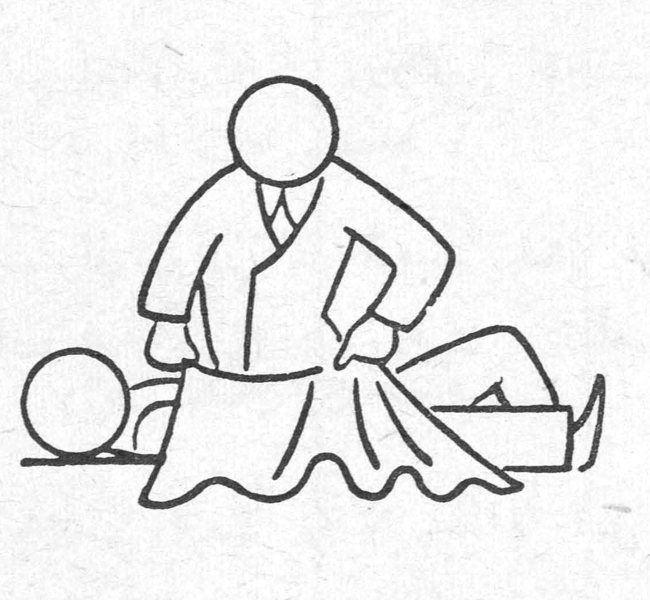
If you enter one of the rooms of your house and find a member of your family lying on the floor unconscious, do you sit him up and try to pour some liquid down his throat, or do you stretch him out on the floor and protect him from the cold until the doctor comes?
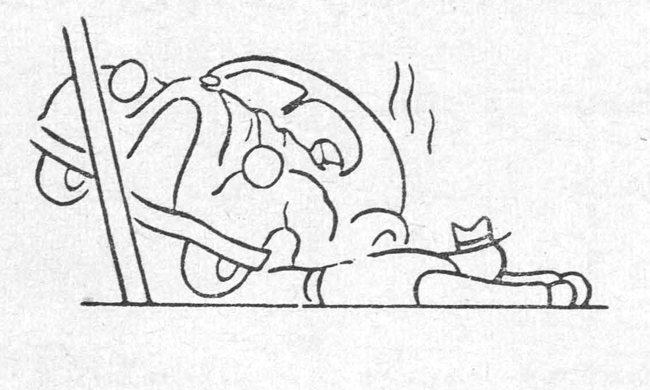
If you come upon the owner of a car lying beneath his overturned automobile, do you try to drag him out from under the car, or do you hurry to summon help to lift it off him?
What you do at such a moment does not merely save the victim's life or destroy it: your own success hangs upon this act of yours. It is therefore essential that you make certain you know what must be done and what must not be done.
Do these things first
If you wish to attend to the victim of a motor accident, attend to it with precision and tact. If you know what you must do and do it well, sure of yourself, the onlookers will not interfere — for the common proverb says, 'Too many hands burn the food.' This proverb applies to the motor accident. If you feel there is any crowding, send one of the onlookers to fetch a doctor, and to tell the victim's family exactly where the accident took place.
First: study the condition of the injured person and the position he is in, the possibility of further harm coming to him, and the question of his exposure to cold and damp. Remember that what you
are doing is only temporary, and the help you render him depends on keeping the sick person quiet and protected until medical help arrives. Do not raise his head; persuade him, if he comes to, not to raise his body; induce him not to move until the doctor has seen him. Do not let him move without a necessary reason.
If you have made certain that the person is suffering from shock and is not ill, examine him briefly for any bleeding, or a broken bone, or one of the signs of poisoning. If he is bleeding profusely, or one of his bones is broken, or he says he has been poisoned (or the look of his mouth makes you believe he has), or if he is burned, or if his breathing has stopped, you must attend to these things first. And if none of these signs appears, it is wise to assume that the case is one of shock only.
Immediate attention to shock
Most shock in acute injuries is caused by the various mishaps that befall a person; shock itself is the condition in which the organs of the human body, or its activity, are in a state of depression or despair. And these are the signs that can be observed. First, the person's extremities grow cold, the color of his body turns pale, and the eyes lose the light of life. Then weakness sets in in the sensitive organs. The pulse quickens or weakens, breathing grows faint or becomes irregular, and nausea and vomiting may follow.
Every one of us in this life is exposed to unexpected accidents that strike from time to time without his being able to avoid their occurrence. The following instructions must be carried out before the doctor comes, for this means the difference between saving a life and destroying it.