
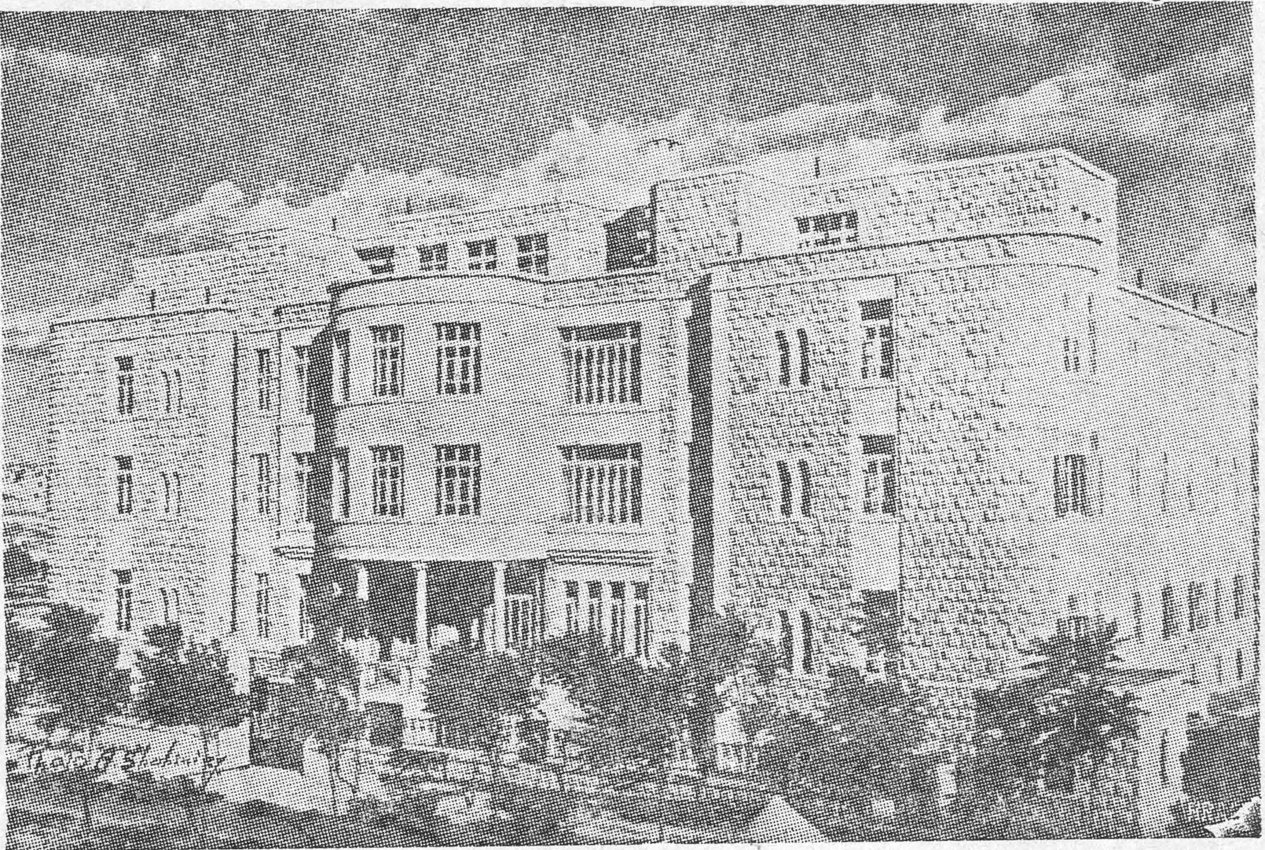
The hospital of the "Kalima" Society in Aleppo
I have written before to "The Woman's Voice" a piece about the "Georges Salem" charitable foundation for vocational education. Today it pleases me to send another word, about two charitable institutions of the "Kalima" Society, also in the city of Aleppo, headed by the jurist Mr. Fathallah Sakkal, formerly Minister of Public Works and Communications, who has all but abandoned the profession of the law in order to satisfy his spiritual hunger with the food of piety and charity, and to enlist himself in the defense of the most wretched of men, those most in need of mercy and compassion — not in the halls of the courts, but in the quarters of the city. And who could be in greater need of mercy and relief than an old man whom the days have robbed of youth and strength, stripped of children, kin, and money, and given him, against his will, old age, weakness, loneliness, and poverty, to face pains and the specters of despair and humiliation, deprived even of people's sympathy?! Or than a poor sick man groaning under the nightmare of illness, sometimes gasping out his breath from pain, with no money to intercede for him with the doctors and the pharmacists?! To the service of these two unfortunates Mr. Sakkal has volunteered himself, offering his money, his learning, and his time, supported by a select company of the men of Aleppo distinguished by nobility of feeling.
The "Kalima" Society administers two charitable institutions, the first of which is the Home for the Aged. This home was founded by Father Boulos Qojaqji in 1924 in the Sissi
quarter, an old quarter of Aleppo whose streets are narrow and full of turnings, its houses packed so close together that they crowd one another for light and air. Father Boulos left Aleppo after handing this small institution over to Mr. Sakkal in 1929. And if the credit belongs to Father Boulos for embodying this noble sentiment and bringing it into being in this institution, praise is owed him too, for he knew how to choose for it the man who would tend it and nourish it with his affection and his labors, so that it would grow and take firm root, and some of the distressed and the wretched would find shelter in its shade.
No sooner had Mr. Sakkal received this small, wholesome seedling than he loved it and grew devoted to it, and set his mind on bringing it out into a broad, spacious air, where the light is bright, the air pure, and the view charming — to
the Sabil quarter, the quarter of palaces, where the upper class resides. And since Mr. Sakkal was sincere with a true sincerity toward this institution, he saw no course but to be the first of the donors: he gave it a plot of land, and his wife, Mrs. Kita, gave a sum from her own money; her family, the house of the late Albert Homsi, donated what their open-handedness afforded, and afterward they donated forty thousand Syrian liras to the hospital project. And no sooner did residents and emigrants sense the sincerity of the Home for the Aged project than they answered the call of humanity with generosity and willing hearts. Yet the project remained under a deficit of 10,000 Syrian liras, until God provided it with a man from abroad who came and asked to stay in the Home for the Aged for a little more than three years. This emigrant was the late Bashir Khawwam: he paid the 10,000 Syrian liras, and he inspired Mr. Sakkal with the idea of building a modern hospital to serve