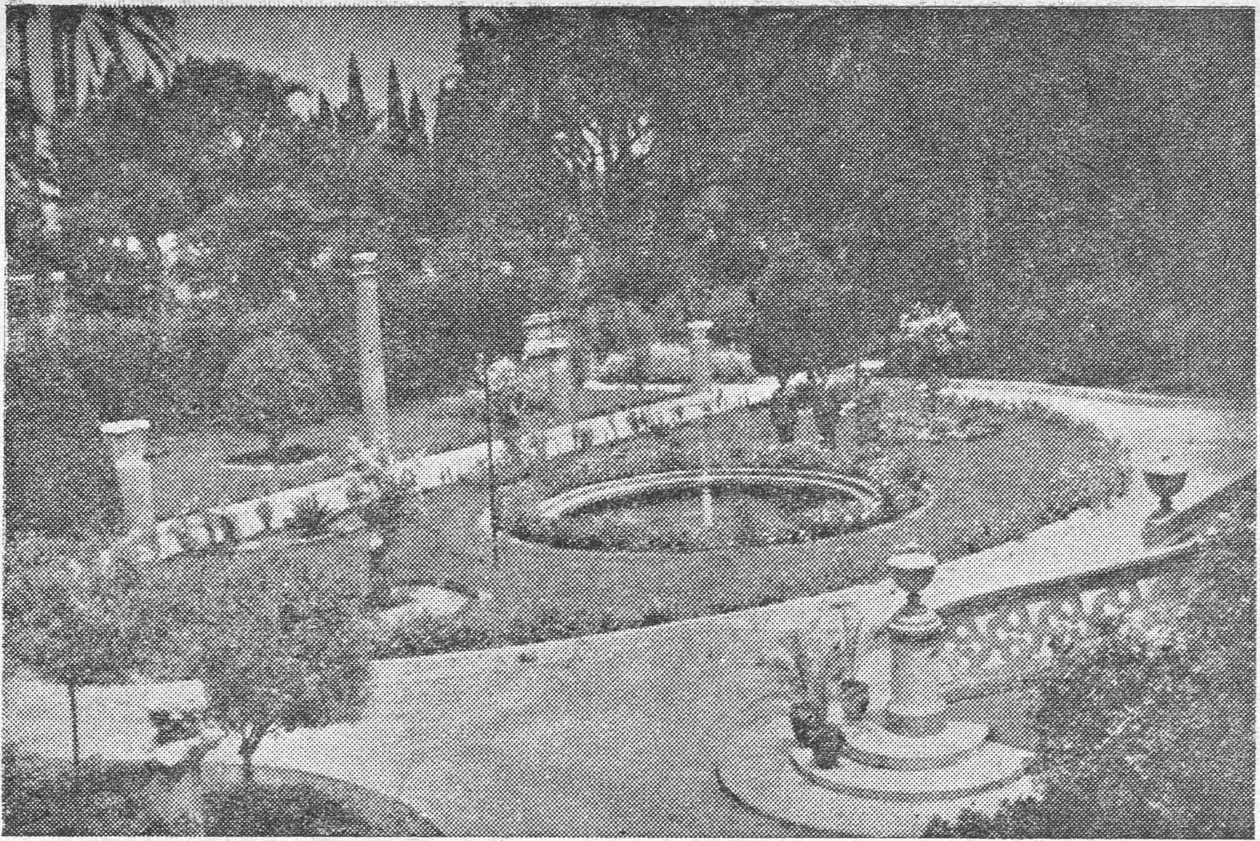
A general view of the palace's exquisite garden, in which the art of laying out gardens is displayed
become a museum of fine arts. The government has used it temporarily as a guest palace.
When you go to visit this edifice, it appears to you through its tall, rare trees and its spacious, magnificently laid-out garden like an enchanting jewel. In its beautiful appearance the palace represents a refined style of architecture. This sense of artistry grows when you enter the reception hall. It is in the Arab style, with its ornamented walls, its marble seats, its slender, soaring columns, the delicate arches, the colored glass, the chandelier, and the Damascene fabrics. The hall is also adorned with instructive maxims carved in marble, and with sumptuous carpets that lend a particular luster of harmony and proportion.
Modern renovations have been introduced into the palace, and among them my attention was caught by a radiant heat-diffuser — a "radiator." So that the radiator should not show itself as such in this beautiful Eastern setting, it was placed inside a special small cabinet decorated with Arab ornament, so that it does not look foreign to the atmosphere. Thus beauty and utility were joined.
As for the dining room, it is beautiful, but in the French style. At the head of the room a large, magnificent Gobelin tapestry representing nature and its animals draws the eye, as does the floor of the room, made of oak cut in exquisite geometric shapes. The ceiling too bears colored relief carvings that harmonize with the atmosphere of the hall. Opposite the dining room is the smoking room, in which the rugged character shows itself in the full sense of the word: in the wine-colored leather seats and their wood of walnut and dark mahogany. The wall cabinets are of the same
wood. On the whole the room is sparsely furnished, and its atmosphere is formal and reserved. Yet the place is not without some commendable innovation: mirrors have been used as frames for some of the pictures, which lends a touch of novelty to the scene.
The upper floor contains rooms for the retinue and the rooms of the master of the house. It is very simple in point of furniture, but its woodwork and its floor arrest the eye with their beauty, as does a magnificent wall tapestry of Gobelin manufacture representing a scene from the life of Christ.
Variety of color is extremely scant, except in the reception hall, where the Arab ornament calls for many colors; even so, the prevailing color is brown. It will also be noticed that the parts of the palace are not harmonious in style: you pass directly from an Eastern hall to another of French character and on to a room of yet another style, and this does not make a beautiful whole, although each part is beautiful in itself. As for the curtains and covers, they are in a pitiable state; the greater
part of them was replaced upon the arrival of Emir Saud.
If the municipality decides to make this palace a museum, the present state of the furnishings is of no importance; but if it resolves to make it a guest palace, then it must be renovated completely, taking into account the colors, the fabrics, and the matching forms whose ensemble makes a sequence pleasing to the eye and to the beholder.
Subscription Notice for Nigeria
The administration of The Woman's Voice requests its esteemed subscribers in Nigeria to apply to Mr. M. S. Mansour for the payment of their subscriptions to the magazine. His address:
Mr. M. S. Mansour
P. O. Box 652 - Lagos.