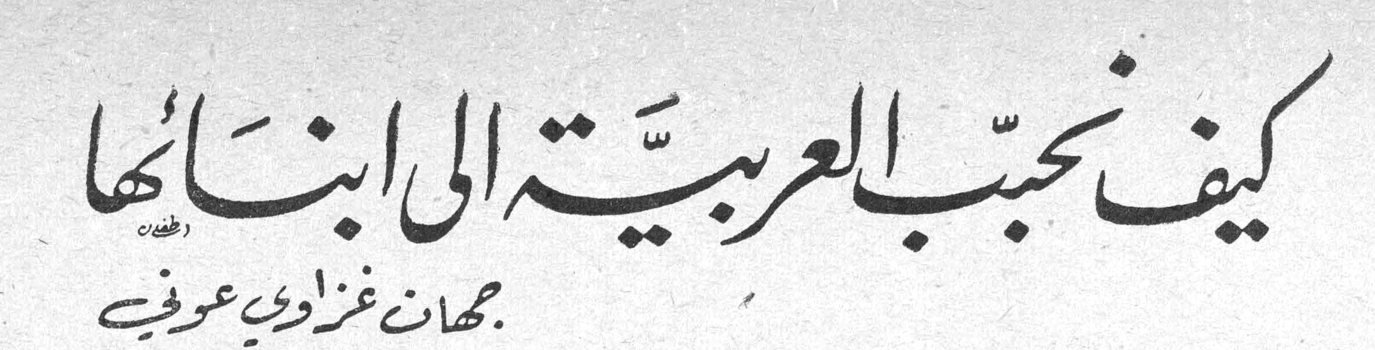
What a subject this is — one that fills the soul with pride, brims the heart with hope, and confers upon the mind a pleasure that is at once its nourishment and its cure.
The pride is in this living language, which the ages have not been able to kill, though they have killed many of its sisters.
The hope is because we, the educated of this generation — people, governments, and teachers — can restore to it its former glory, revive it after a period of death-agony, and wake it from a restful slumber whose term has run too long.
As for the mind, it is because faith works wonders, and because these wonders have proofs and demonstrations which the Phoenicianizers, the Frenchifiers, the Anglicizers, and the champions of the colloquial will not acknowledge — but which logic acknowledges, history attests, and the facts of the present confirm.
For all that I am an optimist, and I repeat with Abu al-Qasim al-Shabbi his famous saying:
"When souls aspire to life, fate cannot but respond."
In this talk of mine I shall not take up the history of this language, nor the need to produce scholars of it who know how it was influenced by other languages and how it influenced them. The history of Arabic is long and far-reaching; as you dig into it you feel as though you were digging for pure gold in a treasure whose gleam dazzles you and whose sight holds you fast in delight. I shall rather set out briefly the raw materials with which we must work to make this language, so beloved of the elite, a language easy of approach, smooth and yielding in its obedience, one with which everyone falls in love for its
sweetness and its splendor, for the elegance of its structure and the majesty of its diction, and for its special properties — such as meter in poetry, derivation, and Arabization.
In my belief the beginning must be made first in the schools and second in the government departments, and likewise with the help of the government itself and the Ministry of Education.
If we speak of the schools, we must understand that the teacher of Arabic — whom the Ministry of National Education must select with the greatest care — should be a devoted lover of this language, so that the pupils catch this passion from him and grow up enthusiastic for it, possessed by it, enamored of its beauty, zealous over everything in it, great and small. He must have a literary gift, so that nothing in the language, coming or going, escapes him. And he must be well acquainted with the course of the literary movement, in the stages through which it passed in earlier times and in the present age, so that he may give his pupils a taste of the pleasure of weighing one writer against another and one book against another. In this way he can spur his pupils on to read through a vast library and to know many men of letters — above all the contemporaries among them, for the abundance of their production and the breadth of their horizons — without letting them feel the weight of an assignment, the annoyance of importunity, or the difficulty of becoming cultivated. At this stage the teacher must leave the pupils wide room to debate and compare; there is no harm in his sharing his opinion with them and discussing their subjects, without belittling or distorting, leaving them freedom of opinion, of inquiry, and of comparison, making of himself a dictionary by
whose guidance they find their way to what they seek.
The teacher must likewise accustom the pupils' ears and tongues — indeed exercise all the artfulness he can in this — to beautiful delivery and splendid diction. He must show them where the grace of an opening lies and where the felicity of a transition. He must direct their attention to the secret of forceful wording and the wonder of eloquence's magic, and compare with them phrase against phrase and verse of poetry against verse, making them feel the melody, listen for the ring, and be captivated by radiant expression in whatever mold it comes.
That is for the intermediate classes. In the elementary classes it is required of the teacher that he possess some facility in improvising classical Arabic, for he must take a middle road, neither climbing too far into the colloquial nor sliding too low with the classical. He may then make his little ones understand that the correct language is not so very far removed from the colloquial. They can, for example, say instead of "btrid," "aturid"; instead of "mahhaya," "mahat"; instead of "het," "ha'it"; instead of "mshi," "imshi" — and so on through all the words that lie close together, which the pupil memorizes easily because of their resemblance, believing he has accomplished something great when he masters them. Then comes the turn of conversation — and what an effect conversation has on straightening the pupils' language! By means of it the child can chatter with his teachers and his companions without fearing anyone's reproach. The child, moreover, is quick to memorize and quick-witted, and his tongue has not grown used to keeping pace with grown-ups in the talk they carry on; his tongue