greatly in the capabilities of my country, and I hold that if we are sincere and cooperate, we can match any institution in the world in any project we please. There is nothing in this national school, for instance, to prevent it from proceeding on the model of the school from which I graduated: the American University of Beirut.
We shall set about perfecting our records and finding many opportunities to increase the nurse's practical experience; then the teaching staff will cooperate in raising the nurse's academic level, and this will be helped by raising the level of admission to the school from the elementary certificate to the complementary certificate.
I said: And where and how will you increase the nurse's experience — in Dr. Khalidi's hospital, you mean?
She said: No. All the hospitals of Beirut stand open to our pupils. According to a set program they move every morning, from eight to twelve, from one hospital to another, spending their training period there, and they report on their work in the theoretical classes in the afternoon.
I said: I understood from this booklet of yours that the conditions of admission are that the pupil master the Arabic language completely and one other foreign language, hold the complementary certificate, enjoy full health and the personality of a nurse, and desire to practice this profession. Would you explain to me what your measure is for this part of the entrance conditions? And the extent of your attention
to the moral side, and its value in grades?
She said: I like this question, for it is at the heart of what I wish to accomplish while I direct this school.
In the first part of the school year the "consecration" of the nurse takes place: the school board meets and looks into the averages of the new pupils and decides which of them may continue their studies. It requires that the average be not less than sixty points; naturally the board relies also on its own judgment.
I said: And does this short period suffice for such a judgment?
— No; mistakes are inevitable. But we make up for them with those who remain. Among the subjects taught — such as physics, psychology, anatomy, the history of nursing, and so on — there is a discipline called "professional adjustment," and in it the nurse learns her duties on the moral side to which you referred. This subject has its very
great importance, and it is taught in all three stages of the school. And I shall do my utmost to make certain it has been digested in the minds of our graduates. Moreover, our nurses swear the oath of fidelity to their profession.
The spirit in this school is good, and I shall digress from the subject to tell you of this phenomenon:
It has been our custom to make small excursions during the holidays, and tomorrow we begin the spring vacation, so our trip will be to Damascus. To fix the date I gathered the pupils and appointed Friday and Saturday as the days of the trip; but the Christian pupils objected that it would fall on Good Friday. So I said Monday and Tuesday, then; but the Christians objected again that it falls on the Great Feast. And when I said, then let the rest of the pupils go, I was taken aback by the objection of the Muslim pupils, who said: "We will not go without our companions." And I tell you truly, they put me in a
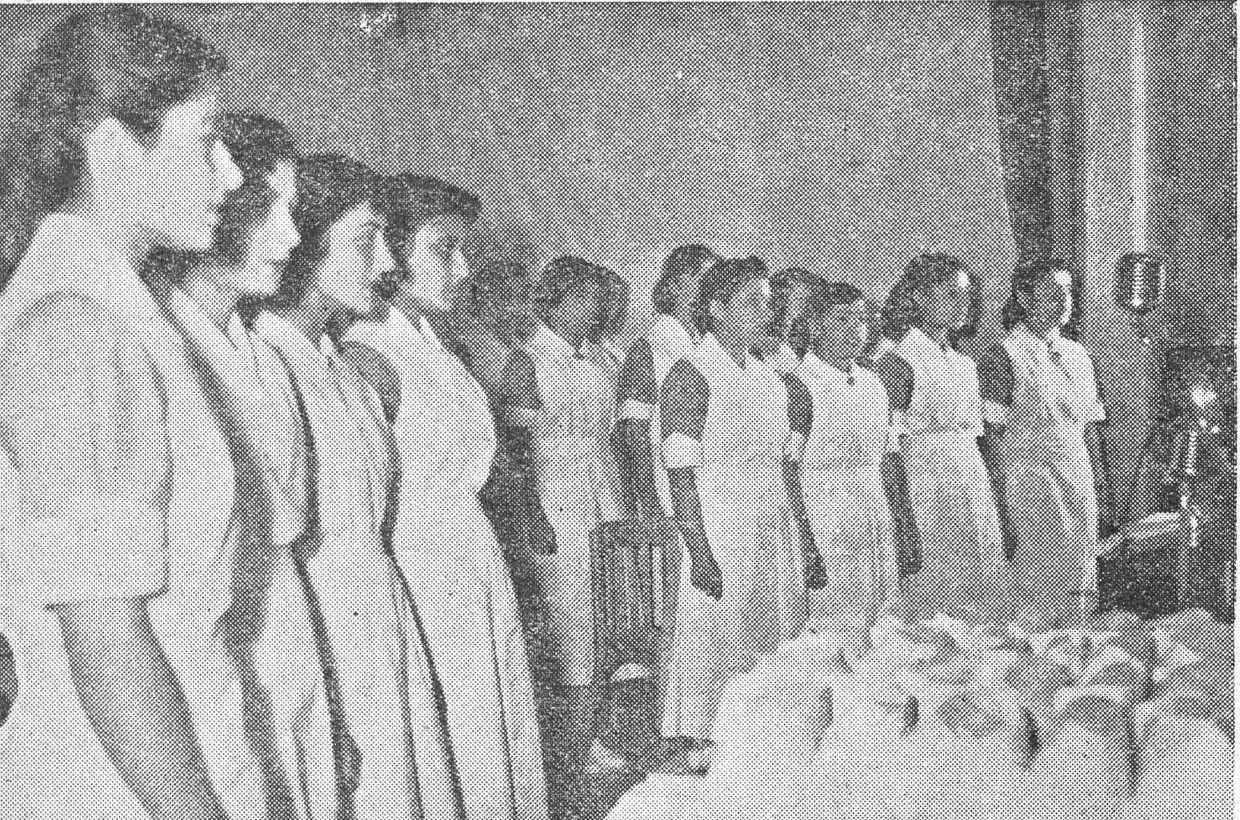
The nurses sing at the diploma-distribution ceremony