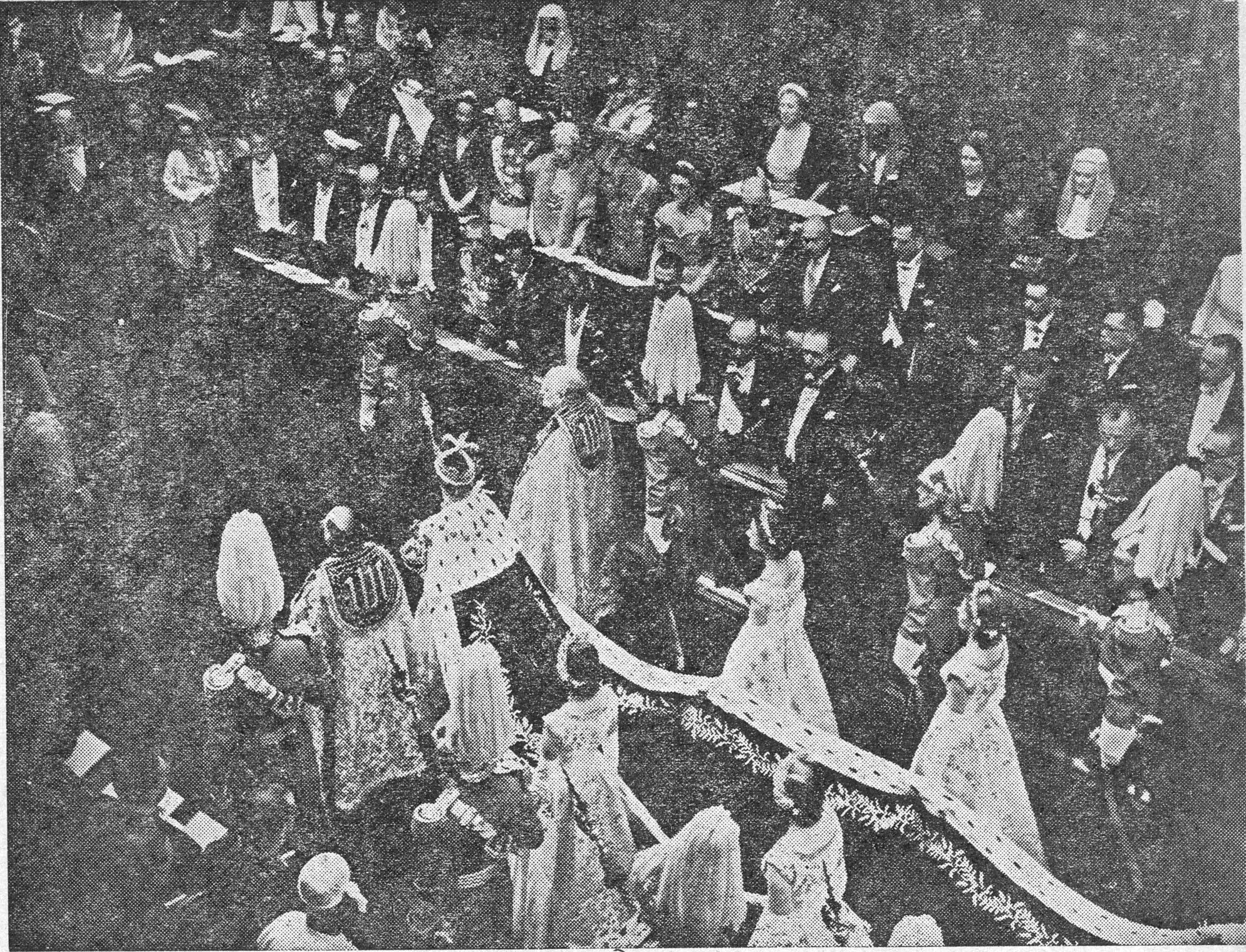
The Queen's guests and the foreign delegations, who had entered Westminster at eight in the morning, did not leave it until half past three, after being invited to the tables laid in the halls attached to Westminster.
The Queen's return to Buckingham Palace was escorted by units of the armies of the British Commonwealth: we saw the Indian army and the Australian army on horseback, and the New Zealanders, etc.... The cheers rose from both sides of the streets, and the cheering that accompanied the passing of Churchill was among the things that caught the attention.
In the evening the Queen was obliged to answer the cheers of the ever-growing crowds and to appear on the balcony of Buckingham Palace six times in succession, surrounded by her husband, her children, and her ladies-in-waiting.
And while the lights of rejoicing and festivity sparkled on the banks of the Thames, the temperature was dropping to zero — and yet it occurred to no one to pay any heed to the frost or the cold.
As for the lesson I drew from these splendid scenes, it is quite simply that England showed on this occasion, before the other nations and before the whole world, that she is firm in her strength.
Yet this display was not a matter of empty show; it had a meaning that goes back to virtues deep-rooted
in the character of the British individual. Among these virtues are self-respect and respect for others, and respect for authority — all of them factors that lead to that marvelous organization, that endearing courtesy, the giving of self for public causes, spontaneous sacrifice, and the deep, sacred love for the homeland's history and its ancient traditions; they lead also to a jealous care for the sanctity of this homeland and its standing in the world, and thence to that love, rooted in the soul of the British individual, for the symbol of this homeland — namely, the throne.
And when we analyzed the flowering of these self-evident merits and qualities — self-respect, respect for others, and the spirit of organization — we felt them at first hand, whether in our conversations with personalities who have their place in British history and who received us in the historic palaces, or in the scenes of everyday life in the street or the restaurant, in the shop or the park... They are the qualities that lead to the rise of great nations.
For in England you find no counterfeit appearances... Time alone has done its work upon souls, so that they have ripened with a natural ripening, deep in its effect and without a trace of falseness, issuing in this marvelous flowering of a greatness whose roots took hold in the seeds of the quiet qualities latent in the British individual.