atmosphere in which love takes on a many-colored form.
Happy is he who takes his wife away for fifteen days to a festival of music or of poetry, that he may reap the kindled fires of his feeling, stirred up by Mozart and by Musset. But nature alone can be trusted to bring ease and contentment back to their two souls: there, across the ocean, they whisper and confide together. Amid the stillness of the countryside and its beauty they weave from their married love a legend that cannot be effaced. For our mother the earth, in all her aspects, labors to revive us — the people of the cities above all — bringing back the rapture of youth to our weary hearts.
Nor is it to be recommended that one of the two spouses take the vacation alone, without the other, except for some pressing need of health. This does not mean that there are not sound and excellent families that need fear no dissolution upon parting. A person's heart, on vacation, need not be a heart shut off from a love that rises above every passing whim. Even so, we must not forget that these trials are violent and overwhelming, and are by no means unlikely to occur. There is no doubt of the difficulty facing the woman who would keep herself: a beautiful woman left to her own devices on the seashore or in the bathing towns, a target for the marksmanship of bachelors and a morsel for the mouths of intruding husbands — whereas in her own small town her family would watch her every movement and every stillness, and the gossiping women would spy on her from behind the window frames. Nor is the field of vacation empty of gossiping women, who sow scandals there and preside over their feeding, as though scandal were the solace of their old age.
Gossips, yes — but unknown ones. Their shafts inflict no wound; such is public opinion in a foreign milieu. And solitude is not a natural condition. Goethe said: "She who can bear boredom in the midst of the bathing season is a woman deep in love." If the family is loose and tottering before the hour of opportunity arrives, it is all one whether the dangers take hold of it. And if it
is knit together and firm, then there is the sacrifice: the price of loss, at the first slip of the foot, is nothing less than the whole of happiness.
Correspondence heals much of the thirst of separation. They say of letter-writing, and of love letters above all, that it grows less day by day. But I am not sure of what they claim. In any case, I am sorry if such is the state of things. Long daily letters work to unite the thoughts of those who are parted, soften the desolation of silence and estrangement, and prepare an understanding that forestalls contention and quarrel.
"But it does not prepare peace
and concord," a young woman said to me, reading what I write over my shoulder. But why not? It is harmony itself at the moment of meeting. She answered: "The eloquence of a letter hangs upon the writer's thought and style." And of that too I have my doubts. How sweet are love letters in the eye of their reader, for their literary dress puts on the garment of the beloved to whom they are addressed.
And upon my life, whoever tempts his companion at the price of a vacation is neither honest nor faithful.
Rendered into Arabic by Evelyn Hitti Kanaan
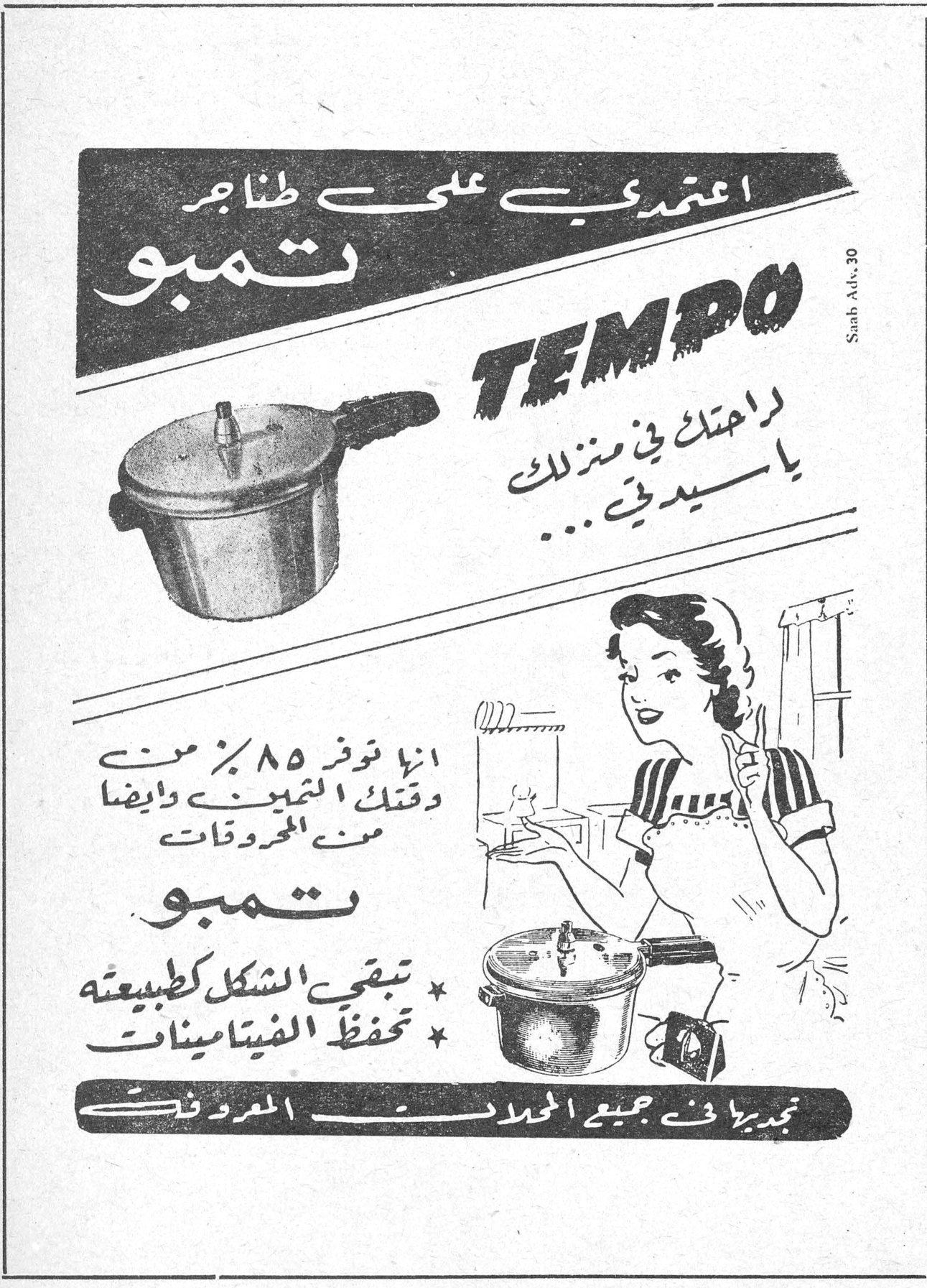
Tempo TEMPO
Rely on Tempo pots
TEMPO
Your ease in your own home, Madam...
They save 85% of your cooking time, and of fuel as well
Tempo
* Keeps food looking as nature made it
* Preserves the vitamins
You will find them in all the well-known shops
Saab Adv. 30