Miss Nabiha al-Wer, head nurse of the government women's maternity hospital in Amman, has a wide reputation in the field of women's medicine in Jordan. She recently visited the maternity hospitals of England and Scotland on a mission for the British Red Cross, and came back to us with all the delightful and charming things she saw there. I present here, for the readers of our "Voice," a talk about some of these observations.
*
It was a warm morning of the breath of spring, the morning I took a car from Jabal al-Hussein in Amman to the women's maternity hospital, to visit it and to talk with Miss Nabiha al-Wer, its head nurse. Her radiant smile of welcome as she received me, and the hospital's quiet atmosphere, invited me in. There was nothing
for it but to make the rounds and talk with the kindly nurses who had done the duty of hospitality to perfection — with Miss Mariam al-Wer at their head — when I had come to them as a guest and given birth to my child there. And in the small, friendly office I took my seat opposite Miss Nabiha and asked her, as I opened my notebook:
Q — You have made many women eager to know what new steps are being taken in England in the world of women's medicine. What was the occasion of so delightful a journey?
A — I traveled to England and Scotland on a mission from the British Red Cross Society, the "Florence Nightingale."
Q — And how long did the journey take?
A — I left Jordan in May 1950 and returned in June 1951. I spent
eight months in London, three in Scotland, two weeks in Stockholm, ten days in Geneva, and two days in Paris — and the first place I visited and saw in the French capital was a maternity hospital!
Q — How does a girl progress in her studies there until she obtains the midwifery diploma?
A — First and before everything, the nurse is expected to be highly educated. A girl with no previous training can obtain the midwifery diploma a year and a half after beginning her instruction, while the trained nurse obtains it after no more than a year.
Q — How did you find the English nurse?
A — The English nurse is an ideal nurse; she carries her profession high aloft on two skillful hands that neither tire nor falter. She works with diligence, precision, and speed, as though she were sitting an examination on which her success depended, or as though her work were pierced at every moment by the eyes of monitors and supervisors and she feared punishment! This faithfulness in work adds to the force of her personality, which is adorned by an excellent culture that raises her standing and the nobility of her profession. What struck me most in her loftiness of character was her vast remove from any interest in tittle-tattle,
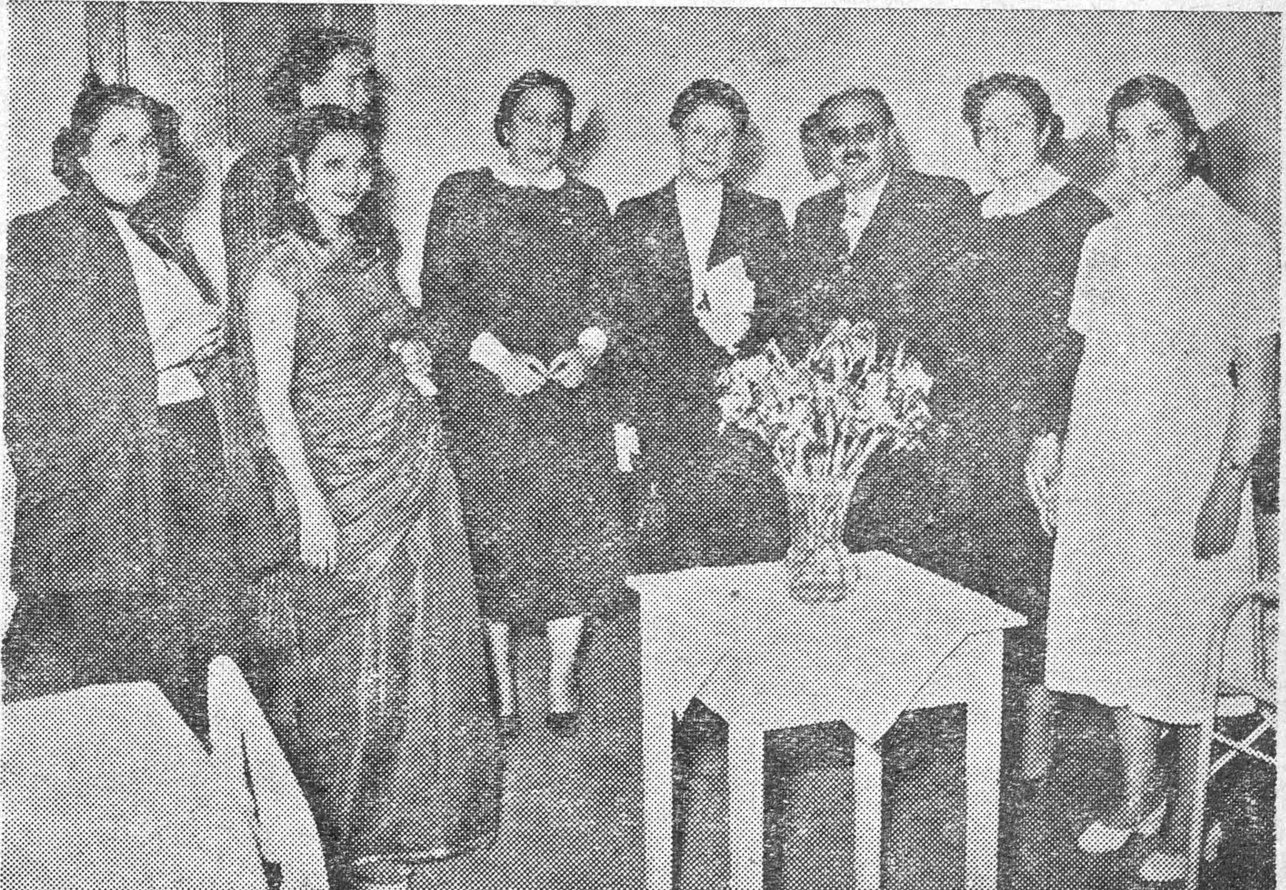
From right to left: Miss Linda Issa, Mariam al-Wer, Dr. Ghalib Qusous, Dame Katherine Watt, Nabiha al-Wer, Elizabeth Hilborn, Mrs. M. N. Idwani, and Noura Nowayhed Halawani.