
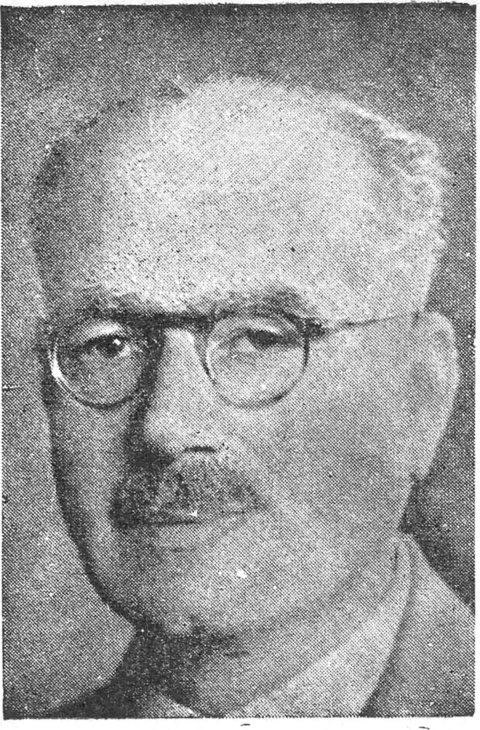
His Excellency Mr. Muhyi al-Din al-Nasouli, Minister of Information and Justice, is a supple journalist and a tactful writer. In the world of thought and in the fields of culture and politics he has made many a felicitous foray. Here he kindly answers a set of questions put to him by the magazine The Woman's Voice.
Q — The Lebanese, by the nature of his practical life in Lebanon and abroad, needs a foreign language alongside his own — and the idea long prevailing is that French is the more widely current in the world. Is it true that the modern trend inclines to tip the scale toward English?
A — This question you put to me is very embarrassing, for I fear it may thrust me into politics, and, as you know, I belong to a government that is neutral in every sense of the word.
The Arabic proverb says that every tongue is worth a man, and it is a proverb that speaks the truth, the whole truth — especially among the Lebanese, who have applied themselves to studying languages since ancient times, and have mastered speaking and writing them, so that many of them have composed prose and poetry in them and been among their leading figures. I can boast, as can every Lebanese, of mastering several foreign languages alongside his Arabic.
The Lebanese have flocked to master the French language since ancient times, and they still flock to it and to English at one and the same time. I do not know whether the scale of English will tip in the future, but I do know that the two languages go along together today, and that our students take them up and master them because they have felt their usefulness as two means of stocking themselves with learning and knowledge, widening the faculties, and keeping contact with the world. Both are living, esteemed languages, well able to express with ease whatever thoughts stir in the mind, and they draw us into the world of research and inquiry. And the Lebanese, while taking up these two languages, do not neglect the other living languages; for the Lebanese is a seeker of knowledge, and what establishes him as an instrument of contact between East and West fits him to pick up wisdom wherever it may be found.
Q — There are those who say that the introduction of a foreign language into the school program should be delayed until the fifth elementary grade, when the pupil has gained some command of his Arabic. Do you support this view or oppose it?
A — I am among those who believe in the necessity of teaching Lebanese youth several foreign languages from childhood, alongside the Arabic language, if we wish the Lebanese man and the Lebanese woman to grasp the spirit of the language they study and to go deeply into it. To say that a pupil's taking up foreign languages from childhood hinders him from mastering his Arabic is a claim that does not square with the intelligence for which the Lebanese is known — especially if we simplify the Arabic language for him, lay its secrets open before him, and place those secrets within his reach.
Q — To what extent would you allow university students to enroll in the various political parties and to carry on their activity freely?
A — I hate to see politics enter the universities and become the students' engrossing occupation, for it is a waste of time and effort, and a deviation from the pursuit of learning, which must be the university student's first and last concern.
I would prefer a thousand times over that the university student busy himself with equipping himself with knowledge and character, so that when he goes out into the world he is fully armed, and becomes the citizen who knows how to serve his homeland with deliberation and balance — by way of the constructive parties, not the destructive ones, and by ways other than parties.
Q — In your view, how much practical benefit will the Lebanese woman reap from her first electoral experience?
A — I think the Lebanese woman will reap several benefits from her recent experiences in the elections. She will equip herself by way of learning and knowledge, and prepare herself to enter the coming electoral battles and to cooperate with man in making the laws, in overseeing the government, and in sharing in the building of the new Lebanon which we want for man and woman alike — that is, for the human element, which is the most important thing we must be mindful of in the present age.