From this university — nay, from this city standing as a torch of light and guidance upon our broad shore — springs the first spark to burn away ignorance and submission!
In its spacious courtyards varied faces greet you, for it gathers students from every Arab land; they meet on one ground, to bind themselves together and pledge one another to love of the homeland, of goodness, and of righteousness.
In this university was held this summer's training session in the methods of education and teaching; and here, dear reader, I carry you off to the classroom, or the courtyard — to the shade of a fresh green tree, or a green bench — to watch those literary circles forming in every corner, for discussion, inquiry, and exploration.
As for the session's teachers, most of them specialists in the arts of education and teaching, they deserve particular notice for the effort they expend with such devotion, confident of a day that will bring the country to what they — and we — desire!
My steps led me to the office of Dr. Habib Kurani, to obtain an interview concerning the teaching session. It was not easy for me to make my way into the crowded office, but chance helped me to my goal, and from behind the registers and notebooks the genial face looked out at me; and when he learned the errand on which I had been sent, seriousness showed in his eyes and he began to pour forth, treating the matter with awareness and experience.
— What is the aim of the teachers' summer session?
— Our schools need the spirit of renewal, and this comes about through acquaintance with the new, comprehensive culture, and the teacher alone is able to bring it to life. And since the teacher is occupied throughout
the school year, we thought it best to hold the session in the summer. It comprises five groups: one group here at the university, and another group — the rural session — at the American School of Sidon.
Understanding among the various
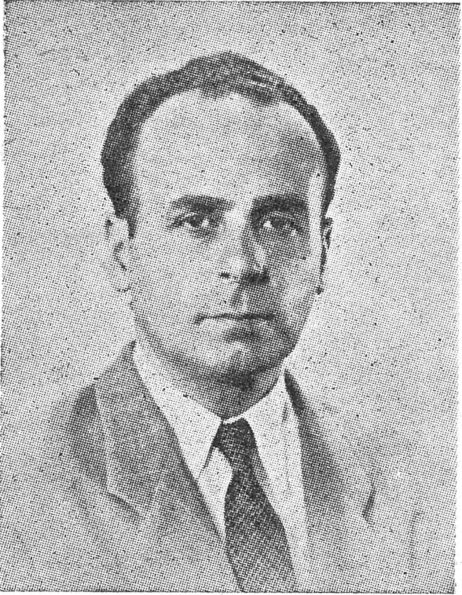
Dr. Habib Kurani
Arab lands is created by way of the child, whom the teacher takes in his charge. On our benches now are teachers from all the Arab lands, conferring together to understand educational problems and to work for the strengthening of general culture.
We laid this idea before Point Four, and those in authority agreed to give some assistance; the remaining expenses are borne by the university with the help of certain of the Arab states.
As for the remaining circles, among them is the circle of Near East studies, by which we mean to make the West understand, and to acquaint it at close range with our civilization; and the other program concerns students who did not finish their course requirements last year, or who cannot study during the school year.
•
In the classroom I accosted Mr. Philip Najjar, the specialist in psychology and education, with my question. He smiled, trying to slip away, but I gave him
no room; rather I placed him before an accomplished fact with my question:
— Who, in your view, is the successful educator? And do you acknowledge woman's superiority in the field of education?
— In my view, the educator can be any person who devotes his life to guiding others by way of persuasion and the exchange of love and respect. He is anyone who believes that education is the foundation of a life he lives in practice, persevering at it all his life without weariness or boredom, striving to achieve the aims that will bring him to raise the level of country and people. I am certain that the side of reform, guidance, and counsel is the first foundation in education, and the weapon of the faithful educator; and I believe in give-and-take and the exchange of views in
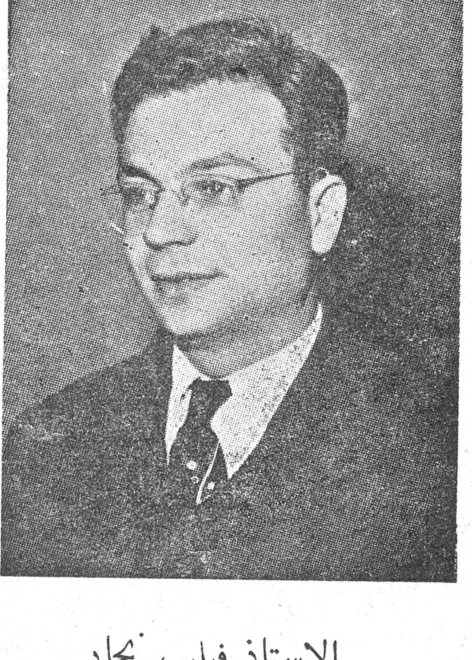
Mr. Philip Najjar
education — without these sacred things, no success in it can be hoped for.
As for woman: being our mother, she alone possesses that exalted heavenly gift, and so she surpasses man in motherhood, the source of tenderness and affection. It is no secret that her educational task is more arduous than man's; but each of the two completes the other, and the two