are no longer satisfied with
the Qadisha grotto lit with electricity, miracle though it be, nor with the sight of the lofty, calm, majestic Cedars, nor with Gibran's gentle, tranquil tomb. What ails us, children of the age of the atom, of speed and radiation, that we are so frozen and so drowsy? Come, let our artists and writers, our poets, singers, and actors go up to Lebanon's Olympus and present us with what nature and history inspire in them. What a wonder — festivals of literature breathed by Gibran at Bsharri: Naimy, Akl, and Labaki. And where is a splendid exhibition of his symbolic pictures: Farroukh, Onsi, and Douaihy. Then, instead of passing carelessly by his tomb and reading Here rests among us "Gibran Khalil Gibran," a touch of the beauty of that native place would have worked deep into our souls, and we should have offered our summer guests a treasure from our inmost selves — and our tongue would rise up to declare: "Here lives our genius, Gibran Khalil Gibran."
Let us pass on to the courtyard overlooked by the statue of the knight Youssef Karam, and hold there an evening of zajal and folk songs, of qaradi and ma'anna — the troupe of al-Shahrur, al-Zoghbi, and al-Murr. And let the figures of the fair maidens sway in "folklore" dances: the dabkeh, say, to the tapping of the darbukkeh, in the old national costumes with their gay, vivid colors; hearts keening with the yearning of the reed-flute, souls leaping to the tones of the oud — its melodies crossed by the clash of the sword and the clatter of the shield, the game of bygone festivities and one of the spectacles of the chivalry of old. And in this atmosphere brimming with the pure folk spirit, dishes of the finest local foods are handed round: tabbouleh and raw kibbeh, ghammeh and stuffed marrows, prepared by our famous restaurants; baklava, ma'moul, and karabij of Aleppo.
At the close of the program a dance is held at the Grand Cedars Hotel, at which the queen of youth and beauty is elected.
You ask me, where is the money to come from? I ask you, where are the planning, the organization, the publicity, and the sacrifice to come from? If the numerous women's associations lent this vital subject genuine attention, and adopted projects for the well-to-do as they adopt projects for the poor, and worked hand in hand with the Commissariat of Tourism and Summering, we should have at least one program every summer for hearts to yearn toward and purses to open for.
The summering season is a pulse of awareness in the whole nation's frame, nourished by the newspapers and magazines, the radio, the cinema, and the popular songs. And were the woman's magazine, and other magazines besides, a living exhibition of her private and public life, in which the glances of her counterparts travel — a living mirror reflecting the beauty and invention God has bestowed on her, toward which her peers gaze with eagerness — they would agree, all willing: "Come, let's go have our dresses made in Lebanon!" This fair one, turning the pages of "The Woman's Voice," would have had her eye fall upon an elegant costume there: the makeshift mannequin — a lady of prominent Lebanese society who kindly presented her photograph in the newest evening gown, by permission of her private dressmakers — stood... Mrs. So-and-so stood among the columns of the Temple of Bacchus in the citadel of Baalbek (or at least so the picture suggests), her hair swept up above a bare neck and shoulder, the folds of the flowing, harmonious gown falling to the soles of two feet strapped into light sandals of the Roman style so widespread today; over her left arm hung a sheer embroidered shawl of the Lebanese Artisanat's making, while her right arm curled about the mute stone column — into which life had crept, nay, which the spirit of the builders of our glorious history had quickened.
"Ay, ruins of Baalbek, greetings" — then let the ruins of Baalbek speak.
If the Girl Guides troupe held
one of its formal parade festivities in the courtyard of the palace of Beiteddine, and its music rang out to the tread of rising Lebanese womanhood as they performed the duty of salute to the residence of the head of the country, the granter of woman's right — while all the while the motion-picture camera recorded, recorded their movements, together with snatches of acting, song, dance, and verse — under the gaze of the image of Abu Saada, whose eyes have broken so many backs in ages past — so that this film might be shown alongside the newsreels in country after country.
Woman is the mistress of the house, and the summer visitors are her guests. Let us then give what we can in knowledge, and wherever we can in deed, for their happy sojourn.
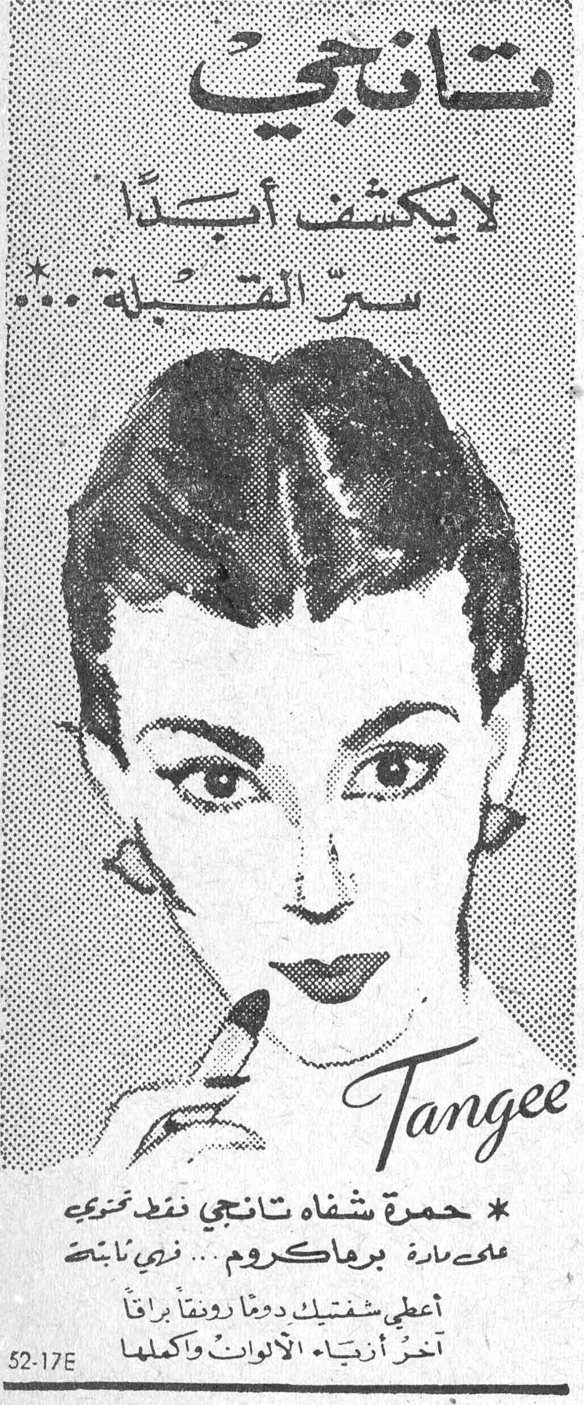
Tangee — Lipstick
Tangee
never betrays
the secret of a kiss...
* Tangee lipstick — the invention of the Permachrome process... pulsing art
Give your lips a sheen of refined luster — the latest fashion in colors, and the most complete
Tangee
52-17E