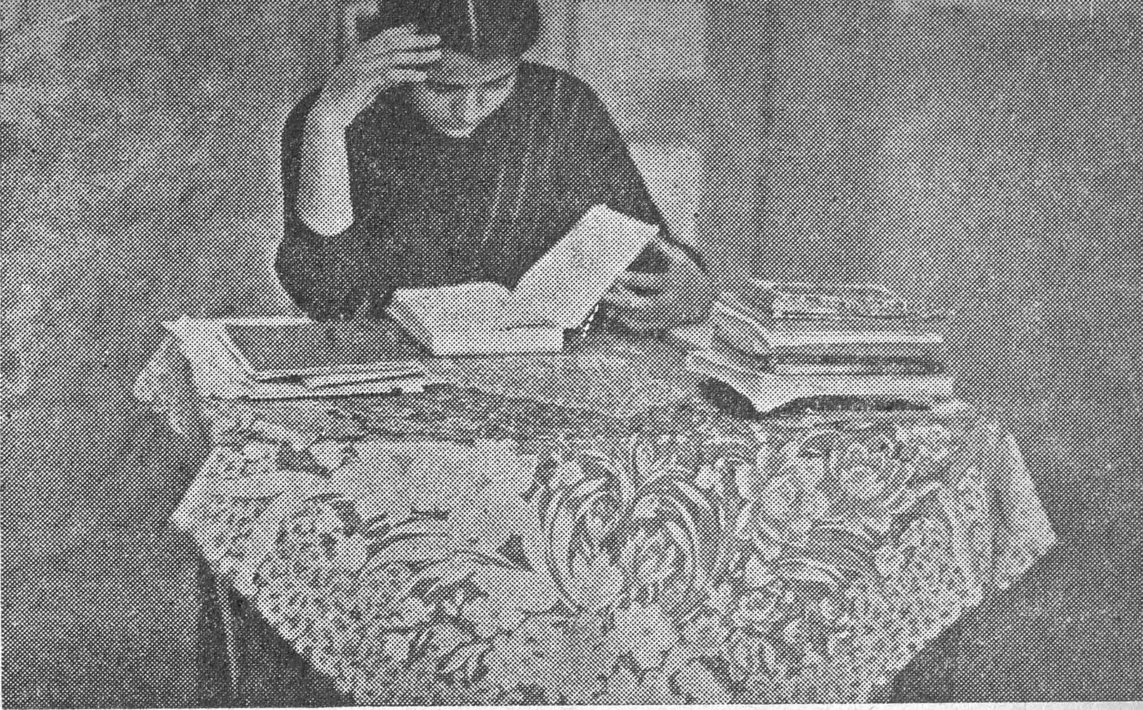
Life calls on us to keep pace with everything new; and how are we to grasp it if we do not read the latest of what is written and said?
In my article to you, Madam, I shall offer some selections on various social topics, chosen from the most important of my reading this month. Perhaps they will help you, especially as your household duties keep you from spending long hours in the library. These brief digests are drawn from foreign magazines and treat several points, and I begin
with this amusing subject:
Why do we lie a little? This may sound strange to your ear; so listen to its explanation through a few examples:
Here is a girl facing her young man for the first time. He asks her whether she smokes or drinks, and she starts up, answering: No! She may be lying in what she says, out of shyness or embarrassment. Necessity compels us to utter lies on many occasions, and our position is justified by our belief that we cannot do without these little lies, which set us walking on an equal footing with the world around us.
If you once visit the village, and the voices of the birds wake you after two hours' sleep, or you pass a sleepless night because of the roughness of your bed, you answer your hostess without hesitation when she asks how you passed your night: I slept like a child, and felt wonderfully rested. Is that not a lie?...
We sometimes lie to our mothers to spare them grief, as in hiding an illness or a failure at work; and the mother has need of lying too — an example of this is a mother who falsified financial statements to make her children believe their future was secure.
The child resorts to lying to defend himself. Here is Samir, late in coming home at the appointed time, telling his mother how the ghoul waylaid him in the garden. This kind of lie is contrived to cover up some deficiency in a person's own self. The most harmful kind of lying is tale-bearing, which breeds enmity and causes evils of grave consequence. A simple example of it: a lady speaks to her husband
by telephone, and a voice at the other end answers that he went out in the morning and has not yet returned — when in fact the poor husband is sipping a cup of coffee, or is in a colleague's office. And the great calamity comes when he returns home.
With this brief study ended, I shall pass to a subtler and more tangled subject. The writer here treats a problem that stirs everyone's interest, with his question: Can woman create as man does? And why not? Do you not believe with me in the failure of the old theory? The truth is the opposite of what they say — they who pay no heed to the shackles that bound woman in past centuries. Now, however, she has begun to shake off the traces of those fetters, to prove her creative capacity, which falls short of man's in nothing. There is no evidence whatever that nature endowed man with a mental capacity surpassing woman's. I can almost hear the man answer quickly: Name me women who have distinguished themselves in any practical field. My answer to this is to draw the attention of whoever contradicts me to the causes that kept woman lagging behind him in the field of the mind. Foremost among these causes is his view of woman as a goal in his life, upon which he builds his artistic and intellectual production: she is the subject of his story or of his painting, but she was not the writer or the artist, because the doors of work were shut in her face. Woman is a natural creative force — and by that I mean her creation of the rising generation and her rearing of it. We do not deny that man helps in the forming of life; but his constant wars and the harshness
of his nature make plain to us his inclination to destroy life as well: he strikes it down without reckoning — unlike woman, the human being, the giver, the tender one. Nature has granted her what it did not bestow on man: motherhood, and all that branches from it of love and devotion, sacrifice and tenderness. And these are the strongest elements that help life to endure.
In the past, man stood behind a narrow barrier to accuse woman of backwardness and shortness of sight. And does anyone doubt whether, if woman gave up her household duties and went out to work, she would fall short of walking with man on one and the same level? But there is no room for actual trial, for woman's natural direction is toward motherhood; and when man learns to understand her true nature, he will acknowledge, without doubt, her capacity to create, and will raise her to the lofty station prepared for her.
History tells us that woman was not permitted to enter the theater until the seventeenth century, while women writers used to appear in the literary field under men's names — a clear proof of the enslavement of woman and of the pressure upon her. You have begun to feel the atmosphere darkening a little; so let us pass on to lighter and softer matter: Have you ever fallen into an awkward predicament? And how did you try to get out of it?
There is no doubt that every lady has been struck by some perplexity in one situation or another — and the kinds of perplexity differ with the occasion!
A gathering once brought me