tango, and Arabic words set to its measure.
It would have been better for the bearers of Frankish names to Frankify their family name, so as to produce some harmony between the two names—for example, to make Pierre Estephan into Pierre Stephan or "Etienne"; Joseph Tannous, Joseph Antoine; Yvette Simaan, Yvette Simon; and so on.
But here we run into another difficulty: the difficulty of spelling these names in Arabic, since many of the Frankish letters—vowels and consonants alike—have no equivalent in Arabic. Note, for example, the difficulty of spelling Pierre in Arabic, for want of the two letters P and E. Whoever comes upon this name written in Arabic letters is at a loss how to read it—above all if he knows no French—and reads it Bayyar or Biyayr.
Ignorance and love of imitation have carried some people so far that they Frankify the Arabic-formed name given them since childhood. He whose name is Hanna, for instance, makes it Jean; and he whose name is Mikhail or Yusuf or Jirji becomes Michel or Joseph or Georges—imagining that imitating the Franks in a name raises him to their station, or that the Arabic name lowers his standing. Such a person is like the ignorant illiterate who supposes that wearing spectacles and carrying a briefcase makes a professor of him. Ibn Khaldun said:
Royal titles out of their proper place— like the cat that, puffing itself up, mimics the figure of the lion.
As for the use of the kunya—Abu So-and-so and Umm So-and-so—it is a custom that spread among the Arabs, who
used it in place of a person's name as a mark of respect and honor, because the kunya indicates that its bearer is the head of a family and the father of sons: that is, a man of standing, strong in his family and his children. The kunya is a plain relic of the era of the clan and the tribe, when a man's personality dissolved into his family and merged into his people—honored in their honor and abased in their abasement. But in this age, when the tribal spirit is passing away and the individualist, independent spirit prevails—the spirit that looks at the individual apart from his people and his family—the use of the kunya has begun to disappear, and it has been cast off entirely in emancipated circles.
At the present time the light, delicate Arabic names of few letters and few syllables are current: Muna, Nuha, Raja, Sana, Ayda, Kamil, Samir, Hani, Munir, Rida, etc...
The meaning of the name is of no importance; what matters is that it be easy to pronounce, light on the ear, in harmony with the
measures and the forms of the language. And just as the rough name of strange construction is found ugly, so too is the dainty name that betrays pretension, affectation, and excess: Awatif, Lawahiz, Siham, Hiyam, Jamal, and the like—sentimental names that offend the taste of an age which sees beauty in simplicity and moderation.
As for the author of this study, she apologizes for her own name, which combines the diminutive of the ages of decadence with the Frankification of the present age. She pleads that she is not responsible for it, and wishes she could change it, though it is too late. She consoles herself with the knowledge that many people are not pleased with their names. All that such people can do is to choose for their children the simple, easy names that harmonize with the family name and respect sound taste—or to offer others their advice and their experience in the matter.
And you, my lady reader—are you pleased with your name?..
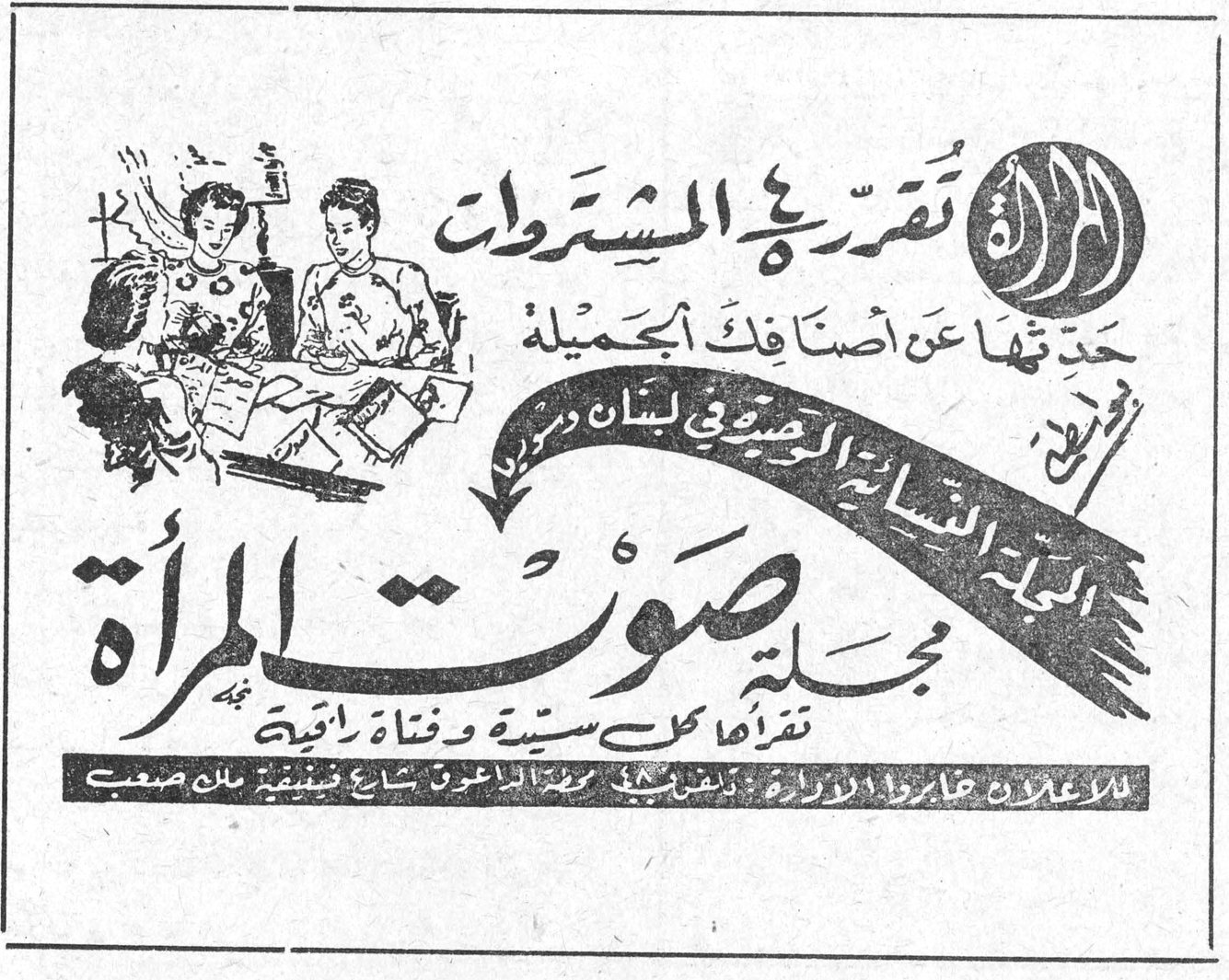
An Advertisement for The Woman's Voice Magazine
It is woman who decides the purchases
Speak to her of your fine wares
The Woman's Voice magazine
The only women's magazine in Lebanon
Read by every refined lady and young girl
For advertisements, apply to the management [...] al-Ma'ouq Street — Phoenicia Street, the Saab Building