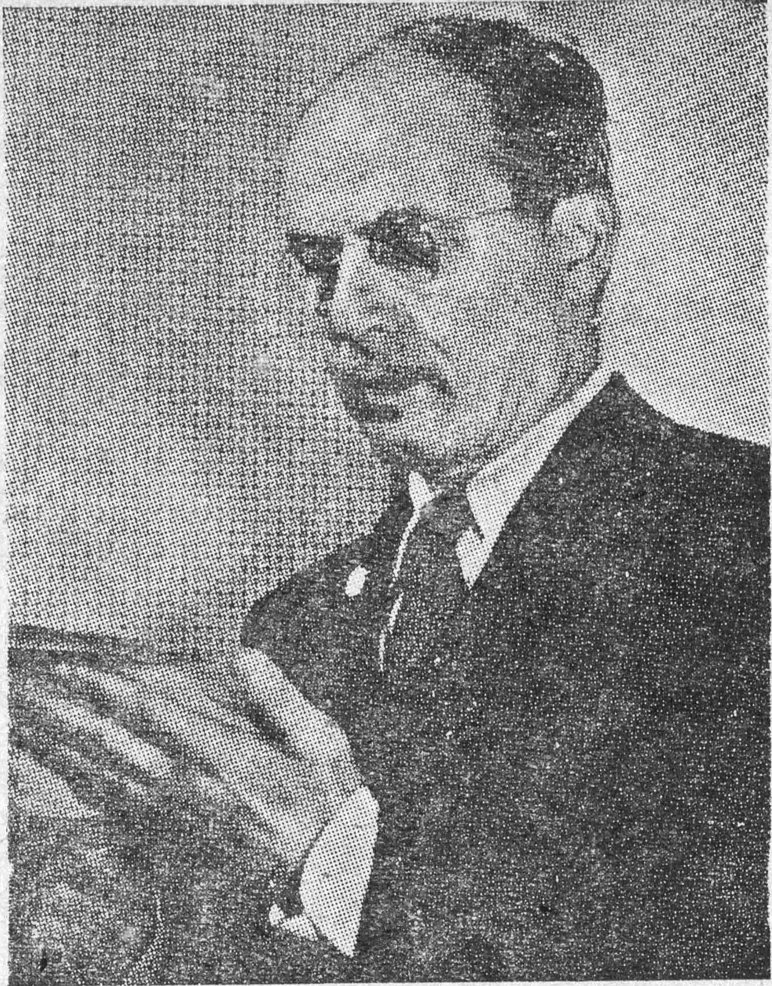
During Dr. Philip Hitti's passage through Lebanon, on his way back from a cultural journey through the countries of the Arab East, India, and Pakistan, the magazine The Woman's Voice put to him a number of questions, particular and general, and he was kind enough to answer them — despite the narrowness of the space — with the frankness of the thinker and the precision of the historian.

Here we publish these answers, with our sincerest thanks.
Q — How does Princeton University contribute to the projects the United States undertakes to achieve rapprochement and establish friendly relations between itself and the Arab countries?
A — If there is any contribution, it is of the unintended and indirect kind, for political contribution is not among the functions of a university, if it is a university in the true sense. The true university has one principal aim: the ascertaining of facts, scientific and literary, the discovery of what is still unknown of them, and then their publication and diffusion — and it makes no difference whether this accords with the policy of the country in which the university stands or does not accord with it. Many readers know that Princeton University houses the only American department fully equipped for Islamic studies, including Arabic, Turkish, and Persian. The bachelor's student with us may, if he wishes, specialize in these three languages, in their literatures, and in the history and culture of their peoples. Likewise the doctoral student may specialize in them — something not available to a student at any other American university. Beyond that, the department of Oriental studies at our university takes up and treats most of the ancient Oriental languages: Hebrew, Syriac, Aramaic, Sanskrit, Chinese, and Indian. In our university library is a collection of Arabic manuscripts numbering no fewer than ten thousand, unmatched at any other university, American or otherwise. And we have an Arabic press on the Linotype, on which we have so far published a number of volumes in a series, some of them in English; the latest volume in it is an atlas
of Islamic history, the only one of its kind. It is clear that our publishing of the treasures of the Arabic language and of the history and culture of its people, and our teaching of this language, beget in the souls of the students and of the American people a certain regard for the sons of Arabic, and smooth the path of mutual understanding — and this is what I mean by the indirect and unintended contribution.
Q — Can the small states not take a neutral stand toward the disputes of the great powers while preserving the friendship of both? Is not the neutral position the better one?
A — Yes, they can — on condition that they remove to Mars or some other planet. But with our Arab states lying in an important strategic zone between East and West, containing as they do the world's highways, the sources of oil, and the keys to Asia and Africa, and with both camps, the democratic and the communist, beckoning to them from close at hand and courting their favor, their bearing proclaiming "whoever is not with us is against us" — the opportunity is at hand to study the situation in the light of their own interest and to take a clear and decisive stand. And we must not forget that if a world war were to break out, nothing would be easier than the violation of the small states' neutrality by both sides. There is no doubt that the possibility of a hot war grows more remote day by day, and the possibility of the cold war's ending draws nearer day by day. A time will come, then, and perhaps soon, when the two rival camps will say to our Arab states — all of them small — "goodbye." By then we shall have lost a precious opportunity
to turn the international situation to account, one that may never return in our future history.