The Art of Home Beautification: Texture, or the Art of Blending in Arranging the Furniture
We have seen in the previous studies how shapes, lines, and sizes play their parts in giving the house its particular character. When we look closely at houses, oil paintings, fabrics, furniture, and other things — at their shapes, their lines, and their qualities of size — we see that another element is working to assert itself. You will quickly convince yourself of this if you close your eyes and pass your
fingers over this page, then over a part of your clothing, and from there to the arm of the chair you are sitting on. Your fingers tell you the difference in touch — of smoothness, or roughness, or softness. Every object has a face of its own — this is texture, or the surface quality of a thing. Differences of texture are as important as the difference of round from square (that is, in shape) or of red from green (that is, in color), and their importance lies in giving a thing its particular character.
Texture is one of the basic elements, and it deals directly with the sense of touch. The tactile value of a thing is best appreciated when we feel it with our hand. The proof of this is that when we go to a shop to buy fabrics, there is a primary driving force urging us to touch them, for the hand, like the eye, helps in choosing.
For some time now, home decorators have been alive to the importance of texture. Even so, we stand in strong need of knowing everything that concerns it. The lady who would be aghast at wearing a workaday dress with a fur wrap, silk shoes, and a straw hat all together pays no attention to her brick fireplace wall, her finely woven carpet, her delicate shirred
curtains, and her iron lamp, which together form a group that is neither harmonious nor beautiful. There are also a great number of houses that lack all variety of texture, in which there is no surface richness or beautiful composition — where everything is smooth and shiny, and all things resemble one another in their texture and their feel. For that reason they look monotonous, and not, as their owners would have them,
gleaming and suggestive of luxury and beauty.
This stress on the composition of texture is not confined to the art of home beautification; it has swept through all the fine arts, and painting above all. Contemporary painters have become aware of the added richness and vitality that texture lends their artistic work. In the nineteenth century, painters boasted of how smooth their canvases were, considering that the summit of progress and of art; but Picasso, Cézanne, Matisse, and others contradicted them, and found that they could obtain new and original effects if they deliberately made certain passages of their paintings rough and different in texture from the rest of the canvas, preserving all the while the artistic balance — for what is wanted is textural variety together with pleasing suitability.
The blending of different kinds of texture is very important in furnishing rooms. For example, joining the aristocratic texture of mahogany to a coarse, nubby weave of rayon does not yield a beautiful result, because polished, gleaming wood demands the softness and richness of the texture of satin, of silky velvet, and of sleek sundus brocade. One may wonder at the harmony, beauty, and luster of an old carved walnut table set upon the ornamented tile we use in
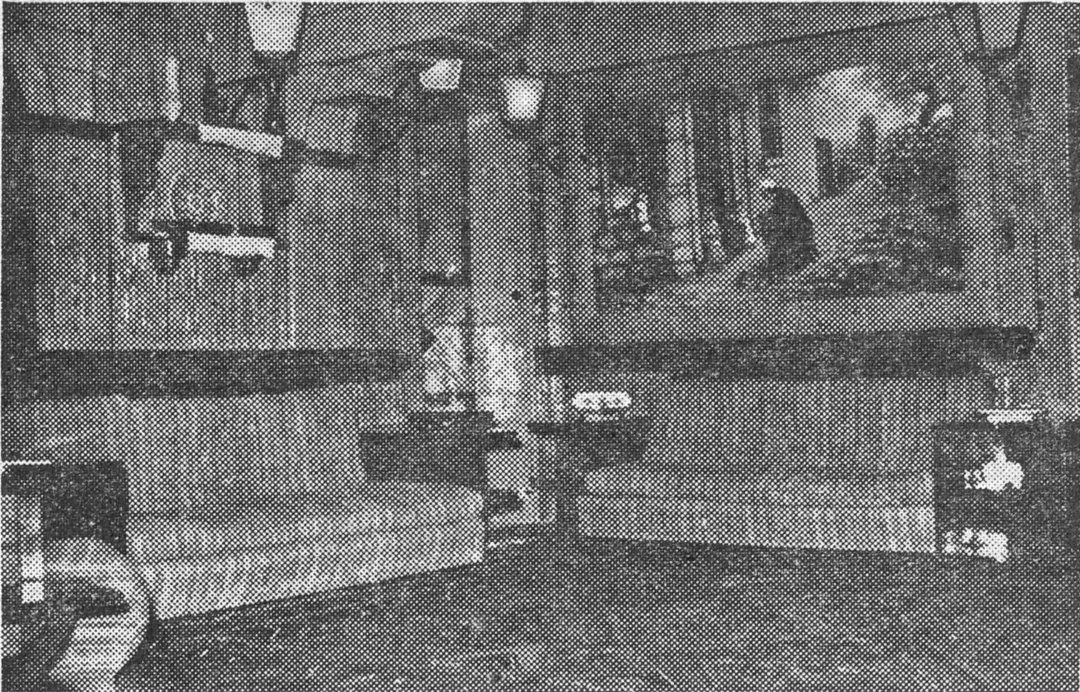
This corner of the family room in the mansion of Abd al-Rahim Diab is beautiful because it is harmonious, and restful in its harmony... The walls are of oak, the lamps of iron, the fabrics rough, and the painting unpolished