with two American friends, to where they were sitting in the shade of the leafy trees, while the men went into the reception room reserved for them; and there we sat in the welcome shade after the burning heat of the sun, even though the hour was near sunset. After drinking coffee and tea and eating biscuits and sweets, the wife, her mother, and her grandmother put to us all sorts of questions, I interpreting for the Americans. Most of those questions turned on each of our husbands and the number of our children; and when they heard the answer, signs of astonishment appeared on their faces at learning that the three young ladies with them were unmarried — for the understanding among them is that a girl is meant for marriage, even well before reaching the age of twenty. Then they set about praying God to favor us with excellent husbands who would make us happy!!! Among their charming customs: the wife and her mother insisted that we take away with us what remained on the plate of biscuits and sweets, and they nearly felt slighted and offended when the two American ladies tried to excuse themselves with thanks — a custom that shows the genuine old Arab generosity. And it appears that when a woman marries a man of eminent position, her mother and her sister come with her, and whoever of her family had lived in her house before the marriage — as though this husband were responsible for supporting not his wife alone but every member of her family; they then come under his protection, or under his command and his control.
The ordinary Saudi man has given proof of an abundant native intelligence and a great capacity for learning. The government has issued a new law requiring the
company to employ Saudis in the posts where they can be relied upon, so as to dispense with the non-Saudis who fill them; and this shows that the Saudi Arab's readiness to learn is great. How many an illiterate man has come to speak English and classical Arabic and to read them both, and has grown able and knowing enough to work at running machines and complex apparatus, or at tasks demanding special technical skill! All these things have a tangible effect on the lives of these men and on their families — a thing that promises a bright future for the Saudi woman, who cannot but feel the wide stretch by which her sister, the Arab
woman in the other lands, has outstripped her on the course. And as I close this talk, I cry out to my Saudi brother to leave the woman there room to show the world that she can run beside him in the fields of letters, of art, and of society. Is she not the descendant of that Arab woman whose exploits filled the pages of the history books and the records of bygone glory? Is she not likewise the sister of the contemporary Arab woman who has raised the banner of progress and kept pace with man in most fields? Let us strike these fetters from her, for she will not be long in entering the door of enlightened awareness, showering good upon her people and her homeland.
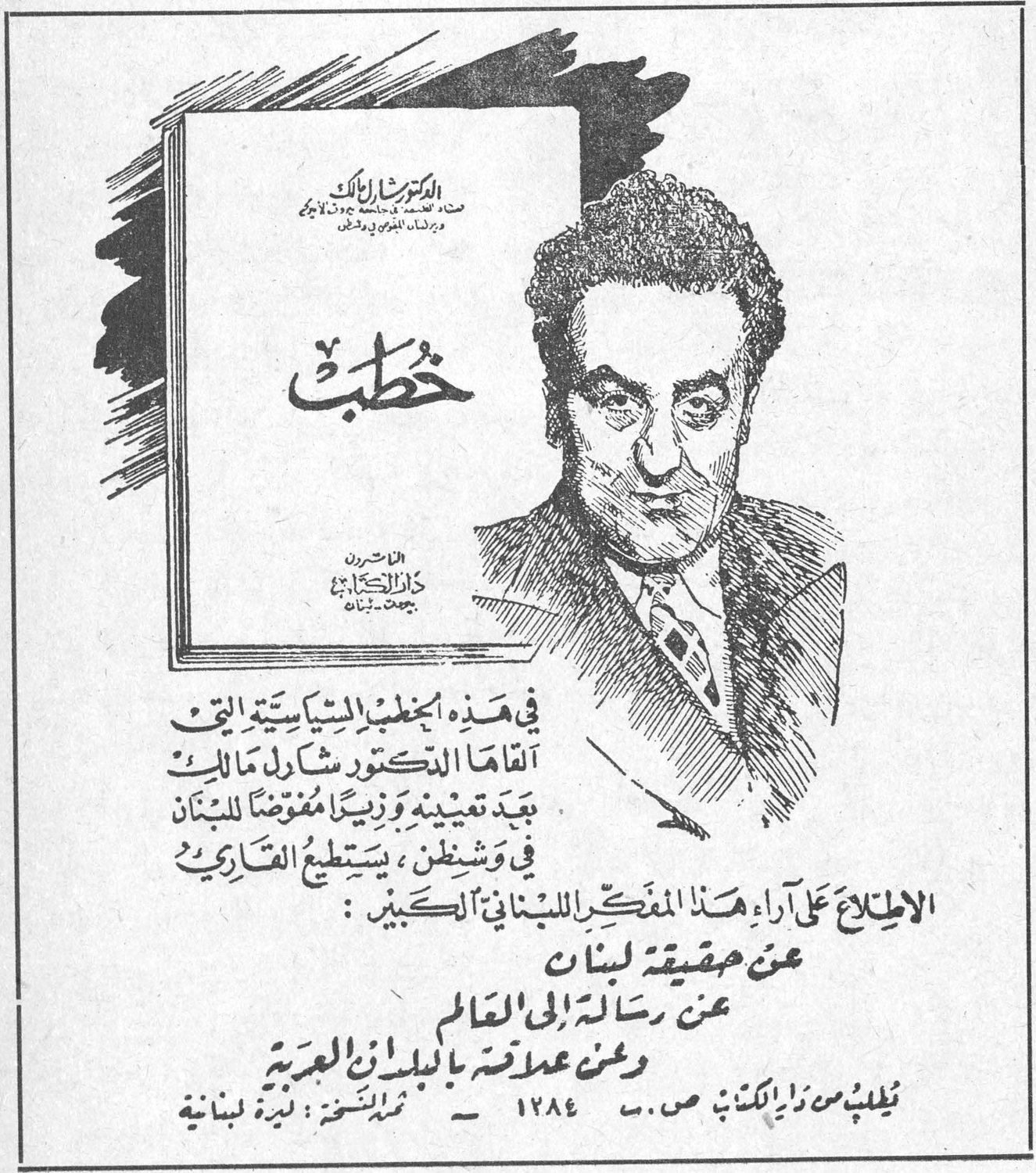
Speeches — Dr. Charles Malik
Dr. Charles Malik
Speeches
Dar al-Kitab — Beirut, Lebanon
In these political speeches, delivered by Dr. Charles Malik after his appointment as Minister Plenipotentiary of Lebanon in Washington, the reader can acquaint himself with the views of this great Lebanese thinker:
on the true nature of Lebanon
on its message to the world
and on its relation to the Arab countries
Order from Dar al-Kitab, P.O. Box 1284 — Price per copy: one Lebanese lira