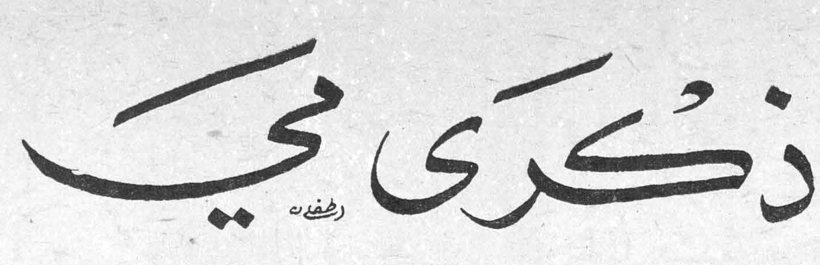
She was born in Nazareth... the city of the Virgin... and the Virgin bestowed on her a spark of her purity... And so she lived in the world and passed through all the stages of youth... then departed with her reputation unstained, untouched by any detractor (1)... Even when they said she loved and they loved her... when she wrote and they wrote to her... all agreed that her love was chaste, spiritual, and pure.
She grew up in the heights of Lebanon, and the poet mountain gave her of its poetry and its magic a poet's gift and a magic... And so she was a poet in her fresh style... a poet in her loyalty to those she befriended.
She ripened and came of age in Egypt, and the Valley gave her of its warmth: warmth in her Eastern nature... warmth in her faith... and warmth in her deep affections...
And so there was gathered in May all that the East possesses of purity and spirituality... of magic and poetry... of warmth and ripeness...
I am not here today to speak in detail of May the woman of letters, who wrote and translated nine books, apart from what was never printed or published... nor of May the cultured woman, who devoured thousands of books and formed her culture from the eight hundred volumes of her private library and her father's library... nor of May the student of knowledge, who mastered seven languages and wrote and translated in three of them... nor of May the pioneer, the first to lift woman's head and to convince men, with hardly an effort, that woman is no less than man in intelligence and brilliance... nor of May the orator, distinguished by the force of her argument and the magnetism of her style, so that she seemed to draw her listeners bodily toward her... nor of May the woman who kept faith with her sister woman, so that books were written about her extolling her powers... nor of May the Eastern woman, who began by writing in French and succeeded, but whose Eastern nature rebelled against her, so that she went back to study the language of her beloved East until she mastered it, wrote in it, and gloried in belonging to it... I am not here today to speak in detail of all these facets of a woman, because each one of them requires a complete talk of its own... and because the newspapers and magazines have examined most of these facets and given them their due... But today, on the anniversary of May's death, I shall speak of May the female — and I shall speak of her as woman speaks of woman.
May was born into an honorable family. Her mother was of the Muammar family, one of the well-known families of Nazareth... and her father, Elias Ziadeh, was a journalist of standing... She was born into
a family over which harmony reigned: her Orthodox mother and her Maronite father formed a household never rent by sectarian fanaticism, and it lived an ideal, tranquil life... She was born into a family of evident wealth, opening her eyes upon soft bedding and servants, so that she never knew want in her life... And she grew up beautiful, though her beauty did not rest upon the recognized rules... for there was in her dark complexion a softness... in her eyes a sparkle of intelligence... in her lightness of spirit and her command of the Egyptian jest... in her quickness of mind and keenness of wit... in all this there was a magic that made her a fascination to everyone who sat with her. And May lived knowing this of herself: no inner complex disquieted her, no anguish over any lack tormented her...
She lived in the shade of two parents who loved her as parents love their only child, even before she rose to distinction... and when she achieved distinction, and they gloried in her and held their heads high as the parents of "May," they added to the parents' fondness for their child their great pride in her...
And May lived amid all this bliss — or what ought to have been bliss — the life of a pampered, contented girl, until her star began to shine... until she attained what no Arab woman of letters has attained in the modern age... until the giants of Arab letters loved and admired her wherever she went... With all these factors gathered in her favor she had every right to be happy... and the world had a right to her gratitude, having given her so much... But May was wretched — wretched not only at that sorrowful end, but throughout her whole life...
May's outward appearance bespoke happiness: ringing laughter and broad smiles and whatever else shows upon that mask behind which lay what lay... But this pen that breathed out bitterness — the pen of a woman of letters breathing out her feelings — breathed out the bitterest of them, as if it were a pen that wept while trying to keep people from seeing its tears, and behold, they flowed to fill the spaces between the lines; as if it sobbed, saying... "a great readiness for grief and pain"... or... "a drop of sorrow in its depth equals a sea of joy in its breadth"... or as in her talk of her sad bird, which hid its head between its wings whenever evening drew near, and sobbed... and much else besides...
(1) This talk was delivered over Radio Lebanon on October 19, on the occasion of the thirteenth anniversary of the writer "May."
Among the chief causes of May's wretchedness was the delicacy of her feeling — and how miserable are
hearts too keenly moved, or, as she herself says, how miserable is the sensitive, tender heart, for wounds take firm hold in its folds... May felt intensely, and in the folds of