as she bent to the embroidery of her dress. For the second time she imagined the wedding day, and Asma appeared before her with Wafiq at her side in his wedding suit. She said to herself: he is a handsome young man and exceedingly pleasant. When I visit Asma he gives himself over entirely to conversing with me, as though I were the object of his visit. Wadad has chosen well, and I wish her every success.
She said this with a sigh, but her mother's arrival cut the thread of her thoughts, so she raised her head and paused a moment from her work, wanting a little rest. But the mother came toward her, trying to hurry her steps, her heavy body swaying now to the right and now to the left. She sat down panting and launched into talk without waiting for a question from her daughter:
"The wedding preparations are finished. I went in and found the two of them arguing over the trousseau. The mother wants to display it to the lady visitors and Asma refuses. Then the girl wants the white veil shortened to end at the neck, while the mother insists that it be long, trailing behind the bride, its ends held by two little boys. And while they were at it, Wafiq arrived in great excitement with a letter in his hand. He told them that his uncle, who has been living in the Sudan for twenty years and of whom he knew nothing, had sent him a telegram asking him to come to him quickly, for he was ill and in grave condition. Then he added that he had decided to answer his uncle's summons, for a wedding can be postponed, but death cannot..."
Here Wadad's mother stopped speaking to catch her breath, then went on: "...Just imagine — the wedding must be postponed to no fixed date. That is very hard."
"Hard, no doubt," said Wadad. "Everything is ready... and here I am toiling over the embroidery of the dress... I hope Wafiq hurries back..."
"He leaves today, without delay!" said the mother, and hurried off to the kitchen, feeling she was late in preparing the midday meal.
Wadad hung her dress in a corner
of the wardrobe, and for the second time fell to thinking about the workings of chance and the turns of fortune. She thought of Asma — would her waiting drag on, and what would she feel in the face of this sudden, strange event... And indeed the waiting of Asma and her friend dragged on, until a letter came from Wafiq announcing his uncle's death: he had taken over his business affairs there and decided to stay for an indefinite period, and he therefore intended to break off his engagement and leave Asma free to marry another. He was sending her a money order for the sum she had spent on him, expressing his deep regret and begging her to accept his apology.
Wadad marveled that matters should develop in this fashion, and marveled still more when, a short time later, a letter came to her from Wafiq asking her to consent to marry him, for he had loved no one but her. He had wanted to marry Asma out of need for her fortune; but now that he had come into ample wealth through what he inherited from his uncle, nothing remained to force him into a marriage toward which he felt no inclination. He would soon return to his birthplace to wed Wadad, if he obtained her consent...
No one was surprised when Wafiq al-Mu'addab came back from the Sudan to contract marriage with his fiancée's friend. Nor did they find Wadad's consent to this marriage strange; rather they thought that had she refused, she would have appeared a fool, for her refusal would not restore him to Asma. Some of them sat one evening discussing the matter, and one of those present said:
"Wafiq did well. In his place I would not have hesitated to make the change — this one is far better than that one."
One of the women listening said: "Fate came to his aid, and God gave him ease after hardship. Plenty of money and a beautiful wife."
Another beside her answered: "For the second time the fates have taken it upon themselves to unmask intentions, to lay bare what breasts conceal, and to deliver Asma from a treacherous husband. Had Asma married this young man, do you
think she would have lived happily with him? Could she live all her life happy with such a man?"
The other said: "Who knows? If he is a skilled actor, he could deceive her to the very end! How many people there are who live on illusions and find happiness in dreams! Lift the veils of illusion from their eyes, and they live wretched and crushed."
Said the one who told me the story: "I do not know what became of Asma after this... I learned that she traveled to distant lands, leaving her mother alone and miserable. And I do not know whether she found a husband who does not count marriage a business deal, or whether she is still deep in her waiting!..."
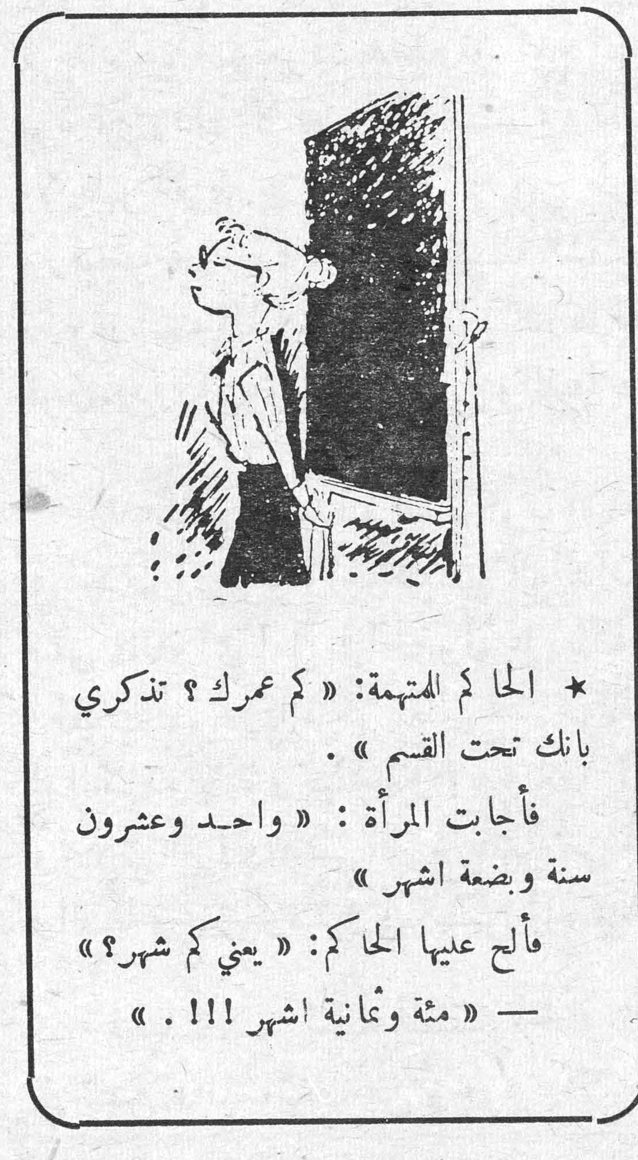
* The judge to the accused woman: "How old are you? Remember that you are under oath." The woman answered: "Twenty-one years and a few months." The judge pressed her: "That is, how many months?" — "One hundred and eight months!!!"