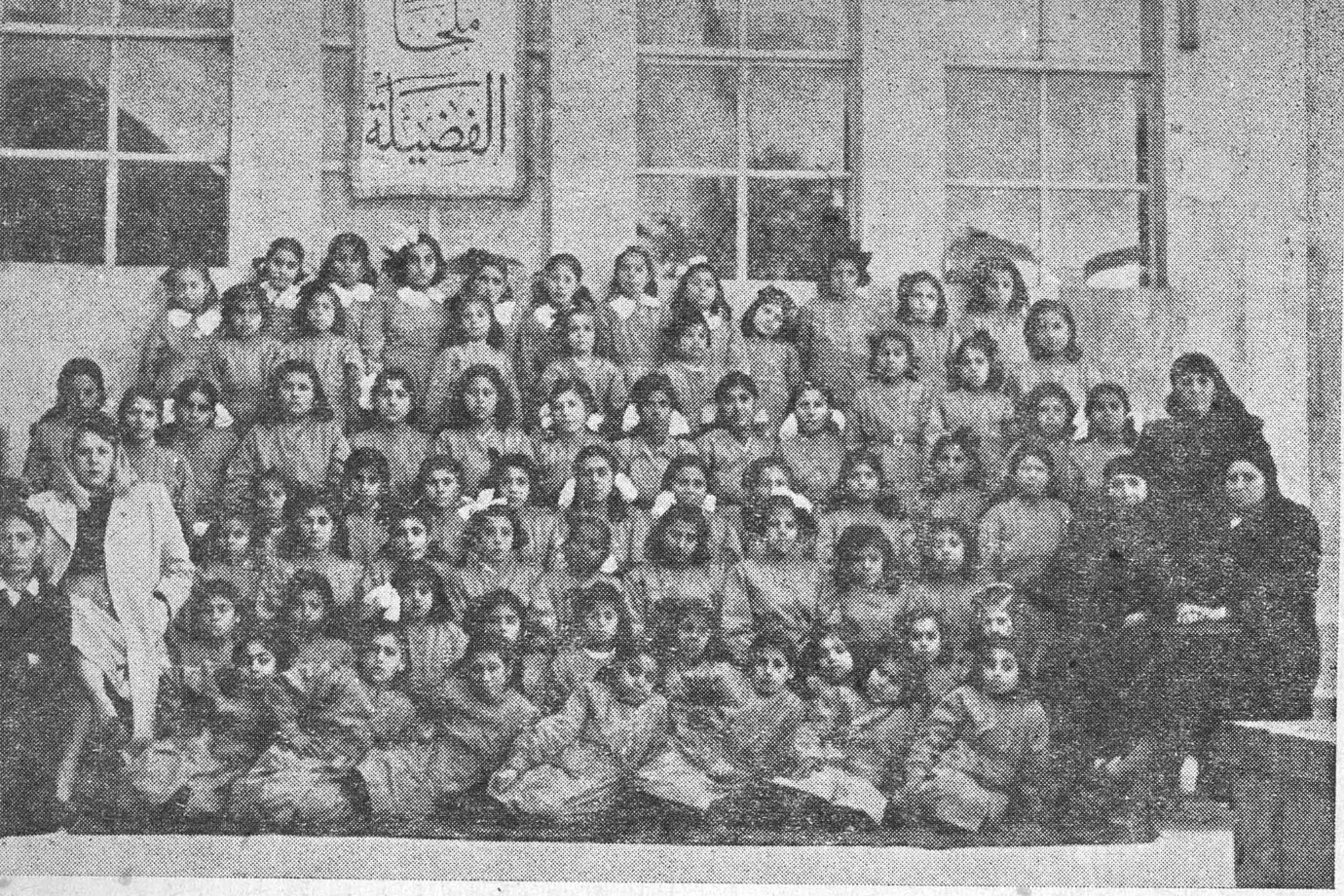
Students of the Fadila Shelter, surrounded by the women members of the association
Some members of my own family likewise objected to me on this score, for they believed the position of a schoolmistress to be work unbefitting me... But I paid no heed to anyone's talk and went straight forward on my path. I had to take out another license, to open a school. There are now in our institution 270 pupils and 65 orphan girls, and besides the trades they learn, we present pupils for the examinations of the primary certificate and the proficiency certificate. Those in whom we discern the intellectual capacity to pursue higher studies we send to the Syrian University, to specialize in medicine, the law, and the like. Last year we sent three orphan girls to the University.
I said: And how is the necessary money collected?
She answered: I began the work relying on God and on myself, for many years; then a number of the wealthy ladies of the city joined me, and we would pay out of our own pockets and collect contributions from the commercial houses. There are also people who send us assistance in the form of vows and gifts.
Nor has the Ministry of Education forgotten us: it appointed four women teachers for us at its own expense. Lately we have begun to cooperate with the Women's Union association in Aleppo, which concerns itself with providing clothing for the orphan girls. The Fadila Shelter, too, joined us recently. And we sought an agreement with the Awqaf association, so that it might carry out this great task in the fullest manner; but we were unable to reach an understanding, and we found that it was an initiative ahead of its time. So we gave up the idea, and I held fast to the project, after having been on the point of abandoning it because of my failing health."
*
I toured the spacious school,
seeing the craft classes and the academic classes, the dormitories and the dining rooms, and was delighted by the order, cleanliness, and arrangement, and by the handiwork and artificial flowers, which call forth admiration and pride. And I saw the room in which Miss Faiqa sleeps, so as to watch over these pearls so dear to her heart, day and night. Although some of the school's women teachers sleep there, her heart is not at ease unless she herself looks after them all, leaving her own house amid the orchards and flowers. She does not repair to this "villa" except when she feels her health in dire need of recreation and rest.
I thought of this good work that Miss Faiqa is doing, and of this social service she has rendered her nation and her homeland for more than 34 years, overcoming the thorny obstacles that rose up in her way. I thought of the orphan girls and foundling girls who have come out of this institute and become cultivated women and mistresses of homes. I thought of the despairing women whose fate would have been misery, wretchedness, and vagrancy — what a calamity they would have been to themselves and to their surroundings, had not a living vein throbbed in the heart
of one virtuous lady. I thought, and thought long; then I chanced to glance toward the wall of the room, and my eye fell on a large, beautiful picture of Joan of Arc — that French girl who was roused to a fierce war against the English soldiers who were trampling the sanctities of her country. And then something cried out within me: here is Joan of Arc before me, in flesh and blood; here is the girl whose heart God kindled with love of humanity and of the children of her people, so that it set her ablaze in a war against hunger, disease, and illiteracy, casting traditions to the winds and offering her money, her youth, and her health as a living sacrifice, well pleasing before God and men.
The French government has instituted a national holiday, celebrated yearly, for "Joan of Arc," and the Catholic Church has numbered her among its saints. Will the Syrian government, then, appraise its "Joan of Arc" at her true worth? And will the Awqaf association give generously and free the hand of Miss Mudarris — now that her devotion has shone forth — to bring this workshop of human souls out into the place, and into the form, that befit it??