
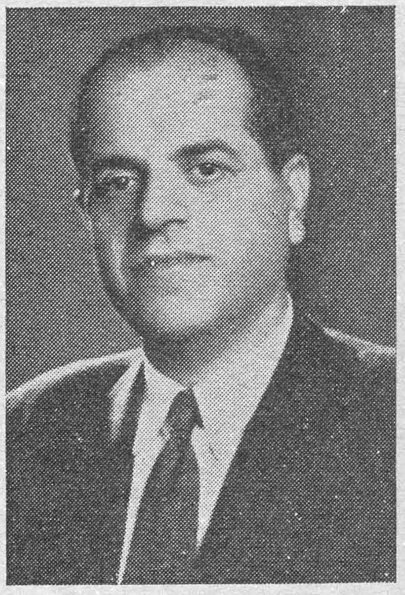
It was at the beginning of June 1920.
Lieutenant Dewey introduced Salma Sayegh, "my colleague" at the French Embassy, with these words:
"Here is a sea brimming with knowledge, taste, and good company — draw from it what you will and what you can."
Salma's pen was then cutting its flourishing path through
the gardens of literature.
And I was at the beginning of my career in translation.
Salma would correct my language and refine my phrasing.
She held in my heart the place of reverence and respect. And how should abundant courtesy, refined breeding, lofty character, self-denial, and solicitude for others be met, if not with reverence, love, and respect?
It was Salma Sayegh who introduced me to Gibran and "baptized" me in Gibran's literature.
I still remember her bereavement at his loss and her grief for him. It was not granted her to witness his funeral, held in Lebanon on August 21, 1931; she was at that time convalescing in Paris. From there she sent me, for that occasion, a word on the departed one of the East, which she concluded as follows:
Salma said to Gibran: "We were denied the sight of you living; we shall not be denied the sight of you dead. We, your followers, fear neither skulls nor bones, nor do we dread hollow eye-sockets; for in the fresh face of the child and in the pallid skull of the old man there is beauty, art, and poetry. And we are as you wished us to be: we see the spark in the worms as we see it in the stars."
Salma held art sacred; she loved artists and respected them.
At a ceremony held for the painter Habib Srour on the occasion of his being awarded the Order of Merit, Salma improvised a speech on Habib Srour in which she revealed his genius and the splendor of his art, and into which she wove the following incident:
Salma was summering with her firstborn infant child at al-Kfour. One day she entered her house and surprised Habib Srour bent close upon himself before the bed of her sleeping child, his immortal brush quivering left and right, rippling across the face of the canvas and roving over its margins, that the
child's face might be drawn upon it in the fullest and most beautiful likeness. The mother stood aghast at this sight, then cried out to the artist: "For pity's sake, do not! To paint a child while he sleeps is an evil omen."
Habib Srour yielded at once to this feeling and destroyed the canvas.
And fate willed that the child should fall ill a few days later, and that death should snatch him from his mother's bosom, leaving anguish and tears behind.
The mother longed to glimpse the face of that child whom death had hidden away — hidden his face forever. She remembered Habib Srour's canvas, and repented most bitterly, and grieved over it with the bitterest grief, realizing that a thoughtless remark had done away with the picture and with that beloved face.
Habib Srour sensed her remorse and her grief; he set about spurring his faithful memory, and his immortal brush set about recording what had clung to that wondrous memory of the absent child's features.
A few hours had not passed before Salma stood in front of a canvas on whose surface she could almost touch the face of her little idol, his hands and his gown — almost feel his quiet breathing and smell his sweet scent. A canvas pulsing with life, radiant with splendor; her eyes remained fixed upon it until death closed them.
... And Lebanon's loss after Salma was like its loss after Mayy and Gibran.
Edmond Wehbe
***
Memory carried me back to 1950, on an evening in Beirut's sweltering spring — and it was fated that that hour should be my last meeting with her —

in her beautiful house, upon the soft settee, near which crouched a bookcase, most of it white volumes ranged with fine precision. I went about reading the titles on their spines, a straw fan in my hand with which I stirred the breezes while I waited for the author of "The Breezes."
I knew that she had summoned me together with Zaheya Ayoub and In'am al-Saghir, with her mind on this magazine's emigrants' issue; and I knew too that, like all teachers, she was plunged deep in the flood of final examinations. Neither June's heat nor her educational and literary occupations had turned her from laboring over a translation — which I concluded was from Portuguese, which she spoke together with its twin, Spanish — and which filled my eyes as it lay on the table in the other corner of the room.
And how great were my ease and my admiration when she received me with a cheerfulness and composure over which her merry spirit and the astonishing quickness of her memory prevailed. Her sensitive fingertips took my clasped hand, and her voice, in the nasal music and charm of French, took my ear; I was