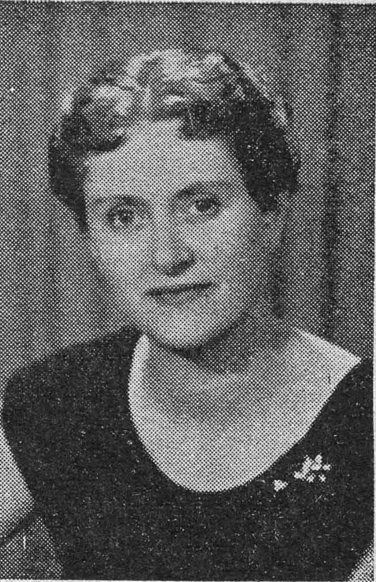
won by the deep-rooted femininity and beautiful art that breathed from her person and her surroundings.
And when the two other guests had arrived — I still remember that we sipped with her an iced tea, refreshing and delicious. When we asked her how it was prepared, she answered with the simplicity and eagerness of every woman who cares for the affairs of her house: "Like lemonade — only instead of water you put tea." Then my curiosity reached the point of
asking again: "You mean the same quantity of lemon and sugar and water?" And she rejoined with the light wit and ready jest for which she was known: "Your question is like the baccalaureate examinations. One says: 'the quantity of lemon and sugar and water itself,' and not 'the same...!!'"
And then there flashed before me a glimpse of Salma the educator, interweaving and intertwining with Salma the woman: sagacity and charm joined together, in a sheer black dress encircling skin like milk and a fairness like honey. And how should there not be traced in my imagination, as in the minds of those who knew her, those two dark-lustered eyes, above whose arched brows rose a gleaming forehead, from which the hair branched away like threads of the sun in their gilding and their renewal! And I would have lingered over the setting of her sun, with its mournful, desolate yellowing, were it not for a proud nose defying the generations — and the revolt of thought bursting forth from the faint movement on that page which is her mouth:
— What shall we say to the emigrants about Lebanon? A country that spreads "the fragrance of the inula and the broom"? While through its corners spread human masses whom the savagery of humanity has condemned to become "fire and firewood for the burnt offering of Palestine"? Where are its pampered sons, and the vagrant childhood, the deprived motherhood, the outcast old age? It is incumbent upon us to find a solution to the problem of the teacher "and of illiteracy in the highlands and the remote countryside." God rest the Syrian leader who did justice to woman. And what do you think of the rulings handed down by some of our judges?
Then she took from the table a pen and paper, and her graceful fingertips began to quiver — the quivering of a slaughtered creature longing for deliverance. The pen in her hand turned scalpel, the ink blood, the pages hearts — stained by injustice, made foul by avarice, turned to stone by bluster. She had a message for the citizen and for the emigrant — she who had known both sides at close hand.
And Salma the writer stood revealed before me in her fullest meanings. She struck out into the ideal and the real, into beauty and ugliness, into intuition and
sense. It was not enough for her to have criticized our frail society "and shown us our faults magnified until we hate ourselves and despair of reforming them"; she pictured it as an impregnable edifice with requirements and designs, which she laid out with precision and exactness after setting down the rock of reason as its foundation; then the clouds of dreams bore it aloft, a fluttering banner, on which the sun of reform shines and which the rains of integrity and dignity wash.
And the time ran out! — as the age runs out of its sons, and learning of its luminaries, and letters of its leading lights.
We three made to take our leave; she bade us stay a moment and walked with us to the door. And when a table crossed our path, on which issues of The Woman's Voice were ranged in a circle with the special "Mayy" issue at its center... her thin, pale fingertips took it up, and she looked and said, with the magazine facing us: "It is an exquisite drawing, and an eloquent issue."
The struggle raging in the world today is an economic struggle, and the nations defend their economies — men and women alike — with a fierceness akin to rabid frenzy. We do not know, then, why woman among us remains apart from what goes on around her, and why one half of the nation stands alone in this struggle while the other half looks on as a spectator, though it is able to render great aid to that half which battles alone in a crisis that breaks backs and chokes off breath.
I say this looking at the material side of this question, which has a moral side that must not be overlooked.
For the man alone to have access to useful knowledge, and to keep it to himself, is a sweeping injustice to the child.
And here my pen pauses, that I may contemplate the thousands upon thousands of the sons of my homeland scattered over every corner of the earth, running after the loaf.
And the loaf is here, in the heart of this country.
The wealth is here, and there is no one to stretch out his hands and take it. The emigrant objects that the country is poor and cannot sustain its people! But there is no poverty save in our hearts and in our souls. Poor souls refuse the struggle; rich souls struggle on, until they live a life — or die!
And freedom, O people of the homeland, is that every human being obtain what suffices him, without loading his burdens upon others.