the most important historical reason for the backwardness of art among the Easterners is the prohibition of idol-worship and the abolition — on religious grounds — of statues and their like; this violent campaign produced a huge void in our artistic life. The Christian religion in the West, on the contrary, worked to encourage art, and art spread and flourished... The artistic renaissance in Italy was the root of Europe's artistic civilization, and at its head stood the 'de' Medici,' the ruling family that was infatuated with art, encouraged it beyond measure, and set aside prizes for its works... This 'madness' for art, this devotion to it and struggle in its cause, brought about an artistic renaissance the like of which the East has never experienced..
Q — Has this European artistic renaissance continued to advance?
A — Europe is still even now digesting the fruits of that mighty artistic renaissance, which goes back over three or four hundred years of continuous work. The capital of European art at present is Paris. The Westerners' taste for art and their esteem for it show plainly in the effort we see among their peoples and governments to erect splendid academies of art and to spend on them generously — academies which with us are still in a primitive infancy.
Q — Do you believe there is a difference between the Eastern and the Western mentality in their grasp of art?
A — You have brought back to my mind a saying of my friend the great sculptor 'Bourdelle' — the companion of 'Rodin' — who once said to me: 'The Eastern brain is of gold, and it is riper than the Western brain. But the conditions needed to bring out these creative powers have not yet been provided for it.' Which means that we are
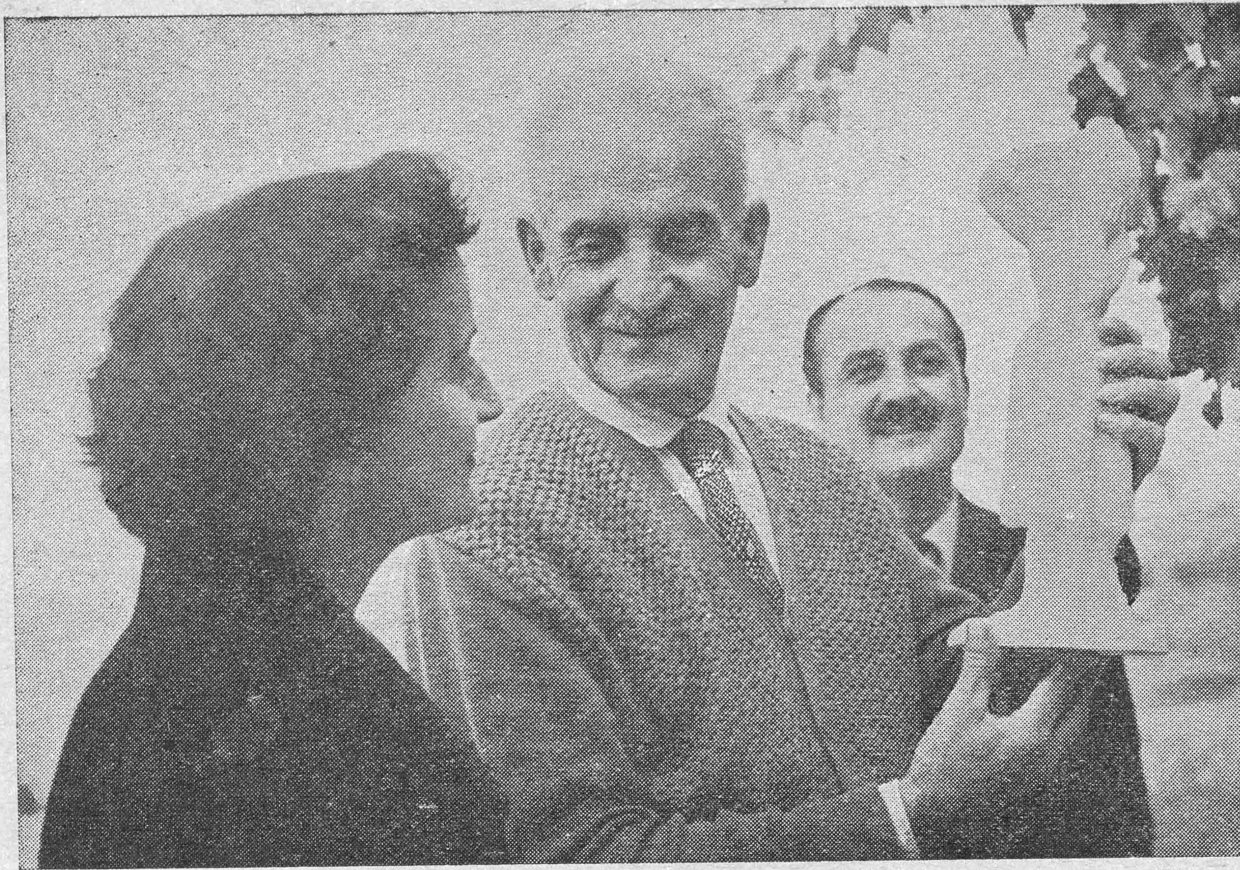
Howayek explains to the editor-in-chief how the 'model' is turned into a 'statue'; to his left, Mr. Azmi al-Buhayri
not poor in artistic gifts, but we are ingrates: we deny these gifts and work to smother them in the cradle.
Q — Did you notice, during your study and practice of sculpture and painting in Italy and France, that the Western mentality distinguishes between woman and man as regards their giving to art?
A — Never; rather, the European mentality has made woman and man equal. By way of example, I remember that when I was working in 1911 at 'Pietrasanta' — a marble quarry in Italy frequented by sculptors — there were more girls among my companions than young men. One companion, a Dutch girl named 'Marisha,' resolved to reach such heights of artistic attainment that her statue would be accepted in the 'Peace Palace' — and she held firm in her striving and her resolve until she had what she wished.
Q — Finally, what is the road to an artistic renaissance? What are the practical ways of filling this void in the life of the rising generation?
A — That is easily done, through home and school. Let our mothers place in their children's hands, before school age, an abundance of picture books, so that they learn to taste art before they learn to read; then let the books they read be well illustrated. Let us make use of Lebanese artists to teach drawing in the schools — nor is there any objection to calling on Europeans if the need requires. Let us encourage gifted students, and draw them on through competitions and valuable art prizes... And let the walls of the schools be adorned with copies of the world's great works of art, so that our children may know who Michelangelo is, and Leonardo da Vinci...
•
These are the counsels of the artist Youssef Howayek — a trust upon my neck, which I pass on to our readers; perhaps among them are some who have ears to hear...
Edvick Jureidini Shayboub
* An ''awra' is a spring that gives little water.