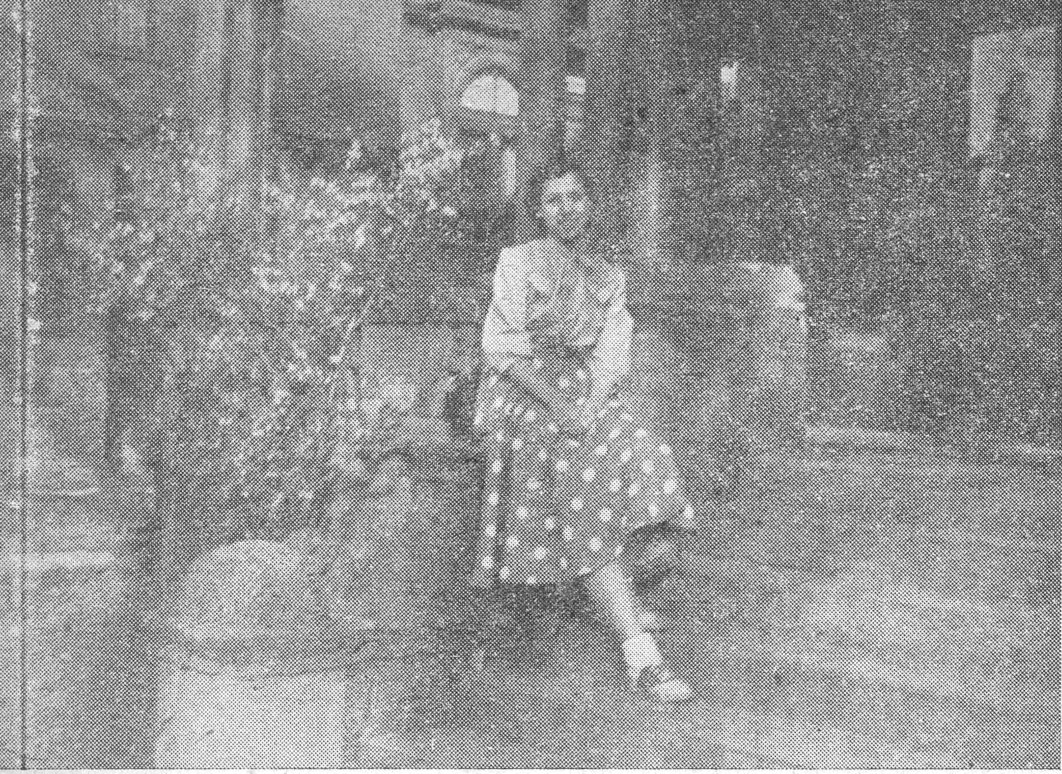
Layla Labaydi in front of her residence in America
Our friend Miss Layla Salah Labaydi recently returned from America after spending a year at the University of Michigan and obtaining the degree of “Master in Education” — Miss Labaydi also holds a Bachelor of Science degree in Arabic literature from the American University of Beirut, and it gives us every pleasure to present her here to the readers of “The Woman's Voice” in a series of her talks about the United States, on the most marvelous things she saw...
In the southern part of Manhattan Island, the beating heart of New York City, and within a stone's throw of Fifth Avenue — the street of modern fashions and elegant ladies — the tourist finds the most marvelous quarter in all New York...
It is a few narrow streets; the passerby in them cannot tell where one begins and another ends. They wind about one another as though they were not part of that great city famed for its well-proportioned streets and marvelous ordering... There, in a calm that ill suits New York's clamorous air, live folk who occupy themselves with the arts in all their varieties. This quarter is known as Greenwich Village. And though the name is familiar to the inhabitants of New York, the world has heard nothing of it, because its artists are either rising artists, or artists who have tried in vain to draw people's attention to their art. Yet this latter company is no class of ordinary artists, for they did not abandon their art to earn a living by other work; rather they moved to this village of theirs to live with their time consecrated to their art, where life is spirit and not matter.
Every morning, on my way to school, all through the month I spent in New York, I would turn aside into these narrow streets to wander through them and among the shop windows there, as a worshipper circles his temple. And every morning I would find something new that pleased my eye and thrilled my imagination, and I would feel a contentment beyond all contentment, and return to my school as if I were another person. How could it be otherwise, when a moment before I had been an artist, feeling all the delicacy and refinement there is in an artist's sense and feeling... How often I gazed at the faces of the passersby there, studying them, trying to fix the picture in my memory, for I am certain that among them is the face of a man whose name will one day shine famous in sculpture, and the face of a woman who may be the poetess of the modern American generation. And among them too are folk who have risen to the loftiest degrees of humanity, because
they live upon art, on high, drawing from it the water of their life...
And perhaps I do not exaggerate if I say that the animals and the inanimate things there have also drunk from art's sensitive springs. The beholder, seeing the cats stealing across the road or peering from those humble windows, imagines them adding splendor and majesty to the place; and seeing the dogs playing in the street, he thinks them more beautiful than the dogs he sees in other places. As for the inanimate — if it is right to call what the artist produces inanimate — it has without doubt drunk from those springs and drunk its fill. The houses, small as they are, are strange in their construction and pleasant to look upon. And the shops are among the most wonderful I have seen: most of them built below ground, reached from the public road by steps whose sides are adorned with flower boxes or with samples of the work of the artist who keeps the shop.
Art in Greenwich Village is not confined to painting, sculpture, literature, acting, and music, but goes beyond them to the making of jewelry, to dressmaking, to cooking, and to the selling of natural flowers... The names these artists have chosen for their shops are enough to show the variety of ideas and imaginations in that little quarter. Among the restaurants, for instance, there is one called “El Chico,” with all the bigness and grandeur in that name; another, “The Little Place,” with all the name's modesty and seclusion; and a third, “Humpty Dumpty,” with all the name's humor and childishness... And in the quarter's bookshops the beholder sees another proof of its variety of thought. There you can buy a book of poetry by Shakespeare or by Gibran Khalil Gibran, a story by André Gide or by Zelda Fitzgerald, and a book of psychology that speaks of dreams or of the influence of religion on man's life... besides all that these bookshops hold of new books we do not know, whose authors we know nothing about.
This is but a fleeting glimpse of what I believe to be the most marvelous thing I saw in the United States — and how could it not be, when there are gathered in it arts each one of which, taken alone, has its own captivating splendor?!