architecture in its school of engineering; and alongside the study of architecture Zareh attended the National School of Decorative Fine Arts and the School of Fine Arts in Paris and took the diplomas of both. Today he works as a professor of architecture in the engineering faculty in Aleppo.
During his stay in Paris, Kaplan followed the lectures of the famous art critic Louis Hourticq, member of the French Academy, for five years, and he also studied under Victor Prouvé, whose masterpieces occupy a prominent place in the museum of Nancy—this besides the long years he spent with Judon, the well-known engraver of wide fame in the engraving of metals.
And with all this, Zareh Kaplan was not influenced by any of the artists under whom he studied. He is a partisan of the use of many colors, and unlike the rest of the architect-engravers, he sacrifices drawings, forms, and lines for the sake of colors, which he delights in varying and playing with perpetually, to bring out the meanings, imaginings, and emotions that stir within him and which his powerful art reflects in his canvases in the language of colors; even in dark and sorrowful scenes you will always see frank, penetrating colors free of complication. Perhaps that simplicity and that freedom from complication spring from his having been influenced by decorative art. The paintings that held the visitors longest, so that they stood in sweet absorption and contented rapture, were the painting of the sunset—which we may rightly call the symphony of the sunset and the harmony of suggestive, poetic colors—and, like it, the painting of Ehden, and Venice, and the Spring Café, and a view in France, and others.
As for Nubar Sabbaghian, he was born in Aleppo in 1920, and from his earliest childhood his artistic inclinations appeared and his aesthetic leanings showed themselves. After many attempts and studies, his artistic bent turned toward the language of transparent, sharp colors, clear with the clarity of the Eastern sky which they reflect. After studying the various styles of painting, he was strongly influenced by the works of the artist Vignal, who belongs to the classical school. His beautiful paintings appeared before the public in 1940, and he took part in several exhibitions held in Aleppo and Damascus, as well as in the exhibition held in honor of the Syrian emigrants in America. In all his canvases shone his overflowing artistic genius and his fertile, sensitive, creative brush. It is worth mentioning that this artist was
deeply influenced by his surroundings, and set about transferring them into immortal artistic canvases, among them: "The Pasha's Orchard," which expresses joy and delight and strength and freshness; "The Citadel of Aleppo at Dawn," in which the colors almost speak and converse—by the strength of their expression, their harmony, and their answering one another—of the stillness of the dawn and its freshness; the painting of Jupiter at Baalbek, standing like an everlasting sanctuary to speak to you the speech of greatness and loftiness and to tell you the story of immortality; and the painting of the palms in Lebanon, which recounts to you the splendor of the towering palm, the wisdom of the outspread sands, and the depth of the blue sea.
Damascus
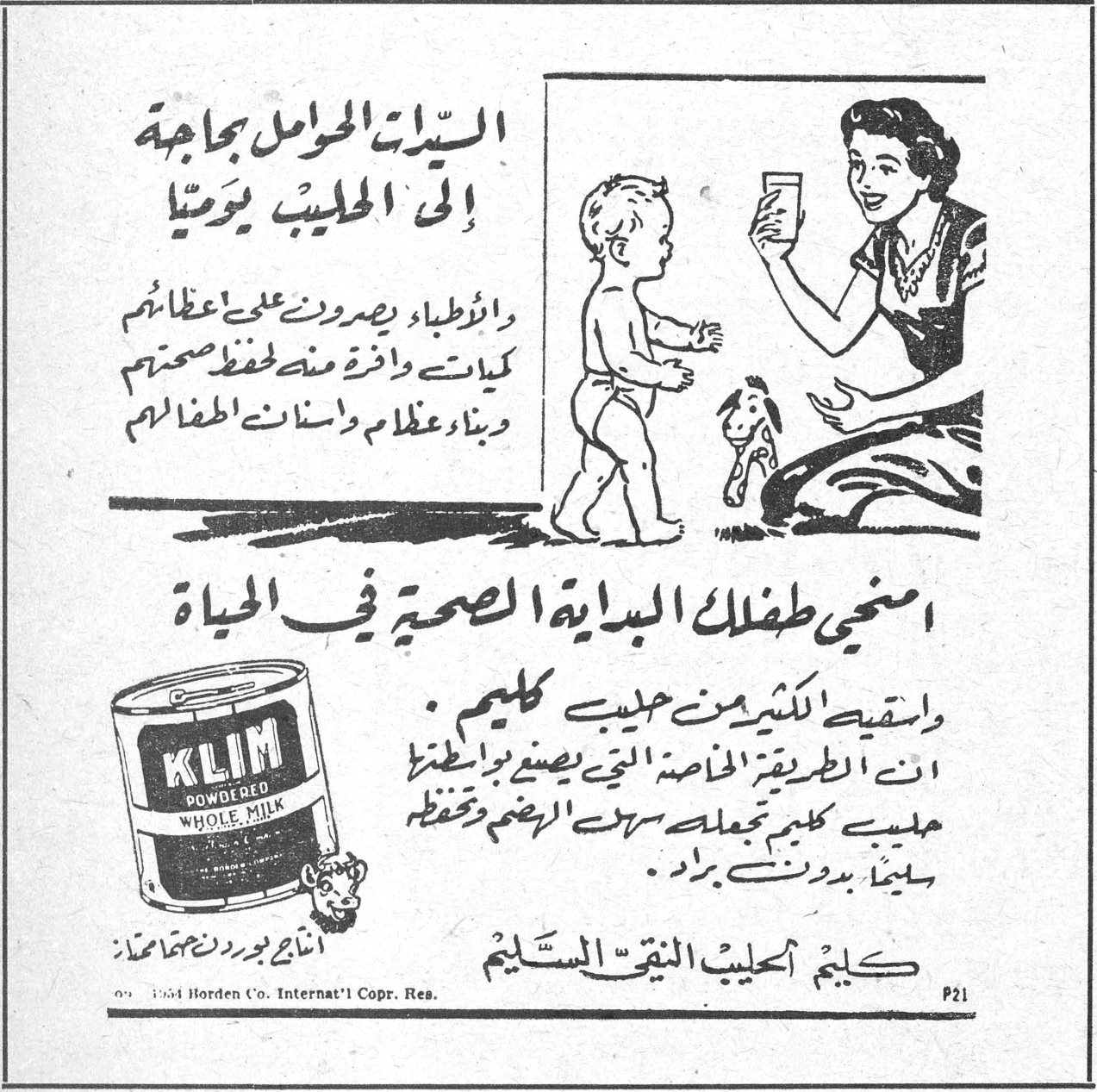
Klim, the Pure, Wholesome Milk
Expectant mothers need milk every day
And doctors insist on giving them ample quantities of it, to preserve their health and to build their babies' bones and teeth
Give your child the healthy start in life
And give him plenty of Klim milk to drink.
The special process by which Klim milk is made makes it easy to digest and keeps it wholesome without a refrigerator.
Klim, the pure, wholesome milk
KLIM POWDERED WHOLE MILK
A product of the Borden Co.