house must therefore attend to what the pictures say before buying them. If the housewife is a gentle, delicate person, the pictures of her house must express these qualities; but if she is a bold, daring, and inventive person, her pictures must possess these attributes. The little girl inclines to dolls and flowers, while the boy's taste turns toward animals, horsemen, and Indians. Pictures, then, must keep pace with the life and inclinations of every person who is to live in the room, if we wish to express his personality.
Just as pictures have a relation to persons, so they have a strong tie with the rooms in which they will hang. Some pictures are fit only for bedrooms, such as family pictures; others suit sitting rooms, and others dining rooms. On the whole, the pictures of the sitting room should be restful to the eye, not disturbing to the members of the family and to friends — such as pictures representing nature, the sea, flowers, and people. Dining-room pictures should be of the class representing nature and still life. Bedroom pictures are for the most part of a private character, differing with the taste of the room's occupant; and the pictures of children's rooms must have a story value that delights them and an artistic value that develops in them the love of beauty — and these are changed as the children grow in years and in mind.
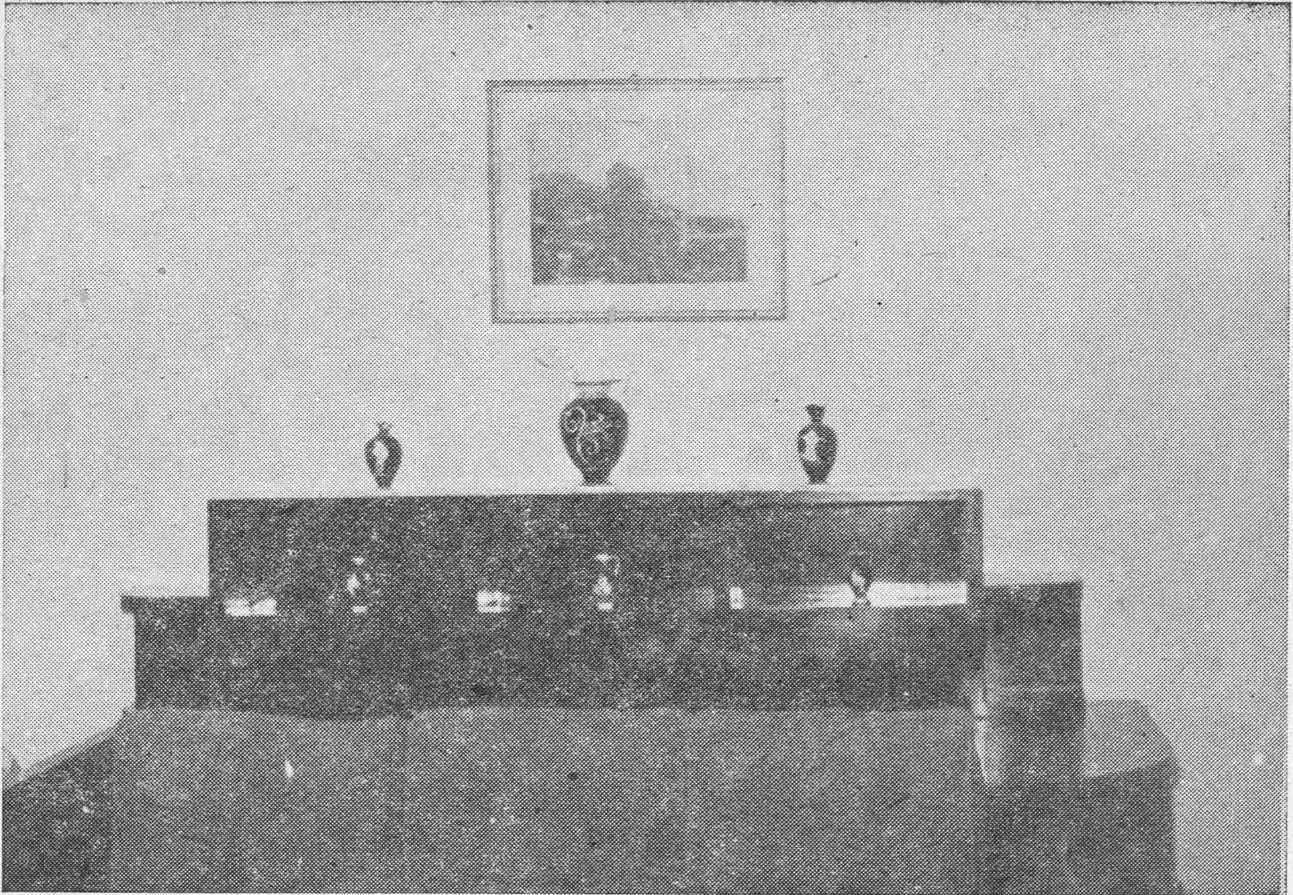
Hanging pictures is an art. Pictures are not there to fill an empty wall, but to compose with the furniture a beautiful, charming group. Pictures are hung a very short distance above the pieces of furniture, so that they and the furniture appear as one unified group, not as a
One suitable picture is sometimes enough above a piece of furniture, as we see in this photograph, which shows a part of the salon of Mr. Theodore Hepkides.
separate line dividing the room horizontally into two parts.
Pictures are placed at the height of a person's eye, not near the ceiling, as is the custom in most houses. In children's rooms they are hung at the height of the child's eye, not his mother's.
Pictures are set so as to lie flat against the wall, not tilting forward. We obtain this result — which makes the picture a part of the wall — by placing the hanging nails at the top of the picture. It is better that these strings not show, for they draw the eye up toward the ceiling, and that is something we do not want. For the pictures to compose a beautiful group, it is preferable that they follow a straight line, either at their bottom, their top, or their middle, according to the line of the furniture beneath them: if it is a straight line, the pictures are aligned at their bottom; if it is not, then the pictures are aligned at the top or the middle.
In the last century, and even in our own day, a room would
be given a collection of pictures of different sizes, shapes, and subjects. Monotony is a disturbing thing, and so is a great disparity among the pictures; proportion among them is required and necessary. Small pictures are usually used as a group, so as to be in proportion with the furniture. We must therefore select from those collections the pictures that are beautiful and suited to one another, and compose from them an enchanting sight. And in conclusion, let us ask ourselves:
Does every picture in the room help, artistically and aesthetically, to complete the ensemble of furnishings?
Are the pictures low enough for us to see them as one group with the furniture?
Are they at the same height on all the walls of the room?
If our answer is in the affirmative, we may take pride that the pictures of our house are beautiful in their placement and their arrangement.