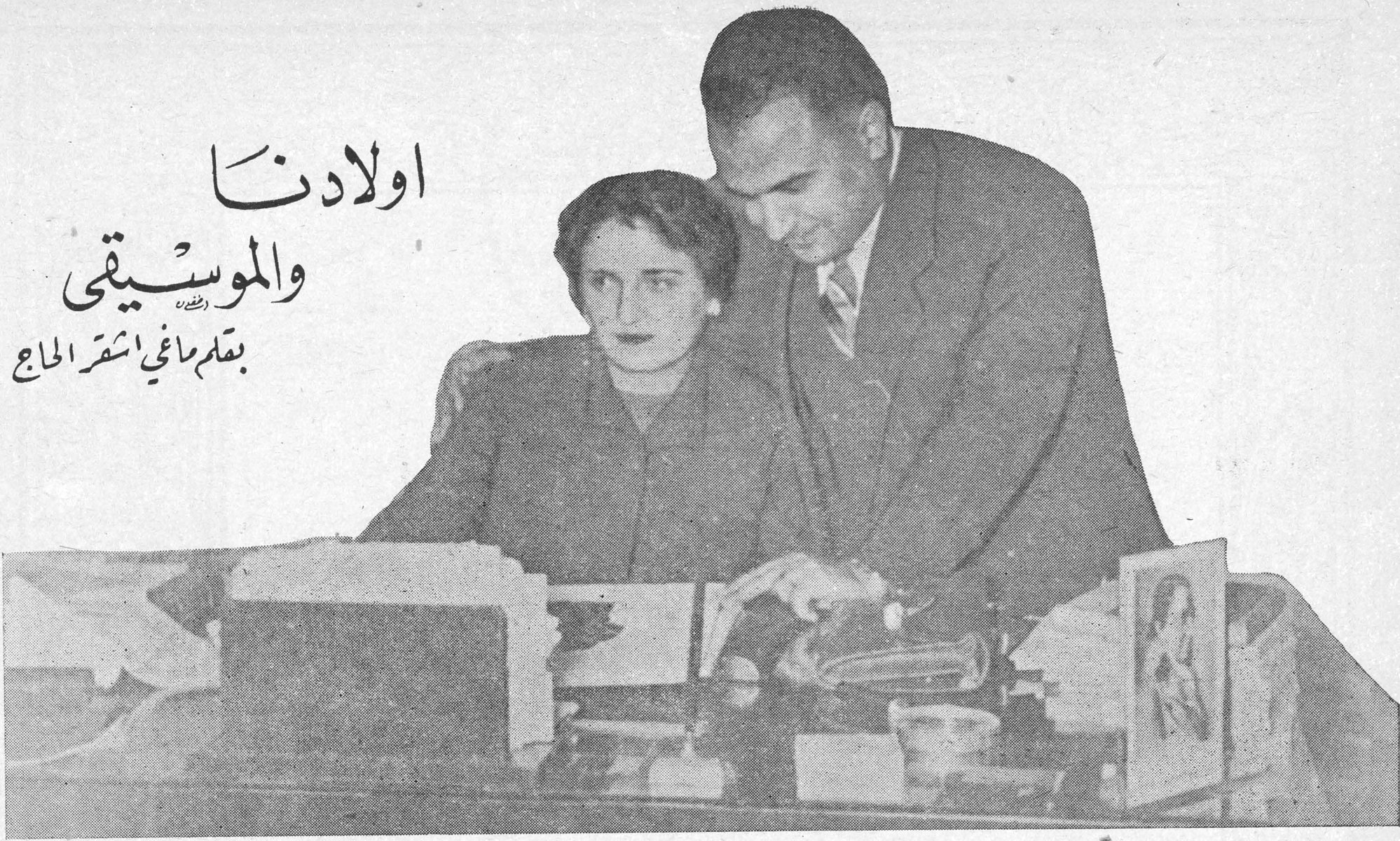
• What is the secret of the gloom on our children's faces?
• What are the benefits of making music part of the very substance of school curricula?
...This is what Mrs. Maguy Achkar al-Hajj answers here, and it delights us that she returns to contributing to the pages of "The Woman's Voice" after a long absence, having arrived at marital settledness with our friend Dr. Kamal al-Hajj. Our warm congratulations to the happy couple!...
True education has many elements and various foundations on which it rests. Among the most important of these elements is music, which imposes its presence upon man by force. Its measure, as some say, helps us gauge the degree of a people's progress toward refinement and civilization, for a truly aware people disdains to express its feelings in vulgar speech and so takes refuge in the loftiest mode of expression, which is melody.
Music is not a kind of idle play and amusement; it is an essential element in the formation of man's personality, above all in the child, for it works truly upon the human soul. If its strains are poured into a child's heart with a willingness to listen to them, they carry him from a world of illusions to a world of movement and activity, especially if he listens to music directed at children
at the beginning of their growth. Why, then, do we not refine the child's sensibility by urging him toward an understanding of the fine points of art, and of music in particular, so that his sense of beauty may grow? This is what enriches the personality and launches it toward the higher sphere of the soul; but our children are heedless of it, or distracted from it.
Our children carry on their faces a mark of gloom which foreigners among us notice and explain by saying: the gloom of your children is within them, for the outward appearances in Lebanon invite gaiety and cheer — a gentle climate, enchanting scenery, open mountains, and green valleys. Yes, the ailment of our children lies within them, because the child in Lebanon remains cut off from his own self until the age of twelve. An impassable barrier separates the Lebanese child from himself — a barrier created among us, in my view, by the aridity of our elementary school curricula.
The child in Lebanon is hardened in feeling, because he is brought up on petrified foundations that the child's own particular logic cannot grasp. Yes, the child has a logic of his own, and we ought to proceed according to it, instead of bending him to our crooked programs so that this logic collapses of its own accord.
The child in Lebanon is gloomy because he is split from his own self; he lives in an atmosphere from which his inner nature flees,