and so there arises that violent struggle and that expected gloom.
The child in Lebanon is lost, flailing about blindly without any real guidance, because true education has become among us one of those alien problems to which sufficient importance is not attached.
The child in Lebanon needs gaiety, suppleness, and free movement with a quiet soul. None of this has yet been provided him, so long as his programs are complicated to the utmost degree, utterly arid, and certainly at fault in their neglect of music in the shaping of his soul.
Has not modern medicine called upon music to cure nervous ailments? Has not music been the first remedy for the patient in convalescence? And is the gap so vast between a patient whose powers are unstrung and a child lost amid the range of his capacities? I hold that a patient in convalescence and a child in the stage of growth need one and the same constructive element, and I observe with regret that the West is more aware of its particular problems than we are of ours. We chase after complicated solutions, when our only solution is to give the child of his own wares, not of ours:
The child begins to take in unfamiliar branches of learning slowly and hesitantly, because his logic is weak. How many benefits music renders him at this stage of his life, strengthening his understanding, which then grows with the support of memory and imagination — and these faculties are in turn strengthened by continued listening to music.
And how the foundations of knowledge grow clear in the child's brain when we sit him down in the evening and, instead of telling him thrilling tales that stir up in his imagination phantom images which often hurl him later into the injustices of disappointment, we play for him a sweet musical strain that quickens
in him mind, understanding, imagination, and memory. All these mental powers crystallize, one after another, the more the child's attention to the piece grows strong and this attention stirs in him some attempt at comprehension. I hold that music — though some may accuse it of inviting softness — I hold that, on the contrary, it spurs to fruitful activity far more than empty tales of fancy. Music is a refuge to which the child resorts to find his lost personality. For music, in all the multiplicity of its colors within a strong unity, reflects the varied colors of the soul, and so it becomes easy for the child to listen to the echo of his own lost inner self.
Why do those in charge of the matter in Lebanon hold back, and not make music compulsory
in the elementary curricula as they make the other subjects compulsory? Music is an effective element in the formation of the child, and it has the prior claim to impose itself upon his world.
Why do they not bring music into the morning physical drill, so that the children repeat melodies as they do their exercises, exercising mind and body at one and the same time? Music is the salt and learning the bread — and what taste has learning unless it is joined with music that brings out the elements of delight in it and keeps it from going stale?
My wish is that music should enter as arbiter between the child and his inner self, and my hope is that the problem will be solved, for music, in its apparent complexity, reveals a strange ease in untying the knots of the soul.
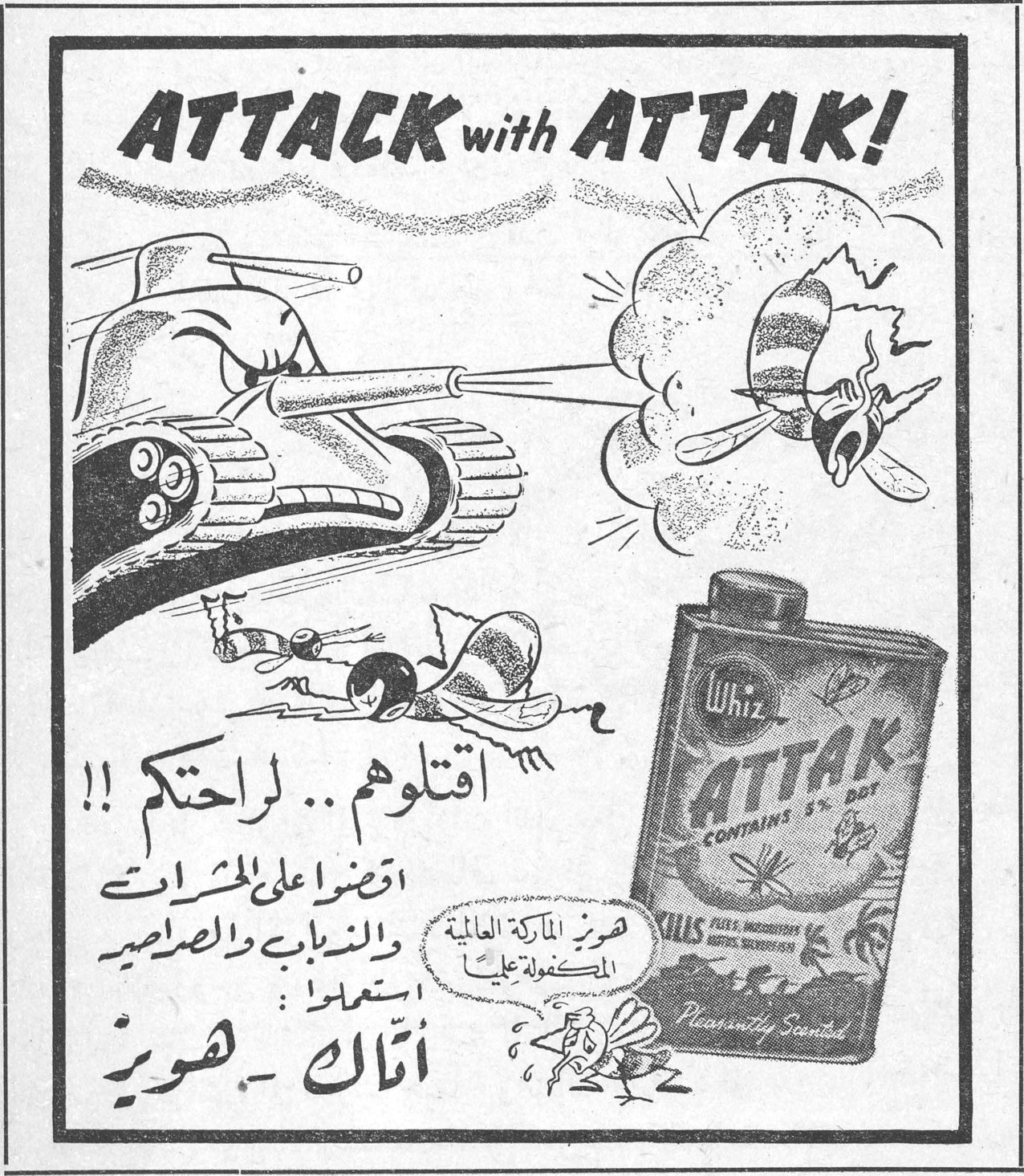
Attak — Whiz
ATTACK with ATTAK!
Kill them.. for your comfort!!
Wipe out insects, flies, and roaches
Bearing the picture of the world-famous registered trademark
Use:
Attak — Whiz
Whiz ATTAK
CONTAINS 5% DDT
KILLS FLIES, MOSQUITOES, ANTS, ROACHES, etc.
Pleasantly Scented