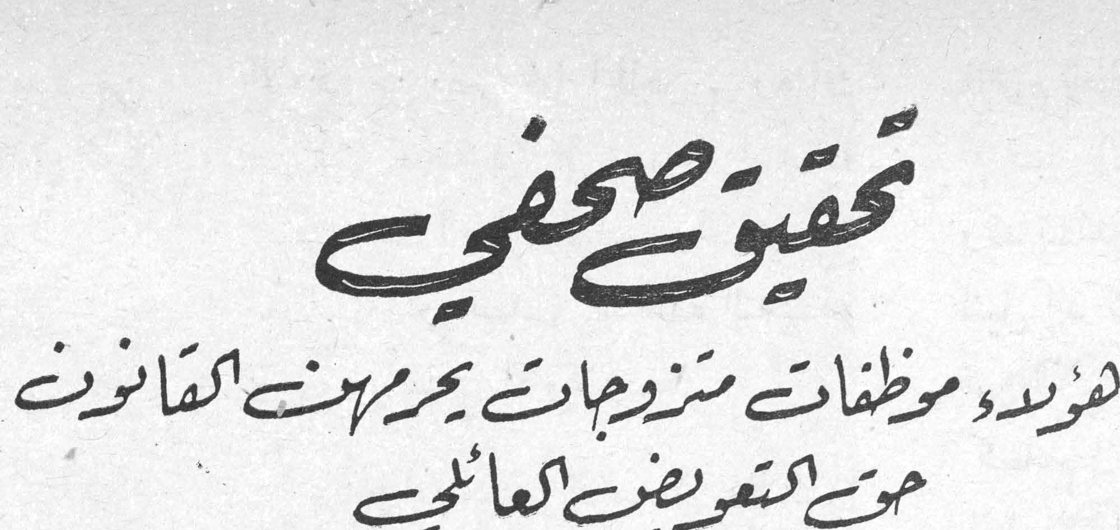
... We promised our dear readers in the last issue that we would bring them a press investigation concerning certain married ladies, women employees on the state payroll, whom Lebanese law denies the family allowance ... In fulfillment of our promise, here we record some of the names, hoping that we shall soon arrive at a fuller count, so that
Lebanese public opinion may know the extent of the injustice that befalls the married woman by depriving her of the family allowance when she is, in most cases, the sole breadwinner for her children ...
The mother bears the greater share of the pains, the suffering, and the hardships in bringing the new generation into life, raising it, and preparing it to be an element of good and of building in human society. Yet for all that, she remains on the margin of the matters that touch the foundations of her children's lives, insofar as they are social individuals and insofar as they are an element of building and construction in the rising generation.
That seemed natural — or shall I say "acceptable" — in the days when the woman, or the mother, was a dependent of the head of the family, who secured for her and for his children their needs and their livelihood. He alone held the right to manage the affairs and concerns of this family, and the law granted him this right and protected it. And so it was with the authorities when the head of the family alone held the right to enjoy the family allowance: they considered it natural and necessarily taken for granted that the man should enjoy this right. And he entered into the texts of the law as the sole party concerned.
But it was not long before the woman plunged into the currents of public life and entered the various fields of work, contributing to securing the family's livelihood and its needs. It thus became natural, and in the logic of things, that the law's position toward her should change, and that its provisions be amended to accord with her new situation; that she should have rights like those of the head of the family; that the family allowance be divided into two parts, the man receiving the first part and the wife the second; or that one of them receive it in full if there is no partner to draw it; or — and this is reasonable and just — that both of them receive it in full, as an encouragement to bear children.
This is the matter from the general standpoint
of principle.
As for the practical, factual standpoint: the magazine The Woman's Voice — whose editor-in-chief, Edvick Jureidini Shayboub, had the merit of priority in raising this subject and in sending an open letter to the leaders of the women's movement to alert them to this very important aspect of women's rights — the magazine The Woman's
Voice, I say, wished to prepare a detailed study of this question, the question of woman's right to the family allowance. So we decided to furnish it with specific information, to be taken as an example of the situation of lady employees who provide for their children by themselves, owing to particular circumstances and causes, and who nevertheless do not draw the family allowance — because the law stipulates that:
"In application of the law of legitimacy, the children are the charge of the father until they attain majority or the age at which they are able to earn their living, and, if they are female, until the day they marry."
"If the father is materially unable to secure his children's needs, the children are legally in the custody of the mother; and upon the mother's death or in her absence, they are in the custody of the nearest relative until majority or until the age that enables them to earn their living."
"The father's absence is considered a material impediment to his fulfilling what is incumbent upon him toward his children, provided that his place of residence abroad is unknown, or that he is in a state of utter poverty that prevents him from carrying out his duties toward his children," etc. ...
From this it is clear that the mother cannot enjoy the right to the family allowance even if she contributes by shouldering an ample share of the burdens that fall upon the head of the family, and that she is entitled to enjoy the family allowance only if she can prove that she is a widow or that her husband's place of residence is unknown.
From the foregoing it is clear that the law in force among us is no longer of such fairness and justice as to be fit for application in a country where woman has taken her decisive step and now stands politically on one level with man; and it has become a duty to raise this subject on a wide scale and to bring it before public opinion.
As a preliminary to