On the margin of Lebanon's signing of the charter of women's political rights
How is woman preparing for the general congress of the Arab Women's Union, which it has been decided to hold at the beginning of next June in Beirut? Is woman conscious of her grave responsibilities, and does she appreciate their importance, so that she will stand in a single, close-ranked line to support her cause and prove her worthiness of absolute
equality with man?
Dr. Charles Malik, Lebanon's delegate to the United Nations, signed the charter concerning women's political rights at the meeting held at United Nations headquarters on the twenty-fourth of last month. The said charter gives woman the right to vote in all elections on an equal footing with man, to occupy public offices, and to exercise any practical activity on the same conditions as man, without discrimination.
This is the summary of the news that the dispatches brought us in the last week of February. If the news carries any significance, it is that Lebanon has recognized for its women, at home and abroad, the full rights of the citizen, preceding therein every other Arab country by granting these rights without particular conditions, such as those that impose upon the Syrian woman, as voter and as candidate, a certain degree of education, for example. I paused a little at this news and went on to ask myself a question to which I would like to hear an answer from the Lebanese woman herself: has this step — the step of granting the Lebanese woman the right of election in both its halves, and the step of acknowledging this in an international charter — been able to stir in the Lebanese woman reflection upon the gravity of the responsibility which the logic of things makes it incumbent upon her to bear?
The results of the last electoral battle in Lebanon, which took place last July and in which the Lebanese woman took part for the first time in the country's history, allow
my question no reassuring answer. We all still remember that certain women's voices were long raised, demanding that the way be opened to woman and insisting on the necessity of granting her rights — and we do not except from this stand the women's associations and institutions — yet when matters came to the test, these personalities drew back from nominating themselves, just as the organizations did not think of arranging a definite program under which one of the women
would be nominated to enter the Chamber; nor did any gesture come from these organizations to back the two women personalities who held their ground in the field to the end, despite their feeling from the outset that their scales would lose against the electing public's traditional faith in the strength of the man.
Does this mean, then, that all the Lebanese woman and Lebanon's women's organizations were burning for was to complete these formalities and then say: what have I to do with politics — it has a lord to protect it?
I have heard and read various justifying comments on this slackness in preparing for the battle and entering it. Some speak of the necessity of deliberation before storming the Chamber for the first time; some of the necessity of preparing public opinion to accept this step; and some, and some...
It does not serve us here to weigh each justification's share of argument and logic, just as expatiating in comment upon an event now counted as old is a matter without
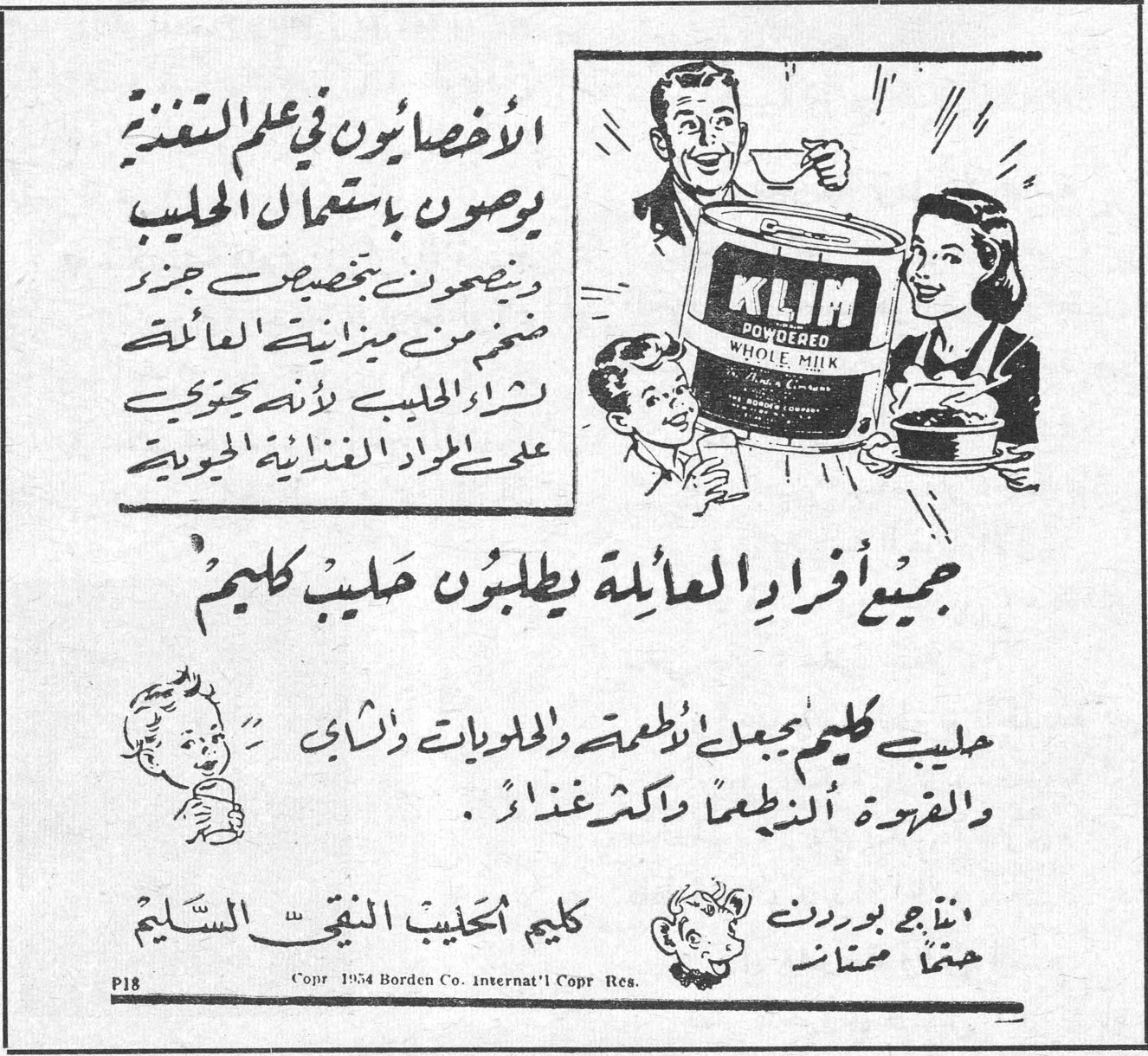
Klim Milk
Specialists in the science of nutrition recommend the use of milk
And they advise setting aside a large part of the family budget for buying milk, because it contains the vital nutritive elements
KLIM POWDERED WHOLE MILK
All the members of the family ask for Klim milk
Klim milk makes foods, sweets, tea, and coffee tastier and more nourishing.
Klim, the pure, wholesome milk
A Borden product
Excellent digestion
P18 Copr 1954 Borden Co. Internat'l Copr Res.