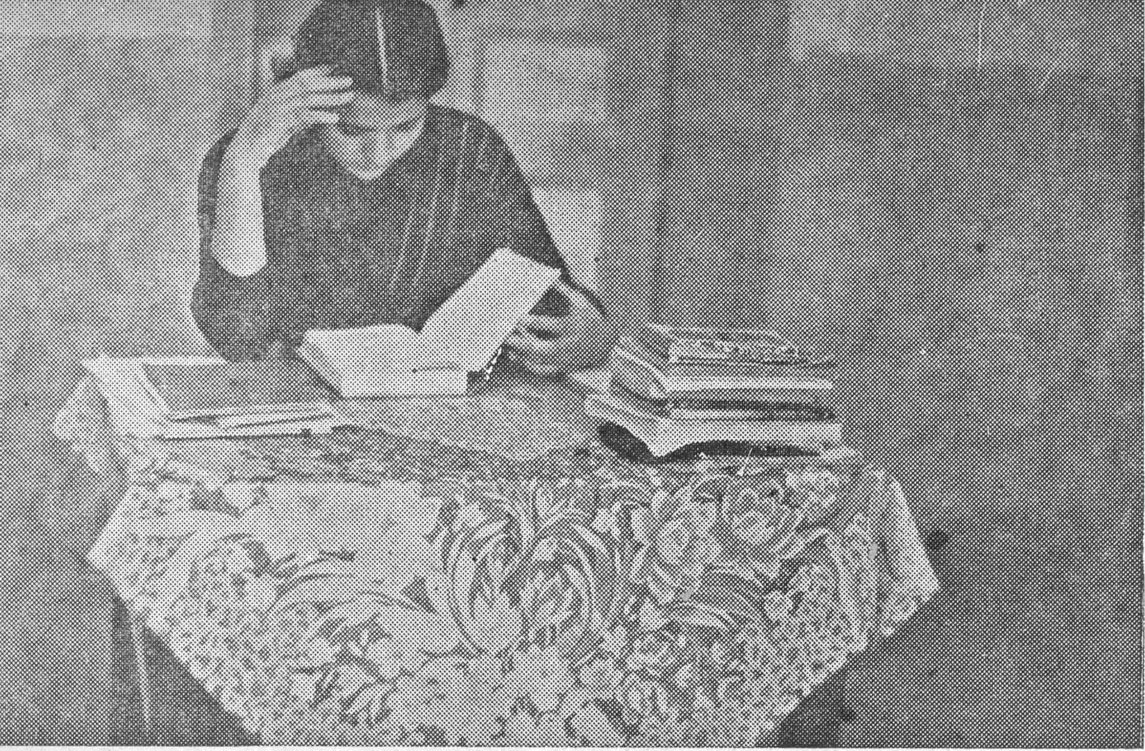
Woman has a world of her own, which does not match man's world in breadth and ramification; and it is to this limited sphere that pens and women's magazines address themselves, to examine woman's works within it — in addition to those works in which she shares with man, whether in the political or the practical field. Were the pens that treat social, educational, and household subjects to fall silent, where would woman's world be?
Here is a study published by Coronet magazine, presenting two prominent personalities in the press and in broadcasting. Woman has proven her mighty strength in the struggle to reach the goal. While many are at a loss how to solve their material problems, we see the specialist in economics, Sylvia Porter, who has kept up the writing of this column for fifteen years in the great newspapers, offering her readers reasonable and useful solutions — the distillations of her experience. She is forty years of age, bright of face and sweet of speech; and she is, moreover, a housewife, a mother, and an author. Perhaps the greatest feature of her personality is her frankness: she was once dismissed from her work at a great newspaper for taking up a case in which merchants had wronged the people; and she received the dismissal with calm nerves and a confident, serene soul.
She met with difficulty at the start of her work, for the newspapers always prefer men and are seldom at ease with a woman; but she proved, like other women before her, woman's worthiness of any post. As for the other woman, she is Mary Margaret McBride, and of her there are tales that resemble legends: one of her birthday celebrations was attended by fifty-four
thousand admirers of her talks and her voice. She is a broadcaster and a pillar of the commercial field, counted as one of twelve outstanding personalities in American commerce, drawing an annual income of two hundred thousand dollars. When General Bradley was asked why he chose to place the first word he addressed to the people after the war on her program, he answered: "To rise in my wife's esteem." And as an example of the regard in which this personality is held: a box left to her by a lady, containing a treasure of riches and a note on which was written: "These are the last of my wedding gifts, and thank you for the happiness you have sent into my life."
As for the subject of love, it is nothing new, Madam, and Pageant magazine has treated it. The writer says that we seek love from the cradle to the grave; life, by his reckoning, is one long search for affection and understanding!
We seek love by our natural impulses at our mothers' breasts, as infants. When our world widens, we find it among family, brothers, and friends; and the greatest love is the love of man for woman, in which there is a fulfillment and an ease that no money can buy. There are five kinds of love. The first is imaginative love — the love of stories, legends, and plays — in which the young man is usually taken with his girl at first sight, and the marital bond dissolves with the extinguishing of that first reality; the woman is drawn by the phantom of this man who lifts her thoughts up into the world of dreaming fancies.
The second kind is bodily love, the opposite of the first, preferred by the man who looks at life otherwise than with woman's spiritual gaze. The third is creative love, which drives the man upward, contested within him by the two factors of security and the love of continuance: the first is quenched by mere sufficiency and bodily comfort, while the second is his need for inner stability in love, which begins on a basis of outward attraction and then progresses by degrees to inner affinity and spiritual harmony. The fourth is spiritual love, which is rare even in imagination, for it means absolute sacrifice without thought of the demands of instinct, together with fidelity, mutual respect, and understanding; it is the loftiest meaning of love. It is followed by realistic love; for though spiritual love is loftier, not every human being can attain it, and so this majority must content itself with realism in love — which is the distillation of all the kinds, as it is the fruit of experience and of mental maturity.
Your Life magazine touches on a moral subject worthy of attention, in an age in which chaos prevails and runs riot. The writer believes that we cannot simply put on our manners, for they are the mirror of our inner selves, and every movement adds a new touch to the picture we are painting.
Amal was given the choice of a fiancé between two young men. One was rough of nature, boastful,
garrulous, but intelligent and good of heart — a hard metal in need of polishing. The other was the butt of his companions' jokes;