itself in this: that she contrived to conceal the news of his death throughout that critical period, lest the thoughts of the Ayyubid emirs and of the fighting Mamluks turn toward the succession to the throne. To the great men of the state who desired to see him she would say: the Sultan is very ill; no one can be admitted to him. He was buried by night, under the supervision of his private physician, in the citadel of Rawda.
Ceremonies at the royal palace continued in their natural course: letters and decrees were submitted for the king to give his opinion upon them, and came out stamped with his signature; the sultan's table was spread at its appointed times as usual; and orders continued to be issued to the emirs, commanders, and chiefs, bearing the king's seal. Thus this wise woman saw that concealing the news of the king's death was an utmost necessity, until she could take stock of her situation and overcome the powerful enemy, and so that the fighting men's attention should not turn to mounting a throne emptied of its master.
When Shajarat al-Durr observed that the enemy was on the point of defeat, and that the concealment of the news of the death was on the point of dissolving, she summoned her husband's son, the Emir Ghiyath al-Din Turan Shah (her own son Khalil having died in childhood), and issued orders to the chief men of the state to swear him the oath of allegiance. Before his arrival she went on laying war plans with her commanders, supervising their execution, and closely watching the course of the battle at Mansura; and such was her zeal that she joined the townspeople with the soldiers in repelling the enemies' raid and punishing them severely — until it was to her credit that the Crusaders were defeated, that they evacuated the country, and that they submitted to the terms of peace which she dictated to them, including the great ransom they paid, which shattered their treasury. But we —
As for Turan Shah's rule, it did not exceed two months, so greatly did he corrupt, tyrannize, and debauch. He denied, moreover, Shajarat al-Durr's kindness to him
and treated her ill, so that she took refuge in Jerusalem; then he sent to threaten her and to demand that she return to him what she had carried off of goods and jewels. He had removed the former men of state from power and had threatened the Mamluks with death; and they, fearing his violence, killed him and proclaimed her sultana over the country. She then ruled with a rule in which she showed every competence and capability. Such was her good statecraft, her firm management, her breadth of knowledge, and the goodness of her repute, that her name was spoken on every tongue in terms of praise, awe, and admiration.
She filled the treasury of Egypt.
She took for herself a series of titles and was called: "The Queen Ismat al-Din Shajarat al-Durr, Umm Khalil, al-Musta'simiyya" —
the last in reference to the Caliph al-Musta'sim billah, who sat upon the throne of the Abbasids in Baghdad, and whose recognition she was eager to secure. For it had been a tradition of the house of Ayyub, ever since Saladin took the throne of Egypt and abolished there the doctrine of the Shiite Fatimids, that whoever sat upon the throne of Egypt should seek the Abbasid Caliph's recognition of his rule.
And when she found that her remaining on the throne had aroused against her the people, the house of Abbas, and the Ayyubids of Damascus — who tried to give allegiance to one of their emirs for the throne of Egypt —
she married the Emir Izz al-Din Aybak the Turkoman and ceded the kingship to him in the year 648 A.H., corresponding to 1250 of the Christian era. He was given the
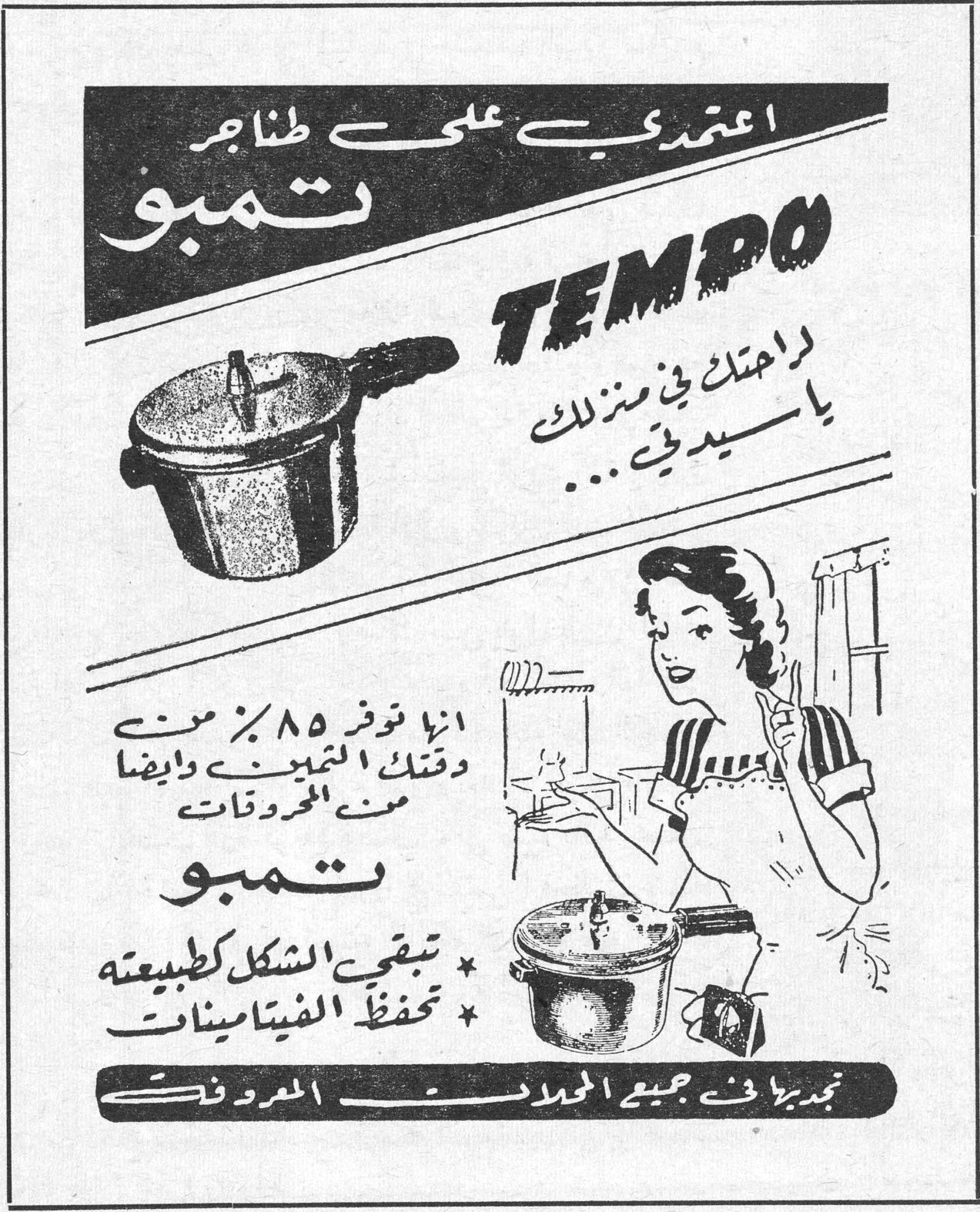
Tempo
Rely on Tempo pots
Your comfort in your own home, Madam...
They save 85% of your precious time — and of fuel as well
Tempo
* They keep food's appearance in its natural state
* They preserve the vitamins
You will find them in all the well-known shops