meant to discuss some weighty matter — and their voices rose in song. The song ended,
and everyone in the hall applauded loudly, with cheers breaking through; the ring broke up, the singers bowed to the audience, and each returned to his place. As for me, once my astonishment at the affair had passed, it seemed to me a novel manner of presenting professional singers. But I soon learned that they were nothing other than a "barber shop quartet."
The origin of these singing quartets goes back to the days when the barber's shop was the meeting-place of the townsfolk, who gathered there in their leisure hours to exchange talk and amuse themselves. The barber himself would relate the social news in detail, with his own commentary on it, and would discourse on the country's domestic politics, setting forth his private opinions on the subject. Nor was his work confined to barbering: it extended to the various arts of medicine. Perhaps one of the most curious facts of that age is that in the seventeenth century, in England and Europe, the barber had the right to practice the profession of medicine, while the law did not permit the licensed physician to practice the trade of barbering. And the barber was, in addition to all this, a recognized artist. His shop always contained a violin, or a qanun, or some other musical instrument with which the shop's patrons amused themselves.
Nor was the Eastern barber any less fortunate than the European and the American barber. My father and mother tell me of similar circles in the shops of the Beirut barbers in the recent past, and of the skill of the barber of yesterday in dentistry, in bone-setting, and the like. The Beirut barber, too, was a man of music: his shop housed an oud,
and pupils learning to play and to sing.
The days passed, and the age of specialization arrived; laws were enacted forbidding the barber to practice medicine — in Europe first, then in America, then in the East. People grew busy, and the circles scattered from the barbers' shops, everyone going off to his own work. In Europe and the East, people gradually forgot the gaiety of the hours they had spent in the barber's shop. But in America they formed a union which they called the "Barber Shop Quartet Union," taking in those patrons of the shop who
were devoted to singing. This union grew until it embraced a great part of the amateur singers of America. All its members are men; they meet from time to time to sing — and they sing wherever a sufficient number of them come together. Their songs are known among the American people as barber shop songs; all of them are quartets — a quartet being a musical composition comprising four different voices — and all of them are gay and merry. Their music is easy, and anyone who loves singing can sing them, whether his voice be good or not.
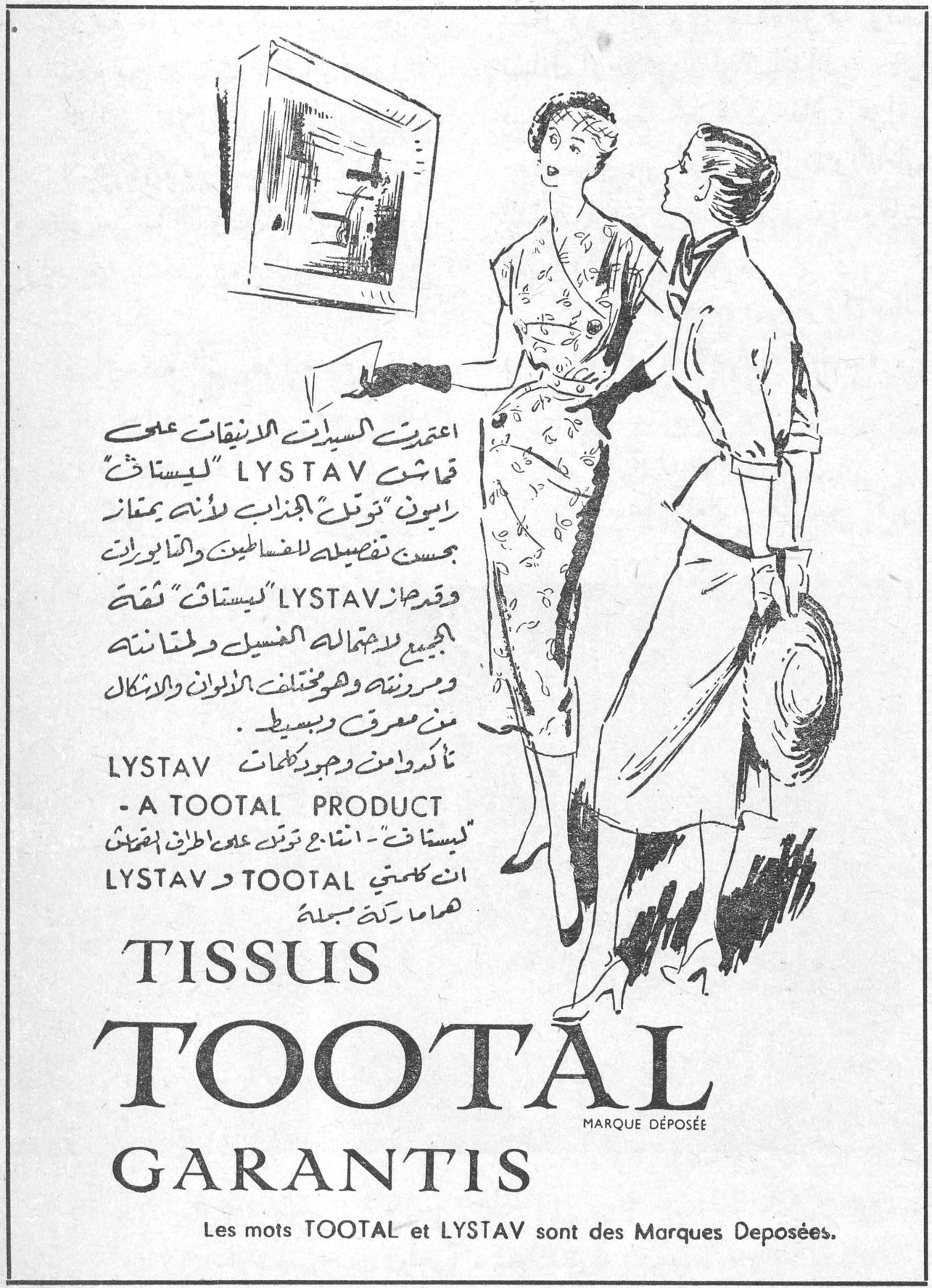
Guaranteed Tootal Fabrics
Ladies have grown accustomed to spending on LYSTAV fabric — Lystav, Tootal's attractive rayon — because it is outstanding in the fine tailoring of dresses and tailored suits; and the capacity of LYSTAV — Lystav — answers every demand: washing, durability, and suppleness. It comes in various colors and designs, patterned and plain.
Make certain of the presence of the words
LYSTAV
- A TOOTAL PRODUCT
Lystav — a Tootal product — Tootal, on the selvage of the cloth
The words TOOTAL and LYSTAV are registered trademarks
GUARANTEED TOOTAL FABRICS
REGISTERED TRADEMARK
The words TOOTAL and LYSTAV are Registered Trademarks.