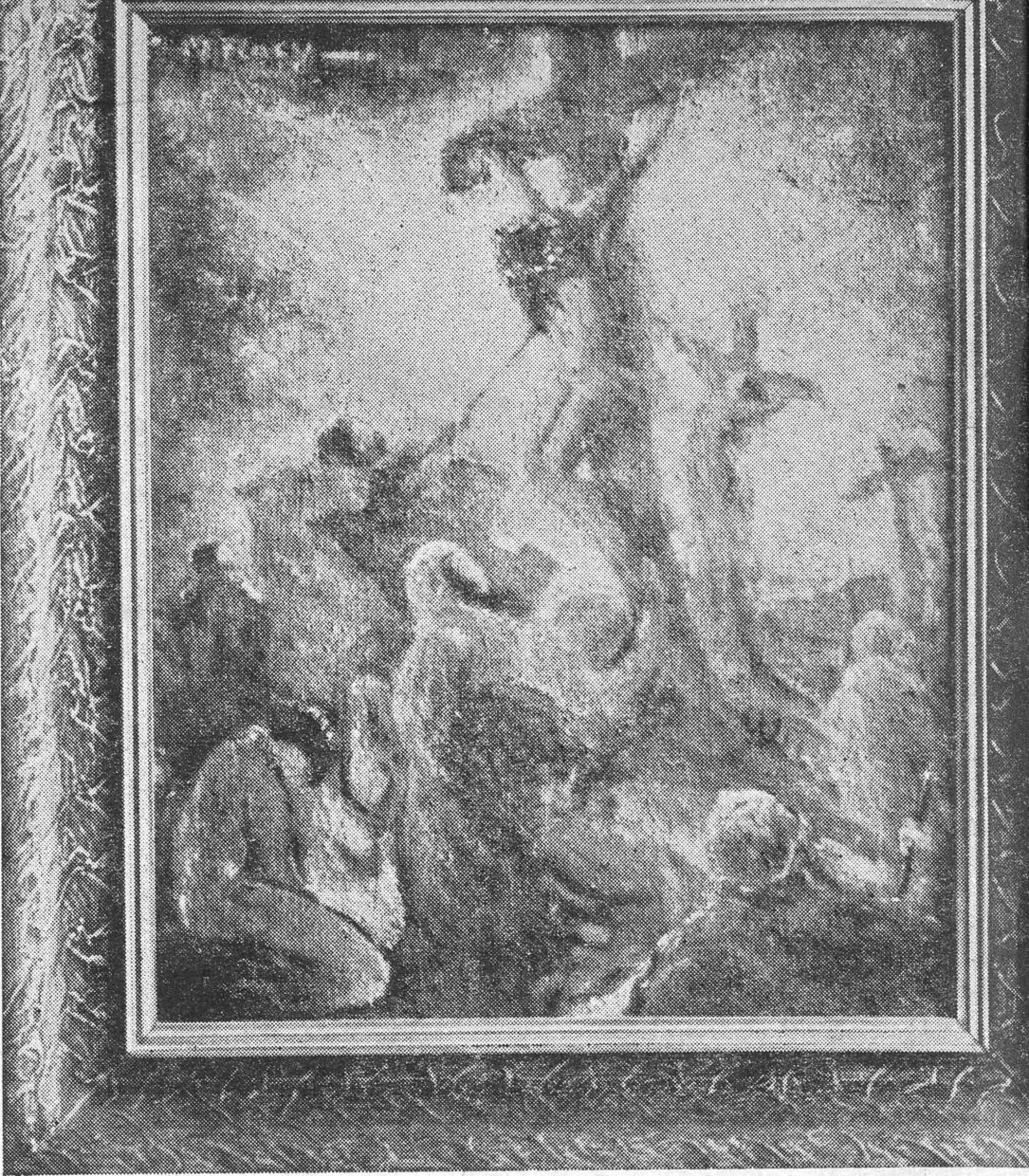
The Crucifixion
tries of Europe, I let no opportunity pass without seizing it to visit art collections of every kind.
Perhaps the variety of my study and observation was the reason for my not belonging to any particular school of art, for I have attempted every kind of painting, the old and the new; but I incline to the moderate impressionist manner, which I consider a universal language understood by the elect and the common folk alike, and which is in my view the noblest thing art has attained to this very day.
Q — How do your occupations allow you to devote yourself to art?
A — I watch for hours of leisure as devotees of the hunt watch for holidays, especially in the summer season, whose long days and warmth allow me to go out to the shores and the countryside. And I hold it a duty every man owes himself to have a hobby to which he can resort and take refuge in his hours of leisure, spending them with pleasure and profit and renewing his energy, so that he returns to his work with resolve and serenity. I do not know boredom, and all that I wish is that my occupations allowed me more time to spend in painting.
Q — Which subjects attract your brush more than others?
A — My brush is attracted, as I have already indicated, by all manner of subjects; I am like a ravenous, hungry man who sees before him a table laden with everything delicious and good, and stretches out his hand to all of it and is never sated. Yet if my time
were ample, I would devote myself to painting the ideas that visit me now and then from the reality of life; but these demand a labor I cannot afford in my particular circumstances, so I turn to such portrait painting as comes within reach, or to what is easier still — the painting of landscapes and still life.
Q — What is your opinion of the schools of modern art?
A — Would that I could do this question justice in a brief phrase; but it is a fascinating, thorny subject with rugged paths, which I hope to plunge into on the pages of this magazine in a special piece. All that occurs to me now is that there is nothing new under the sun. Let not him who lays his colors on his canvas with the butt of his brush, or who sees red as green, or who imagines a man's eye in his belly, or who conceives things as lines and squares and circles — let him not think he has invented gunpowder. These are all old experiments that have accompanied every stage of pictorial art or decorative art. And what they call modern art, with all its whims of novelty and imitation, its steps of guidance and of error, its qualities of ugliness and of beauty, is no more than one of the roads of development, which must one day issue in the establishment of a richer art; it has no value except in the measure that it serves a loftier civilization, for whatever in it is corrupt and founded on impotence and charlatanry will wither away by the roadside, and whatever in it is sound and founded on honesty of endeavor and direction will endure — and on this none but time will pronounce the decisive word. In the span of my artistic life I have watched schools — if it is right to call them schools —