in Lebanon, its steady advance and its flourishing.
The average of what the tourists spend annually runs from seventy to one hundred million Lebanese lira. We see, then, that the result comes back to:
1 — Increasing the income of foreign currencies and encouraging their investment inside the country.
2 — Strengthening the feeling of national and civic dignity.
3 — Spurring on the cleaning and beautifying of every community.
4 — Creating an interest in the national economy.
5 — Spreading publicity for the country abroad.
And publicity is among the matters the Commissariat has lately attended to, among its many fields of activity, and has spread by every means: among them the cinema, among them the press, and among them participation in the international exhibitions. It pleases me to recall to the Commissioner what the newspapers noted of Lebanon's winning the first prize at the economic fair at Bari in Italy in the year 1953; the Commissariat likewise continues its efforts to organize the Lebanese pavilion at the São Paulo
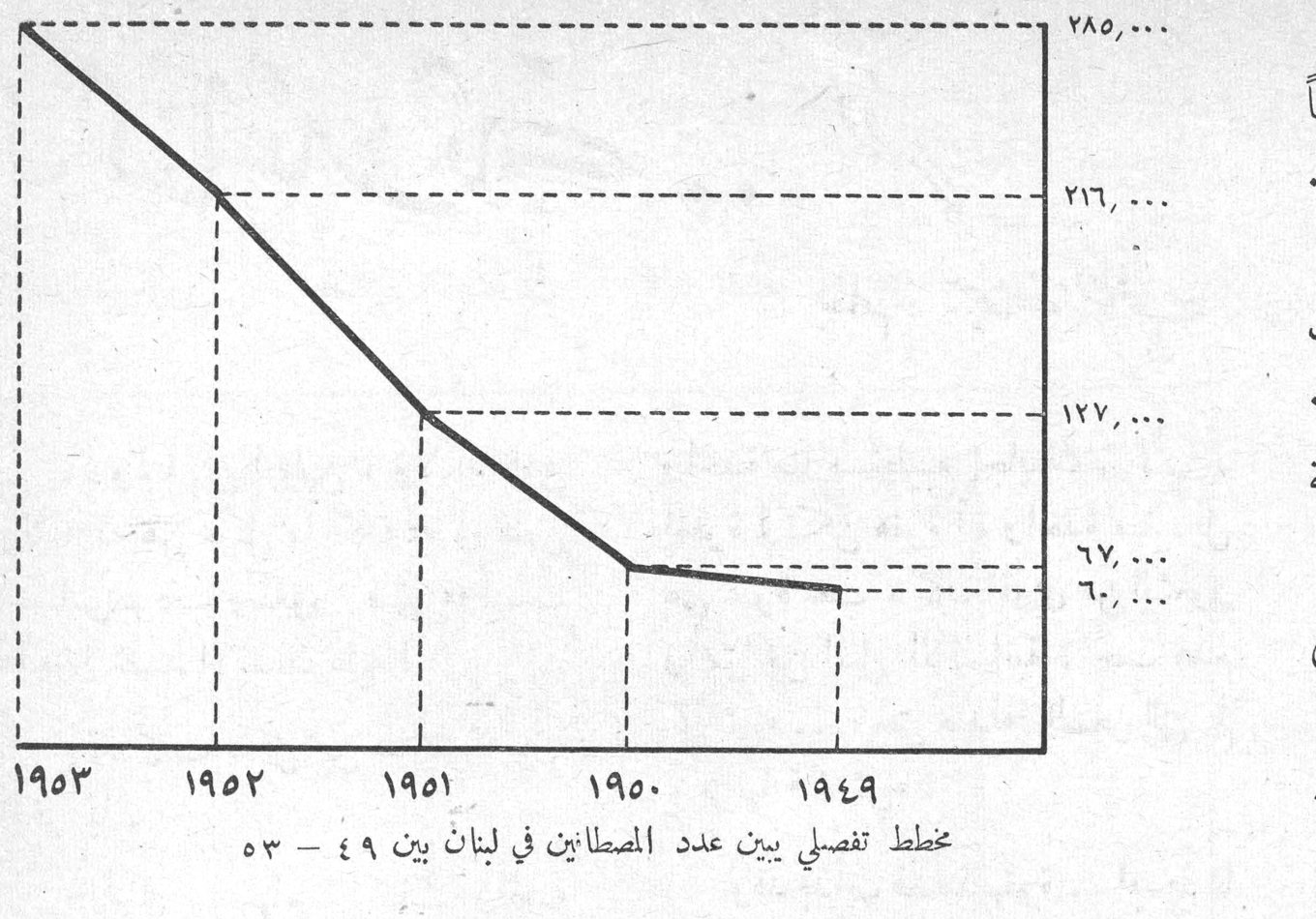
A detailed chart showing the number of summer visitors in Lebanon between '49 and '53
exhibition next July. Among the means of publicity, too, is Lebanon's entry into various international councils and bodies.
He went on to say: There comes to my mind now the completion of an important program for the tourism year, the coming 1955.
— And you will promise us a reportage on this program, God willing?
— Without doubt; and I have great hope in woman's sharing in its publicity. And what proves woman's cooperation with the Commissariat is that yesterday I was at a meeting with the committee for emigrants drawn from the women's organizations in Lebanon. This committee divides its work between contact with the Lebanese abroad, to strengthen their bond with their first homeland, and visits to the country's various regions, meeting the members of their municipalities to carry out the Commissariat's projects with all zeal and devotion. Would that every institution attended to some side of tourism and summering, so as to cast off the inferiority complex that turns us away from that openness of heart which is among the necessities of mixing and acquaintance. Would that we came out of self-contraction into the sphere of equality with those foreign in race and tongue — not to shun and criticize them, but to attract and charm them. It would be but courtesy and graciousness of conduct
for a Lebanese family, for example, to invite a company of foreign tourists to a simple tea party in which harmony and refined taste shine forth, so that they may touch at close range that exemplary family life of ours of which we have so long sung. How fitting for us to hold fast to our inherited solidarity, that it may strengthen our arm in joining the ancient civilizations of the East with the modern civilization of the West, on a ground of understanding and affection.
'And what I wish for Lebanon is what I have witnessed in my many journeys — I mean that local coloring with which every country by itself is tinted. I remember one day attending a popular festival in Portugal in which folkloric splendor shone forth, in sumptuous national costumes, a matchless characteristic dance, and astonishing, breathtaking horsemanship. And likewise there still ring in my ears the folk songs of Greece, rising from around the mountains to mingle with the echo of the moans of the Aegean Sea — in the days when the east of the Mediterranean drew down its inspiration, its people were the very masters of travel: they fused the arts, plowed the deep, and mingled with the races in every school. Let them suffice us as a spur, that we may venture into the arts of this age of models, of give-and-take, and of acquisition, and so enchant hearts and minds. Lebanon, O homeland of the tourist — wide open to him are your spaces.'

• A mother was worried because she had not heard from her son, who was at a boarding school, for weeks; at last she received a letter from him which read:
My darling Mother: They have forced us to write to our parents. Your loving son