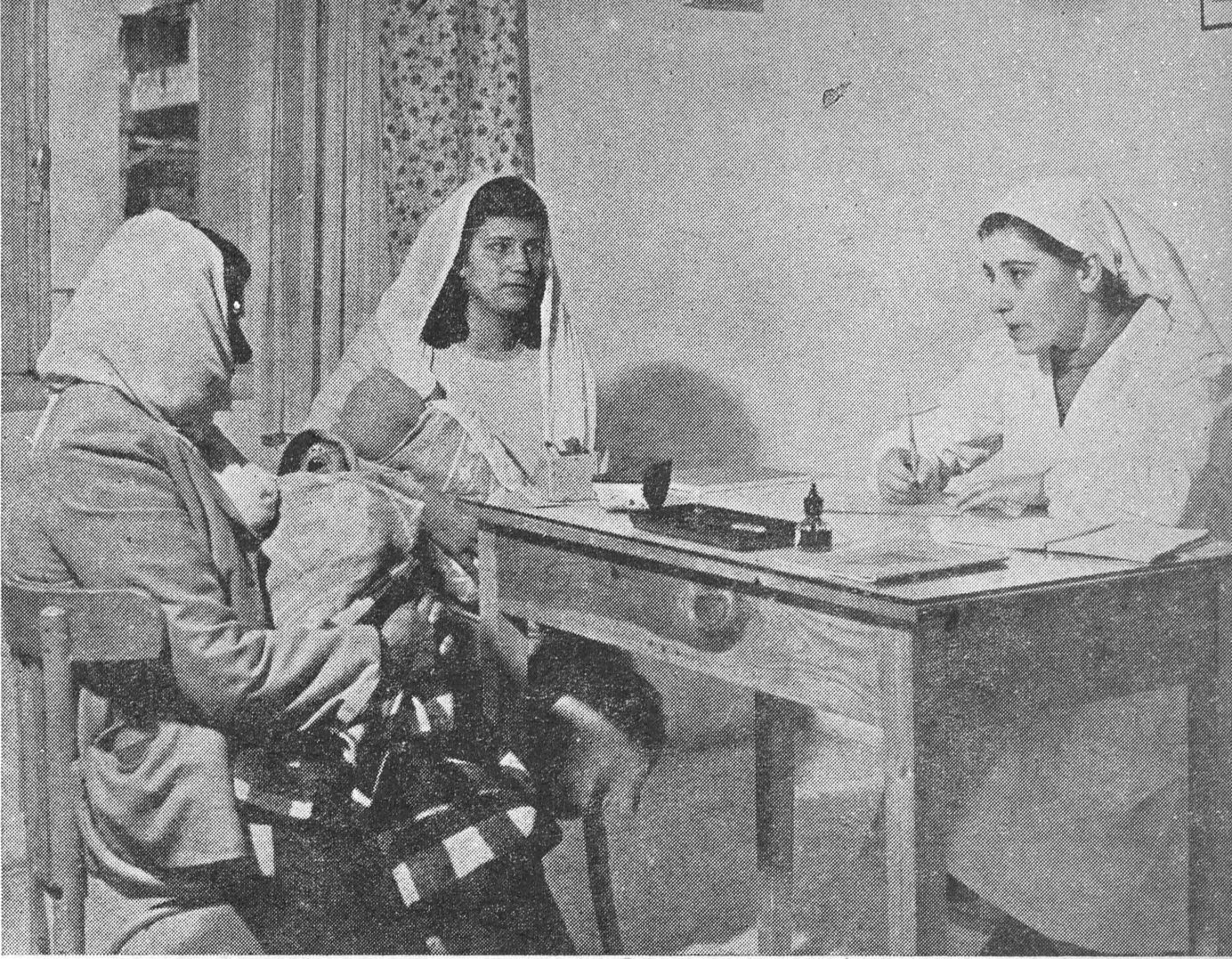

The social aide receives the mothers at the Achrafieh center and records her necessary information
It is the first of its kind in the Middle East — and no wonder, for Lebanon was and remains the pioneer in this field. Social service, moreover, is of recent date, the child of individual liberty; it arose to establish, through the consolidation of relations among individuals, mutual respect on a footing of equality. And this age of ours still strives to preserve the sanctity of persons and to raise the social level by encouraging the individual to do his duty, by defining that duty, and by helping him — not by way of material almsgiving alone, but above all by encouraging him to fulfill this duty himself and to face its difficulties with his own energy. The difference between the one method and the other is that the latter preserves the individual's dignity and his moral and social standing, whereas charity pure and simple places him in the position of the debtor before the creditor — an abject position that obstructs social progress and often does harm, for it stirs in the depths of souls revolt, rancor, and hatred.
The first credit for founding this school belongs to a nun of the Sisters of Jesus the Redeemer, Dr. Henriette Risico, who received her medical training at the French Faculty of Medicine in Beirut. She loved Lebanon and consecrated to its service her energy and her qualifications. This zealous nun supervised for a time the direction of the school of licensed midwives attached to the said faculty, and from her close contacts, above all with expectant and nursing mothers and their many likes, the necessity of organizing social service became clear to her. She therefore founded a center
for the care of motherhood and childhood in one of the poor quarters of Achrafieh (the Syriac quarter behind the Hôtel-Dieu). The activity of this center expanded, and the necessity became plain of resorting to specialists in the social field who would ensure the service in its most complete form.
After that, Mother Risico thought, and thought long... and the fruit of her hopes was a school for the preparation of women workers in the social field, which she undertook to found at the beginning of October of 1948, after the issue of Decree No. 11549, dated April 10 of 1948, officially authorizing the establishment of the Lebanese School of Social Training, and of another decree, No. 2500, dated July 26 of the same year, declaring the said school to be of public benefit. Her first concern was that this school should be stamped with a purely Lebanese character, so that it might fulfill the desired aim and prepare Lebanese women for work in the national milieu, with a view to reviving it and
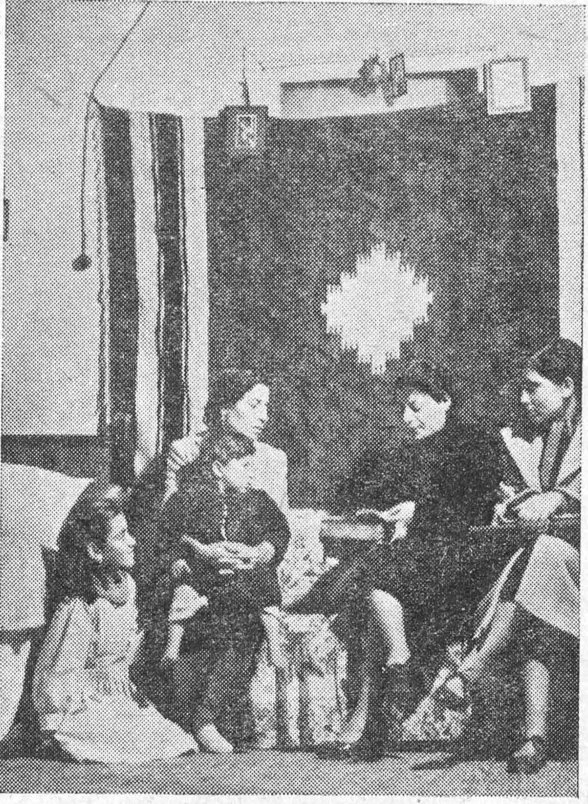
A social inquiry in one of the homes attached to the center: the social aide is seen talking with the mother and taking from her some of the necessary family information