raising its level. To realize this idea she called on the help of two nuns of her sisterhood, the one of Syrian origin holding a licentiate in letters, the other of French nationality holding the diplomas of nursing and of social services. The first year was limited to certain licensed midwives and nurses who had assisted Mother Risico at the aforementioned center for the care of motherhood and childhood. This school had assumed official character after Mother Risico had studied with the Lebanese authorities the programs to be followed; the Ministry of Education shared in preparing these programs, which it drew from the Western countries after adapting them to the nature of Lebanese reality.
On September 20 of 1949, the said Ministry issued Decree No. 16315, creating an official diploma of social-health service called 'the Certificate of Social Training,' whose examinations it supervises jointly with representatives of the Ministry of Social Affairs and the Ministry of Health and Public Assistance. As for the number of social aides who have graduated from this school up to now, they are twenty-four: one of them Palestinian, six Syrians, and seventeen Lebanese, working in the various social institutions, governmental and private. The school itself, moreover, has become a center for spreading the social spirit through all Lebanese circles.
The students of this school are required to have completed their twentieth year, and to have obtained the nursing diploma from an officially licensed school and the diploma of licensed midwife, or to be holders of the baccalaureate, on condition that they afterward com
plete a theoretical and practical medical course lasting a full year.
The period of instruction there is likewise a full year, beginning in October and ending on the same date of the following year with the official examinations, a second session being held for those who fail in the month of February. As to the courses followed, we shall confine ourselves to saying that they are varied and comprehensive, preparing the student for fruitful work in the various social fields: the care of childhood and motherhood; concern for delinquent juveniles; health and social supervision in the schools and in the family setting; medical and social services in factories and workshops; the treatment of rural family affairs; and the combating of social scourges — above all chest diseases and venereal diseases, unsanitary dwellings, and the like.
The theoretical courses are medical, legal, economic, legislative, psychological, and pedagogical, and are given in the evening between four and seven; the practical training takes place at
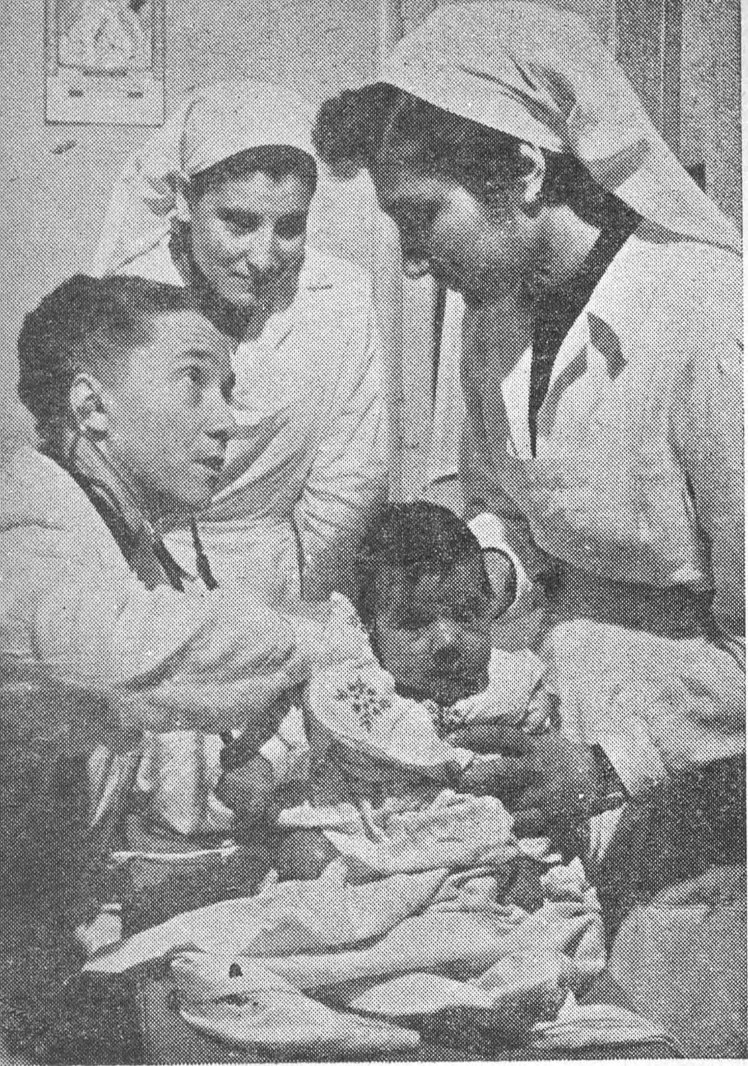
Dr. Risico, president of the School of Social Training and founder of the mother-and-child care center in Achrafieh, examining one of the sick children, assisted by the social aide.
the social centers daily before noon, and its aim is that the trainee should face social problems at close quarters and grow accustomed to treating them.
As for the body responsible for the
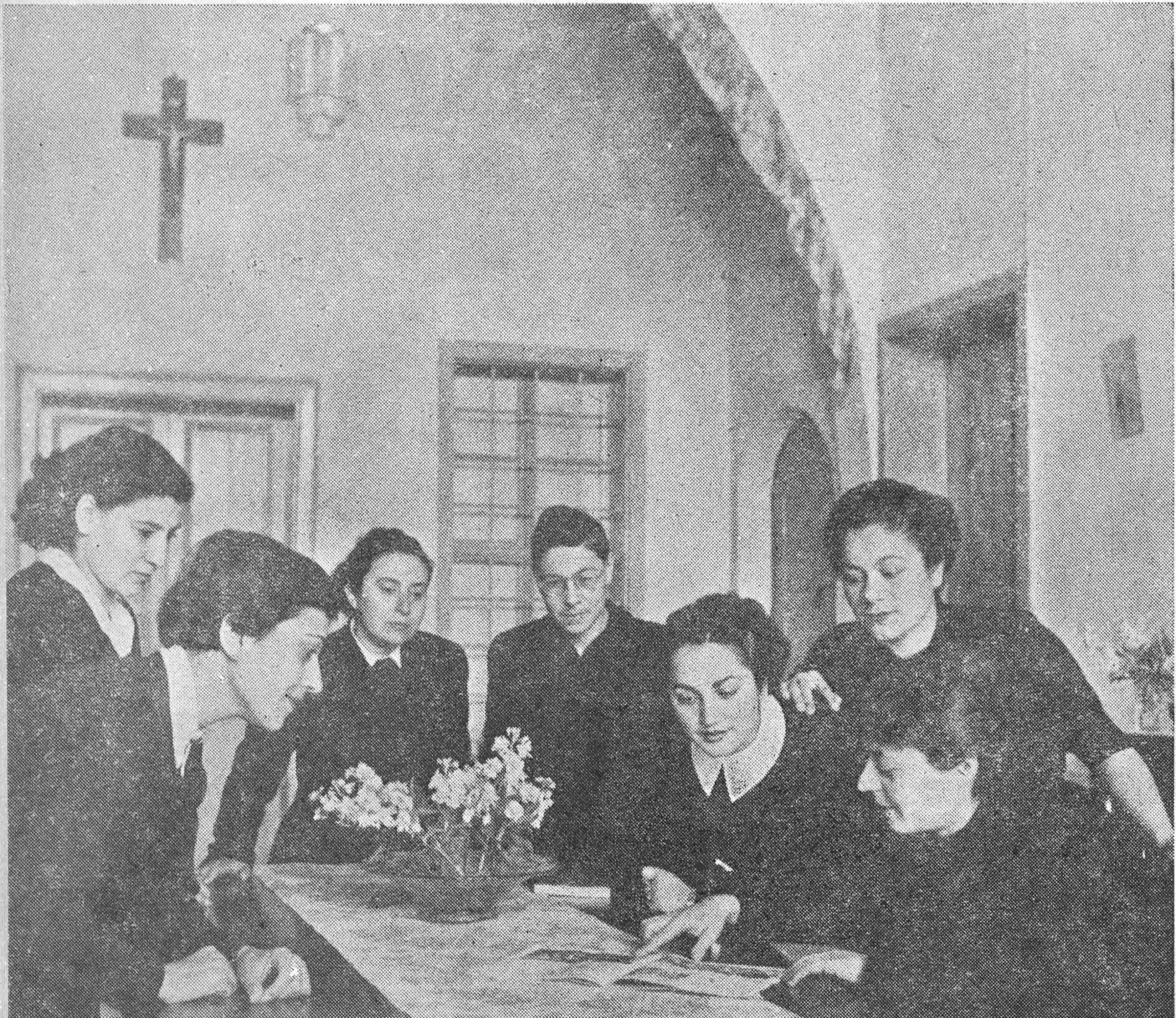
A group of graduates of the School of Social Training during a discussion