the sentimental character which music in Italy had borne; for he turned it from the melody of love and the refrain of the heart to the melody of liberty and the refrain of sovereignty and national dignity, until Verdi's music became the resounding anthem of patriotism, the sweet song of liberty, and the pure voice of national unity — so it paved the way for the blessed revolution, and the noble uprising sprang up in the spirit of the people.
Then the German Holden Trio presented a number of Verdi's magnificent operas — among them La Traviata, Rigoletto, Aida, and Nabucco — and souls were delighted and spirits enraptured.
The second festival was a festival of laughing, merry literature, which lightens the burdens of life; the speaker was Mr. Fouad al-Shayeb, Director-General of Propaganda and News in Syria. At the opening of his talk he dwelt on al-Jahiz's Book of Misers, which is considered the masterpiece of laughing literature in Arabic letters to this day. He mentioned men of letters from the West known for merry or satirical literature — such as Erasmus, Hugo, Twain, and Shaw — and then passed to the heart of his lecture, which he called "Pictures from the West," in which he recounted an American's impressions of life in England, taken from a recent American book.
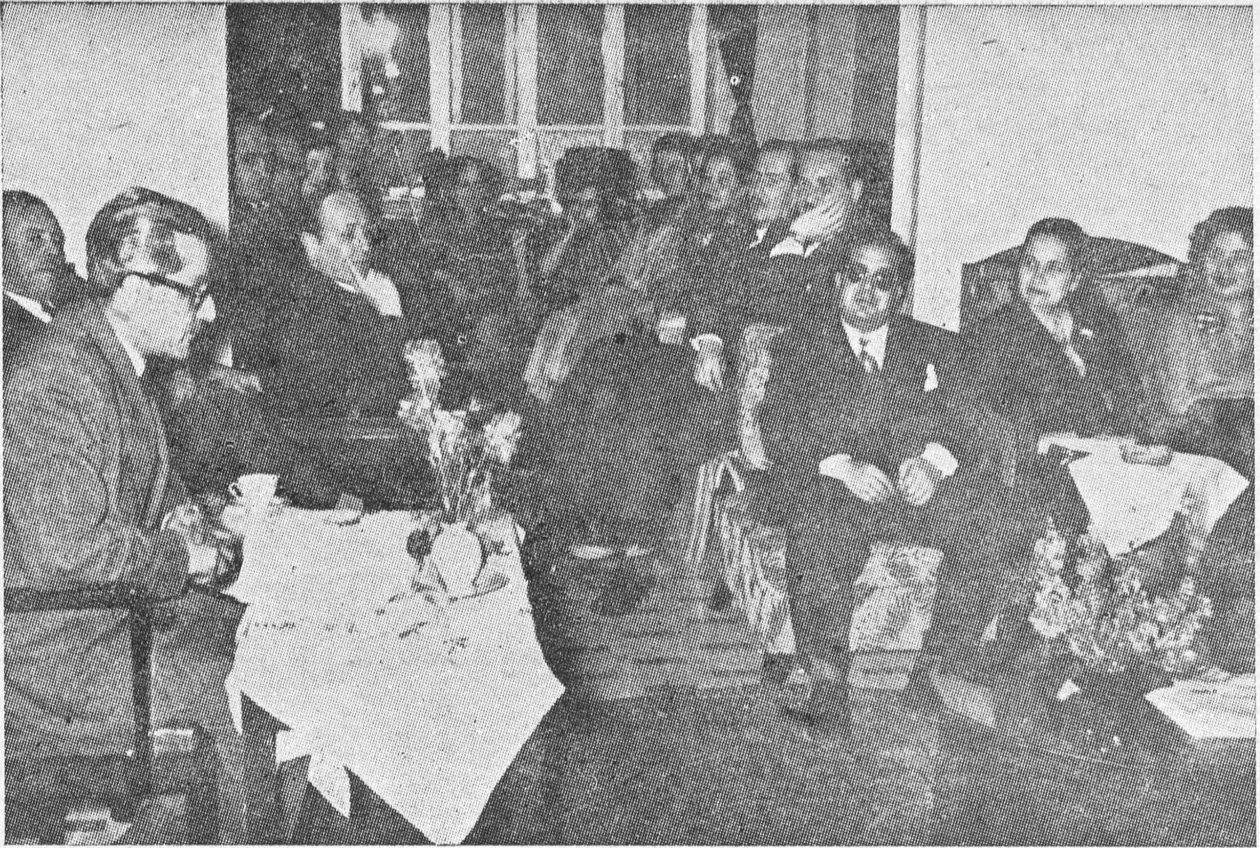
• The Sukayna Forum issued invitations to hear the valuable talk given by Dr. Ibrahim al-Kilani, professor of Arabic literature at the Syrian University, on Sukayna daughter of al-Husayn, whose name
Dr. Kilani delivering his talk on Sukayna daughter of al-Husayn at the Sukayna Forum
the Forum bears in perpetuation of her memory and in acknowledgment of her service to literature and men of letters. In his talk the lecturer pictured the flood of luxury and ease that pervaded the age in which Sukayna lived — the Umayyad age — and then presented her private and public life in a style of brilliant colors and mellow cadences, in which Dr. Kilani stands alone among the Syrian moderns. He showed how Sukayna was a complete embodiment of the true revolution, in the full sense of the word, and how she was the true model of woman: in her beauty, which made her the resort of hearts and the delight of eyes; in her elegance and her innovations in that art, which made her the pioneer of her age in that field — especially in the dressing of hair, by which she became known and which became known by her in her day, so that people spoke of the "Sukayni coiffure," which captivated not the women only, but whose imitation passed over to the men as well; in the spirit of gaiety and playfulness
that made her the sweet basil of souls and the delight of hearts, adorned by a nature deep-rooted in uprightness and an ancient attachment to honor; in her blazing intelligence and her polished literary taste, which made her an arbiter among the poets of her age and her house a place of pilgrimage for them; in her lavish generosity toward the poets and her tender care for those of them in straitened circumstances, until she became for them a Kaaba to which they turned from the far ends of the land. He pictured the poets' infatuation with her and their singing of her merits — especially Umar ibn Abi Rabi'a, whom Sukayna inspired to his most splendid love poems. But fortune is never complete for any man! For Sukayna was unhappy in her heart, unhappy in her married life — except with her husband Mus'ab ibn al-Zubayr — for spiritual response and intellectual harmony were lacking between her and the husbands she married after the martyrdom of her first husband...