the marks of vulgar breeding, while restraint — the governing of feeling, of glance, and of tongue — is among the chief marks of refined taste.
The foundation of taste in all its forms is precision of observation and delicacy of sense. He who notices the varying ripples in the color of the sea and the effect of light and shade on the shapes and colors of things ought also to notice the frown of the person he is talking with, or the brightening of his face, and to read in his glances and movements what he conceals of his feeling.
The modern inquirer holds that lying, and all that derives from it, is among the chief manifestations of weak taste. Lying is not, in his eyes, merely a sin and a moral flaw; it is also proof of a grave deficiency in the education of taste. And lying is not confined to the fabrication of reports and the turning of truth into its opposite: affectation, exaggeration, extravagance in praise, fawning, and dissembling are all varieties of lying, and hence manifestations of weak taste and of the cheapening of personality.
It has been said, in defining taste: it is that a person do or say the fitting thing at the fitting time, in the fitting manner, provided this comes about spontaneously and instinctively. And for taste to become spontaneous and instinctive, it must issue from long practice, until it becomes, like artistic skill, an inseparable part of its possessor, enabling him to judge with an ease that makes people imagine that taste in him is a natural faculty — which it is not.
This definition shows us that the rules of taste, like the rules of art, though possessed of a certain stability, undergo development and take account of the changes of the times.
If you saw a modern woman walking with the slow, languid gait of the women of the past age, you would think her walk affected, or at least contrary to the taste of the age.
And she who uses benedictions in her speech
instead of the simple word of thanks — she too is ignorant of the rules of modern taste. Like her is he who uses in his writing and
his sayings the phrases of pomp and the titles of aggrandizement after the manner of past ages.
For among the signs of weak taste is putting a thing out of its time or out of its place — for example,
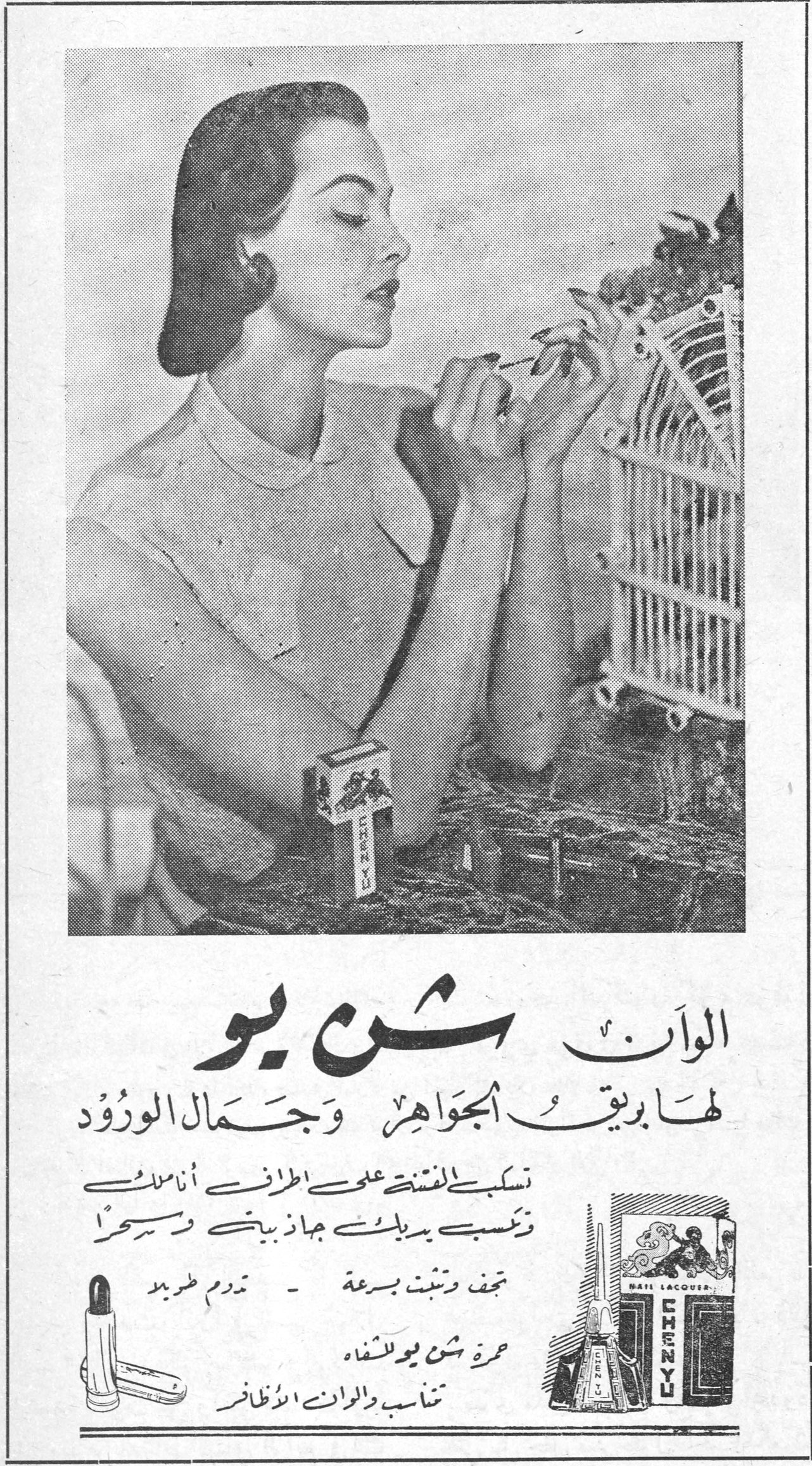
Chen Yu Colors
They have the sparkle of jewels and the beauty of roses
They pour enchantment upon your fingertips
And lend your hands allure and magic
They dry and set quickly — they last long
Chen Yu lipstick
Matches the nail colors
CHENYU
NAIL LACQUER